

 Specialities
 Services
 Resource Center
 Pricing
 About
About
 Contact
Both — work RVU increases on 99214, 99215, and 99205 raised the code-level value, but the budget-neutrality conversion factor reduction to approximately $32.35 per RVU reduced the dollar payment on every code, leaving most primary care encounters with a net per-encounter loss of $2 to $6 despite the RVU increase.
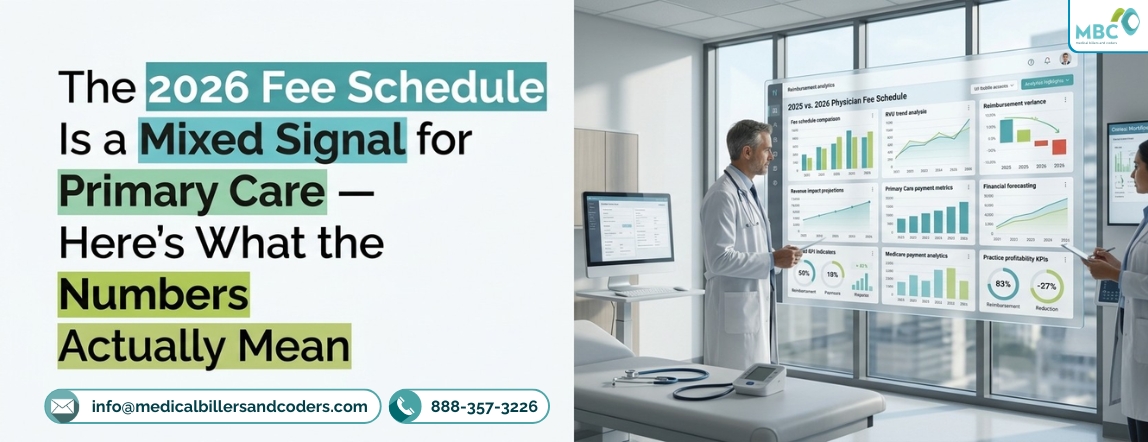
The 2026 Medicare Physician Fee Schedule is a mixed signal for primary care — targeted E/M RVU increases produced headline gains on paper, but the budget-neutrality conversion factor cut reduced the dollar value of every RVU billed, leaving most primary care practices with a net reimbursement outcome that is neither as positive as the E/M increase announcement suggested nor as negative as the conversion factor cut implied.
The number that determines your practice's actual 2026 outcome is not the RVU increase percentage on any individual code — it is the interaction between your practice's E/M level distribution, your chronic care management billing volume, your Medicare Advantage payer mix, and the specific conversion factor your MAC is applying to your claims. For how Family Practice Billing Services infrastructure captures the full value of the 2026 fee schedule changes, see Family Practice Medical Billing Services.
What the 2026 Fee Schedule Actually Changed for Primary Care
The E/M Gains: Real, but Narrower Than Reported
CMS's 2026 Physician Fee Schedule final rule increased the work RVU values for the primary care E/M codes that carry the highest cognitive complexity weight — specifically targeting the codes where primary care's time-and-complexity burden is highest:
- CPT 99215 (Level 5 established patient, office): Work RVU increased to 2.11 from 1.92 — a 9.9% increase in the work component
- CPT 99205 (Level 5 new patient, office): Work RVU increased to 3.17 from 2.99 — a 6.0% increase
- CPT 99214 (Level 4 established patient): Work RVU increased to 1.50 from 1.42 — a 5.6% increase
- G0136 (Social determinants of health risk assessment): New HCPCS code with a standalone RVU value, separately billable alongside E/M visits — a genuinely new revenue opportunity for practices documenting SDOH screening
These are real gains in the work RVU layer. What the announcement did not lead with is that the 2026 conversion factor — the dollar multiplier applied to every RVU — decreased to approximately $32.35, reducing the dollar value of every RVU across all CPT codes.
The net per-encounter result for primary care's highest-volume codes:
| CPT Code | 2025 Payment (Est.) | 2026 Payment (Est.) | Net Change |
|---|---|---|---|
| 99214 | $136 | $130 | -$6 per encounter |
| 99215 | $185 | $183 | -$2 per encounter |
| 99205 | $232 | $228 | -$4 per encounter |
| 99213 | $96 | $91 | -$5 per encounter |
| G0136 | Not billable | $26 | +$26 (new code) |
Payment amounts reflect estimated national average rates based on 2026 MPFS conversion factor and work RVU values; actual reimbursement varies by MAC locality, practice expense RVU, and payer contract.
The 99215 is the closest to neutral — the work RVU increase nearly offset the conversion factor reduction. The 99213 and 99214 produced a net per-encounter loss despite the E/M RVU increase, because the conversion factor reduction hits lower-acuity codes harder in absolute dollar terms.
Where Primary Care Actually Gained: CCM and SDOH Codes
The genuine net-positive revenue story in 2026 for primary care is not the E/M adjustment — it is the expansion of separately billable chronic care management and social determinants of health codes that most practices are significantly under-billing.
Chronic Care Management (CPT 99490, 99491, 99487): CMS maintained the full CCM RVU values in 2026 while clarifying that CCM services can be billed in the same month as complex E/M visits when the clinical contact is distinct. For a primary care practice managing 150 to 300 Medicare patients with two or more chronic conditions — the standard panel composition for a family medicine or internal medicine practice — consistent CCM billing adds $180 to $420 per patient per 12 months in separately reimbursable revenue that most practices are capturing at less than 40% of their eligible panel volume.
G0136 (SDOH Risk Assessment): The new standalone SDOH screening code — billable separately from the E/M visit once per rolling 12-month period — represents $26 per patient per assessment for a service most primary care practices are already performing and documenting without billing for. For a practice with 800 active Medicare patients, consistent G0136 billing adds $20,800 in per-12-months revenue from a service already embedded in the clinical workflow.
Principal Care Management (PCM — CPT 99424, 99425, 99426, 99427): The PCM codes — covering management of a single high-complexity chronic condition — gained broader MA plan coverage in 2026, with United Healthcare and Aetna both expanding their PCM coverage policies in their 2026 contract amendments. For practices managing complex diabetic, CHF, or COPD patient panels, PCM billing at scale adds $85 to $140 per patient per month in separately billable care management revenue.
The Medicare Advantage Variable That Changes Everything
The analysis above applies to traditional Medicare fee-for-service. For practices where 40 to 65% of the Medicare panel is enrolled in MA plans — the national average range — fee schedule changes operate through each plan's internal rate-setting logic rather than directly through the MPFS.
Three MA plan behaviors are determining whether the 2026 E/M RVU increases translate into actual primary care revenue gains:
- MA plans that update rates to MPFS annually — these practices receive the 99215 work RVU increase, net of the conversion factor reduction, in their 2026 MA remittances
- MA plans on a lagging update cycle — these plans are still paying at 2025 MPFS-derived rates, meaning practices are receiving the 2025 E/M rate without the 2026 RVU increase applied
- MA plans with fixed-dollar primary care capitation or global payment models — fee schedule changes do not flow through to per-encounter reimbursement at all
Payer variance detection across all three MA plan rate behaviors is the single highest-leverage billing action a primary care practice can take in 2026 — identifying which plans are paying at the updated 2026 rate, which are lagging, and which owe retroactive rate adjustments under contract terms that specify annual MPFS alignment.
What the Numbers Actually Mean: The Net Primary Care Position in 2026
| Revenue Category | Net 2026 Impact | Recoverable? |
|---|---|---|
| 99213 / 99214 per-encounter reimbursement | -$5 to -$6 per encounter | Partially — through E/M level optimization to 99215 where MDM supports it |
| 99215 per-encounter reimbursement | -$2 per encounter | Offset — CCM and G0136 on same patient panel recover the gap |
| CCM (99490, 99491) — under-billed volume | +$180–$420 per eligible patient per 12 months | Yes — consistent billing of existing eligible panel |
| G0136 SDOH assessment | +$26 per patient per assessment | Yes — already performed, not being billed |
| PCM (99424–99427) | +$85–$140 per patient per month | Yes — MA plan coverage expanded in 2026 |
| MA plan fee schedule lag | -$6 to -$18 per encounter | Yes — through payer variance detection and contract enforcement |
The net position for a primary care practice that implements consistent CCM, PCM, and G0136 billing while addressing MA plan payer variance is a net revenue gain of $120,000 to $280,000 per 12 months per physician — despite the conversion factor reduction — because the under-billed care management code revenue dwarfs the per-encounter E/M loss at scale.
The net position for a practice that does not address under-billed CCM, PCM, and G0136 — and does not monitor MA payer variance — is a net revenue loss of $18,000 to $54,000 per physician per 12 months from the conversion factor reduction alone, with no offsetting gain captured. For how Old AR Recovery addresses prior-year CCM billing gaps still within the timely filing window, see Old AR Recovery Services.
MBC Spotlight: Primary Care Billing Services Built for the 2026 Fee Schedule Environment
MBC's Primary Care Billing Services are structured around the 2026 fee schedule reality — not the headline narrative. Our dedicated account manager assigned to every primary care engagement monitors your E/M level distribution monthly, identifies your CCM and PCM eligible panel volume against actual billing capture, tracks G0136 billing completeness per Medicare patient, and runs payer variance detection across every MA plan remittance to identify which plans are paying at 2025 rates and which owe 2026 rate adjustments under contract terms.
Our system-agnostic platform integrates with your existing EHR and practice management system — Epic, Athenahealth, eClinicalWorks, or NextGen — applying CCM and PCM billing prompts at the point of care documentation and SDOH screening workflows that generate billable G0136 encounters from your existing clinical process. With MBC's 97% clean claim rate, 30% A/R reduction within 90 days, and 98% client retention, our Revenue Integrity Framework converts the 2026 fee schedule's mixed signal into a net revenue gain — capturing the care management upside while protecting against conversion factor and MA payer variance losses.
MBC's Pricing Structure is percentage-based with no setup fees — full MBC's fee structure at our Pricing page.
Practices completing MBC's Complimentary 90-Day AR Diagnostic consistently identify $80,000 to $220,000 in primary care revenue gaps tied to under-billed CCM, missed G0136 encounters, and MA payer variance — gaps the 2026 fee schedule change amplified but did not create.
Request Your Free Revenue Diagnostic
If your primary care practice's 2026 revenue is tracking flat or below 2025 levels despite stable patient volume, the fee schedule math is likely working against you in at least two of the four categories above. Request Your Free Revenue Diagnostic and let MBC's primary care billing specialists identify exactly where the 2026 fee schedule is costing your practice revenue — and what billing infrastructure changes recover it. Contact us at info@medicalbillersandcoders.com or call 888-357-3226.
