

 Specialities
 Services
 Resource Center
 Pricing
 About
About
 Contact

Top 6 Dermatology Billing Updates for 2025
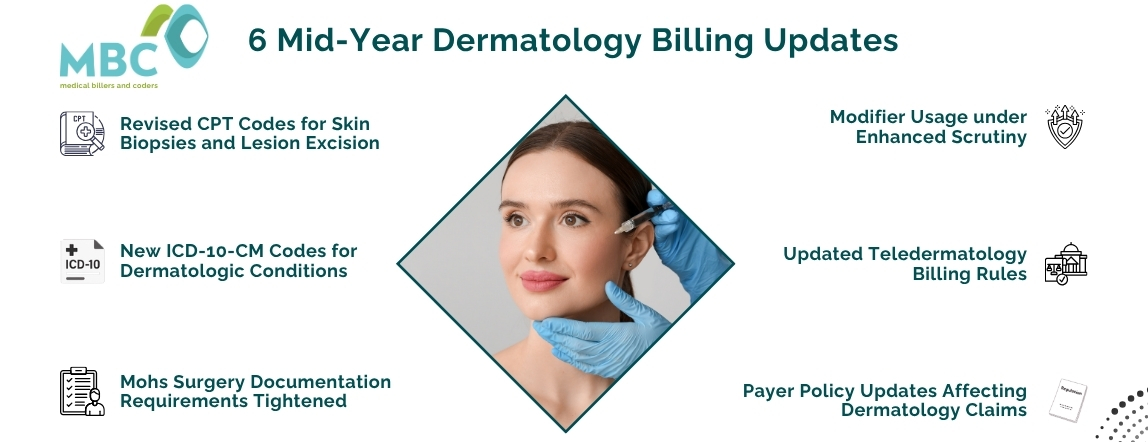
Here are 6 Mid-Year Dermatology Billing Updates:
- Revised CPT Codes for Skin Biopsies and Lesion Excision
- New ICD-10-CM Codes for Dermatologic Conditions
- Mohs Surgery Documentation Requirements Tightened
- Modifier Usage under Enhanced Scrutiny
- Updated Teledermatology Billing Rules
- Payer Policy Updates Affecting Dermatology Claims
Midway through 2025, significant billing updates have been introduced that impact dermatology practices nationwide. From revised CPT and ICD-10 codes to payer-specific policy changes, these updates are critical for practices aiming to maintain compliance, reduce denials, and protect revenue.
Whether you manage billing in-house or work with a medical billing outsourcing company, these six updates should be reviewed and implemented promptly:
1. Revised CPT Codes for Skin Biopsies and Lesion Excision
Several CPT codes for dermatologic procedures have been updated as of July 1, 2025. Changes impact:
- Biopsy codes (11102–11107)
- Excision codes (11400–11646)
Payers now require more specific documentation around lesion size (including margins) and depth for reimbursement. For instance, size must be recorded before excision to support the CPT code selection.
Practices should update EHR templates and clinical documentation workflows to align with these changes. Partnering with experienced dermatology billing services can help ensure that the correct codes and modifiers are applied from the start.
2. New ICD-10-CM Codes for Dermatologic Conditions
October 1, 2025, marks the release of new ICD-10-CM codes. For dermatology, these additions include:
- Expanded options for actinic keratosis
- New codes for drug-induced skin reactions
- More granular classifications of autoimmune skin conditions
Using outdated or incorrect diagnosis codes will lead to automatic claim denials. Ensure that all billing software and encounter forms reflect these updates. If you're outsourcing, confirm your medical billing services provider is already using the 2025 code set.
3. Mohs Surgery Documentation Requirements Tightened
Several commercial payers and Medicare contractors have revised guidelines for billing Mohs micrographic surgery (17311–17315). New documentation expectations include:
- Justification for choosing Mohs over standard excision
- Layer-by-layer pathology reporting
- Preoperative and postoperative photo documentation (in some regions)
Claims without adequate support risk denial or post-payment audits. Reviewing these new requirements with your billing team or your outsourcing dermatology billing services partner is essential.
4. Modifier Usage under Enhanced Scrutiny
Incorrect modifier use remains a top reason for dermatology claim rejections in 2025. CMS and commercial payers are monitoring:
- Modifier 25 (significant E&M on the same day as a procedure)
- Modifier 59 (distinct procedural service)
- Modifier 24 (unrelated E&M during a global period)
Improper use can trigger audits or lead to recoupments. Providers should review modifier policies and retrain staff. Working with a specialized medical billing outsourcing company that understands dermatology-specific modifier rules can significantly reduce this risk.
5. Updated Teledermatology Billing Rules
Continued virtual visits have led to permanent changes in telehealth billing codes. As of mid-2025:
- 99202–99215 remain billable for telehealth with audio/video
- POS codes and modifiers (e.g., 95, GT) must be used correctly
- Some payers now require documentation of time spent and video technology used
Practices should verify payer-specific policies and update scheduling, intake, and documentation workflows accordingly.
6. Payer Policy Updates Affecting Dermatology Claims
Several national payers, including Blue Cross and UnitedHealthcare, have introduced mid-year policy updates that affect dermatology claims. Common changes include:
- Tighter prior authorization requirements for biologics and injectables
- Bundling of services like destruction and cryotherapy
- Adjusted timely filing deadlines
Missing these updates can result in preventable denials and revenue loss. A proactive approach—in-house or through an outsourced dermatology billing partner—is critical for staying compliant.
Implementation Requires Speed and Accuracy
The second half of the year often brings changes that directly impact claims and reimbursements. Dermatology practices that fail to adapt in real-time risk delays, increased denial rates, and compliance complications.
A well-trained internal team can manage these changes with the right tools and education. However, many practices partner with a Dermatology billing outsourcing company to ensure quicker adoption, built-in compliance checks, and specialty expertise.
Support for Mid-Year Updates
Medical Billers and Coders provide dermatology billing services to keep practices ahead of coding, payer, and policy changes. Our certified coders monitor CPT and ICD-10 updates, payer requirements, and claim performance—so your practice doesn't have to.
Need Help Updating Your Billing Process?
Contact Medical Billers and Coders today to ensure your dermatology billing is 2025-ready. We'll review your current workflow and help implement these mid-year changes for cleaner claims and better cash flow.
FAQs
1. What are the most critical dermatology CPT code changes in 2025?
The July 2025 CPT updates include revised codes for skin biopsies (11102–11107) and excisions (11400–11646). These changes require more detailed documentation of lesion size and margins. To avoid denials, practices must ensure their coding workflows align with the new CPT definitions.
2. How do the 2025 ICD-10 updates impact dermatology billing?
New ICD-10-CM codes 2025 include expanded options for actinic keratosis, autoimmune skin disorders, and drug-induced eruptions. Using outdated codes after October 1, 2025, may result in automatic claim rejections. Updating your systems and staff training before the transition date is critical.
3. How are dermatology billing updates in 2025 impacting claim approvals?
Healthcare providers report a noticeable uptick in claim rejections due to minor CPT or ICD-10 mismatches since July 2025. The stricter documentation rules for biopsies, excisions, and Mohs surgery lead to more scrutiny from Medicare and commercial payers.
"We're seeing more rejections over biopsy coding changes that weren't communicated to the team." – Practice Manager, Dermatology Clinic, Texas.
4. Are private payers following CMS updates exactly or adding their own rules?
Most commercial payers are not only following CMS changes but also adding additional requirements, especially for biologics, skin cancer procedures, and cryotherapy. Policies also vary regionally, which frustrates many providers.
"We submitted the same code to two payers—one paid, one denied. The payer-specific changes are hard to track without help." – Claims Specialist, Midwestern Dermatology Network.
5. How does the billing company stay updated with mid-year CPT and ICD-10 changes specific to dermatology?
As a Leading medical Billing company, MBC actively monitors CPT updates from the AMA and ICD-10 revisions from CMS. Our dermatology billing team participates in specialty-specific coding webinars and updates EHR templates, claim logic, and modifier rules in real-time. Clients receive update summaries and proactive support before changes go into effect.