


It's a billing service that uses machine learning to check claims against payer-specific rules, coding accuracy, and eligibility data before submission, catching errors that generic clearinghouse edits miss.
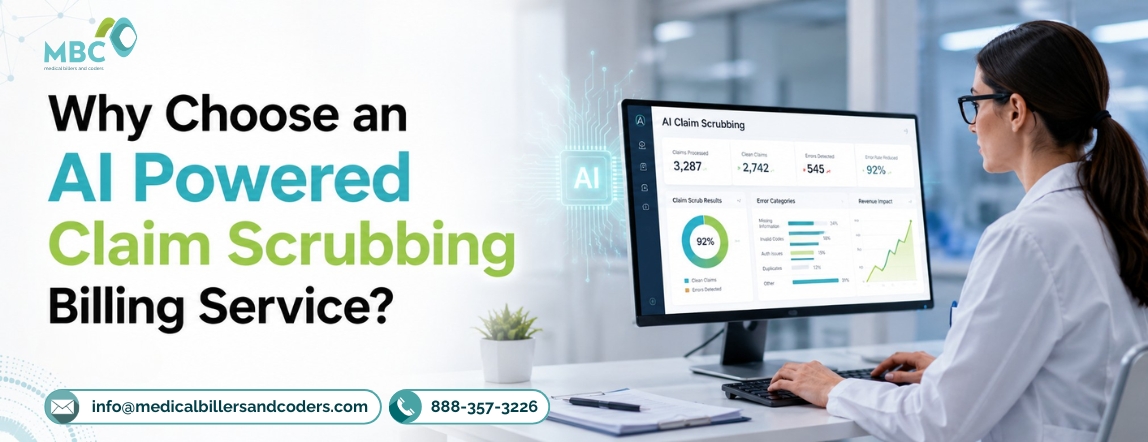
An AI Powered Claim Scrubbing Billing Service is worth choosing because it identifies coding errors, eligibility mismatches, and payer-specific rule violations before a claim is ever submitted, pushing first-pass acceptance rates above 98% and preventing the $25 to $118 in rework that every denied claim otherwise costs your practice.
In 2026, that difference is no longer optional. Initial claim denial rates climbed to 11.8% in 2024, up from 10.2% just a few years earlier, and 41% of providers now report denial rates above 10%. Practices that still rely on manual review or static rule-based scrubbers are absorbing losses that AI-driven infrastructure is built to prevent.
What's Driving Practices Toward AI Powered Claim Scrubbing in 2026
Payers didn't wait for providers to modernize. Insurance carriers are running their own AI models to flag discrepancies at a scale no human reviewer can match, and several have faced scrutiny for denial rates far above what manual review would produce.
At the same time, CMS finalized one of its largest single-year coding overhauls, adding 288 new CPT codes, deleting 84, and revising 46 more for 2026, a shift that has already generated rejections at practices still working from outdated superbills and EHR templates.
A traditional biller checking claims line by line simply cannot keep pace with payer rule changes that update weekly. This is the gap an AI Powered Claim Scrubbing Billing Service is designed to close: it applies payer-specific edits, historical denial-pattern analysis, and real-time eligibility checks at the moment of submission, not after a rejection lands.
How AI-Driven Scrubbing Actually Reduces Denials
Static rule engines ask one question: is this code valid? A genuine AI-driven platform asks a second, more useful question, does this combination of code, payer, and diagnosis have a documented history of rejection? That predictive layer is what separates real automation from a relabeled clearinghouse edit.
According to AAPC's 2025 findings, practices using staff-AI collaboration models saw an 18% mean reduction in denial rates compared with rule-based automation alone. Broader industry data shows that shifting from reactive denial management to proactive AI-driven prevention delivers 30-50% fewer denials, along with faster payment cycles and a leaner accounts receivable backlog.
For a mid-sized multi-provider group, that difference routinely translates to tens of thousands of dollars recovered annually that would otherwise sit in write-offs.
The table below breaks down where the gap actually shows up:
|
Capability |
Manual / Legacy Scrubbing |
AI Powered Claim Scrubbing Billing Service |
|
Rule updates |
Lag payer changes by weeks or months |
Continuously learns from payer-specific denial patterns |
|
First-pass acceptance |
Typically 90-93% |
98%+ achievable pre-submission |
|
Eligibility checks |
Single check at scheduling |
Real-time checks at scheduling, check-in, and submission |
|
Denial insight |
Reactive, after rejection |
Predictive risk scoring before the claim leaves the practice |
|
Rework cost per claim |
$25-$118 per reworked claim (AMA) |
Substantially reduced through upstream prevention |
Choosing the Right AI Powered Claim Scrubbing Billing Service for Your Practice
Not every vendor marketing "AI" is running real machine learning. The distinction matters: a system that only applies generic rules to every client isn't meaningfully different from a legacy clearinghouse edit with a new label.
When evaluating an AI Powered Claim Scrubbing Billing Service, ask whether the platform trains on your specific payer mix and specialty, whether it integrates real-time eligibility verification and continuous credentialing monitoring, and whether it can walk you through exactly how it would have caught a claim you already lost.
Regulatory timing adds urgency here. Under the CMS Interoperability and Prior Authorization Final Rule (CMS-0057-F), impacted payers were required to implement key provisions by January 1, 2026, with full API requirements phasing in by January 1, 2027.
Practices that pair this shift toward electronic prior authorization with AI-assisted claim scrubbing are positioned to catch authorization gaps before submission instead of discovering them in a denial letter weeks later.
This is also where outsourcing tends to outperform in-house builds. A dedicated medical billing and coding services partner tracks payer bulletins, CPT updates, and credentialing status simultaneously, something most internal teams can't sustain alongside patient-facing work. If your team is spending more than 15% of billing hours on rework and appeals, that's a clear signal your current infrastructure has hit its ceiling.
Partnering with a revenue integrity partner that offers true AI Powered Claim Scrubbing Billing Service capability gives you both speed and judgment. Our medical billing services team builds denial-prevention protocols around your specialty mix and payer contracts, not a one-size-fits-all rule set.
For practices exploring the switch, you can review how our Revenue Cycle Management plans scale with claim volume before making any changes.
Ready to stop losing revenue to preventable denials?
Call us at 888-357-3226 or email info@medicalbillersandcoders.com to schedule a claim scrubbing assessment. We'll show you, using your own recent denials, exactly where an AI Powered Claim Scrubbing Billing Service would have changed the outcome.
