

 Specialities
 Services
 Resource Center
 Pricing
 About
About
 Contact
Denial management and follow-up billing service for wound care providers ensures faster reimbursements and fewer write-offs. Wound care billing is complex. Frequent denials and slow follow-up can damage cash flow fast.
At MBC, we specialize in wound care denial management that not only identifies root causes but prevents repeat issues. Our follow-up billing process tracks every claim aggressively, ensuring you don’t leave revenue on the table.
Why Denials Are Common in Wound Care?
Wound care claims are prone to denials for several reasons:
- Incomplete or missing documentation
- Incorrect modifier usage
- Bundled codes not separated
- Lack of medical necessity proof
- Delays in prior authorizations
Even a minor coding error can lead to significant payment delays.
MBC’s Denial Management Process
Our process for denial management is built for efficiency and outcomes:
1. Root-Cause Analysis
We review every denied claim for the exact reason.
Our coders and billing experts identify trends to stop repeat denials.
2. Rapid Appeals & Resubmissions
We act fast—resubmitting claims within payer timelines.
We draft strong appeals that meet clinical and billing requirements.
3. Payer-Specific Edits
We tailor our billing approach per payer to reduce friction.
No generic templates—just real strategy that works.
High-Value Wound Care Claims Paid Faster
High-value wound care claims, like debridement or skin substitute therapy, can be worth $1,000–$5,000 per visit. Because of their size, payers review them more closely, which often slows down reimbursement. Here are the key facts and insights:
- High Denial Risk: Nearly 22% of wound care claims face initial denials due to coding errors, missing documentation, or lack of prior authorization.
- Longer Payment Delays: The average payment cycle for high-dollar claims is 30+ days, which hurts cash flow for wound care centers.
- Denial Management Works: Proactive claim reviews and payer follow-up improve recovery rates by up to 35%.
- AI + Human Intervention Speeds Results: Practices using AI-driven scrubbing plus human-led appeals now receive payments in 12–15 days instead of waiting a month or more.
- Big Financial Impact: Faster payment on just 20 high-value claims per month can free up an extra $400,000–$500,000 annually for large wound care practices.
- Cash Flow Stability: Quicker reimbursements mean more predictable revenue and fewer disruptions in daily operations.
Focusing on denial prevention and timely follow-up ensures high-value wound care claims get paid faster and more consistently.
Follow-Up Billing: Don’t Let Claims Go Cold
Most revenue loss happens after a claim is submitted.
Our follow-up billing service tracks:
- Every outstanding claim past 21 days
- Payer responses and delays
- Claims in appeals or correction cycles
We don’t just "check status"—we push for resolution and payment.
Key Benefits for Wound Care Providers
MBC gives wound care practices a powerful edge:
- Fewer write-offs: We recover claims other firms miss
- Faster reimbursements: We cut your AR time in half
- Better compliance: Every claim is clean and audit-ready
- Real-time reporting: Know what’s pending and why
- Dedicated account managers: One contact, full visibility
Why Choose MBC?
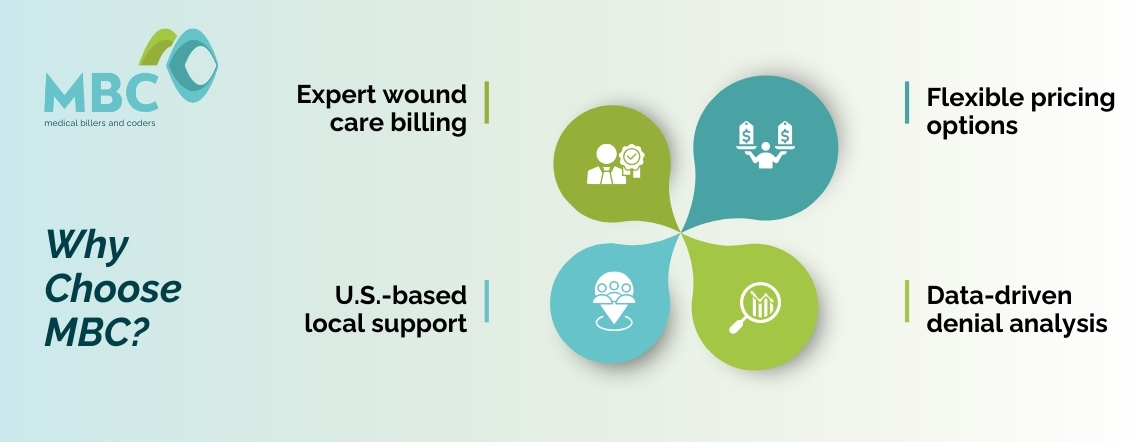
Unlike generic billing firms, MBC offers:
- Wound care billing expertise
- Flexible pricing models
- Data-driven denial analysis
- U.S.-based support with local healthcare knowledge
You’re not just outsourcing billing—you’re gaining a partner in profitability.
Schedule a billing audit today
Stop chasing denied claims.
Let MBC handle your denial management and follow-up billing with precision.
Schedule a billing audit today and see how much revenue you can recover.
FAQs
1. What is denial management in wound care billing?
Denial management in wound care billing identifies and corrects the causes of claim denials. It ensures faster resubmissions and fewer revenue losses.
2. Why do wound care claims get denied?
Wound care claims get denied due to documentation errors, coding issues, or lack of medical necessity. These problems can be fixed with proactive denial management.
3. How does follow-up billing improve revenue?
Follow-up billing ensures no claim is forgotten or delayed. It tracks each claim until payment, reducing aging AR and write-offs.
4. How fast can MBC resolve denied claims?
Most denials are resolved within 7–14 days. Our team prioritizes time-sensitive claims to meet payer deadlines and recover funds quickly.
5. Is MBC experienced with wound care billing?
Yes, MBC specializes in wound care billing and RCM. Our team understands the coding, compliance, and payer nuances specific to wound care providers.
6. What are the most common denial reasons in wound care billing?
Wound care claims often get denied due to missing documentation, incorrect modifiers, bundled codes, or lack of medical necessity. Understanding these denial triggers helps providers take preventive steps. Learn more in our detailed guide on denial reasons in wound care.
7. How do you streamline the appeals process for denied wound care claims?
By acting quickly with proper documentation and payer-specific strategies, providers can speed up appeals. Learn more in our guide on streamlining the appeals process in wound care.