

 Specialities
 Services
 Resource Center
 Pricing
 About
About
 Contact
It is a Medicare Physician Fee Schedule policy, effective January 1, 2026, that reduces work RVUs by 2.5 percent for most non-time-based CPT and HCPCS codes. CMS derived the figure from five years of cumulative productivity data in the Medicare Economic Index, and time-based services are excluded from the reduction.
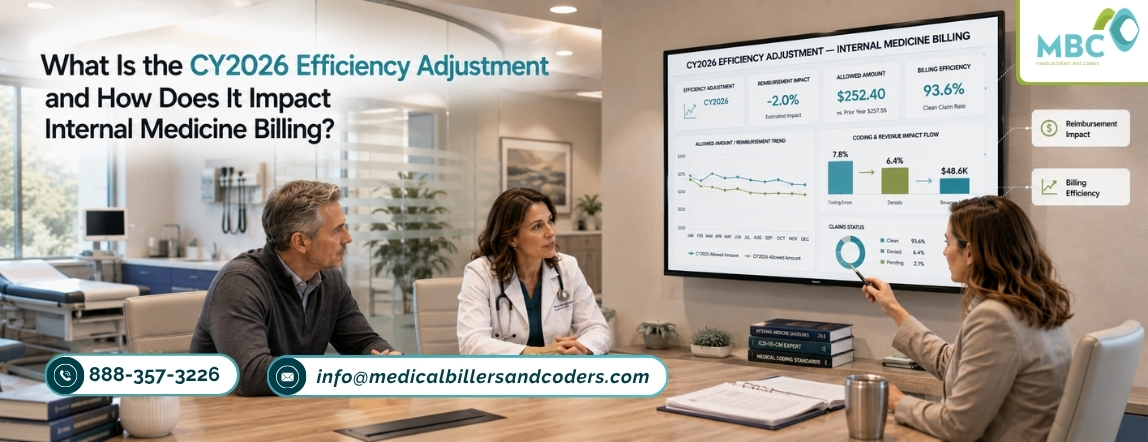
The CY2026 Efficiency Adjustment is a Medicare Physician Fee Schedule policy, effective January 1, 2026, that cuts work RVUs by 2.5 percent on most non-time-based CPT and HCPCS codes, while leaving core internal medicine E/M office visits largely untouched.
What Is the CY2026 Efficiency Adjustment?
CMS finalized this adjustment in the CY2026 Physician Fee Schedule final rule to reflect anticipated productivity gains in services CMS considers more efficient to furnish today than when they were originally valued. The reduction applies to work RVUs and the associated intraservice physician time for affected codes, and CMS derived the 2.5 percent figure from five years of cumulative productivity data embedded in the Medicare Economic Index.
Time-based services are excluded from the cut entirely. That single exclusion determines most of the real-world impact on internal medicine, since standard office visit E/M codes and time-based care management codes fall outside the adjustment's scope.
The Triple Threat to Internal Medicine Margins Under CY2026
1. Non-Time-Based Ancillary Code Erosion Diagnostic testing, spirometry, EKG interpretation, and minor in-office procedures billed alongside E/M visits fall inside the adjustment's scope, and practices billing a meaningful ancillary volume will see reduced reimbursement without any change in denial rate.
2. Payer Adoption Lag Commercial payers do not adopt CMS methodology changes on identical timelines, and a practice assuming uniform adoption across UnitedHealthcare, Aetna, Cigna, and Humana risks reconciliation surprises when contracted rates do not move together.
3. Coding Mix Complexity Masking Net Impact A single visit often blends time-based E/M with non-time-based ancillary codes, and without code-level tracking, a practice cannot isolate which portion of a claim absorbed the cut and which did not.
Each threat quietly compounds Yield EBITDA loss across a multi-provider group's full claim volume, not just on codes flagged for review.
Table 1: CY2026 Efficiency Adjustment Exposure by Code Type
| Service Type | Time-Based Status | CY2026 Impact |
|---|---|---|
| Standard E/M office visits | Time-based / MDM-based | Generally excluded from cut |
| Chronic Care Management (CCM) | Time-based | Generally excluded from cut |
| Transitional Care Management (TCM) | Time-based | Generally excluded from cut |
| Diagnostic testing (spirometry, EKG) | Non-time-based | Subject to 2.5% RVU reduction |
| Minor in-office procedures | Non-time-based | Subject to 2.5% RVU reduction |
Table 2: Payer Adoption Considerations
| Payer Category | Adoption Pattern | Practice Consideration |
|---|---|---|
| Medicare (via Medicare Administrative Contractors) | Effective January 1, 2026 per CMS final rule | Applies uniformly across MACs |
| Medicaid managed care | Varies by state program | Confirm state-specific adoption timeline |
| Commercial payers (UnitedHealthcare, Aetna, Cigna, Humana) | Not required to follow CMS timeline | Payer variance detection needed per contract |
Why the Right Billing Partner Matters Here
A practice without code-level visibility into its time-based versus non-time-based mix will not see this erosion until Q1 reconciliation, when the revenue is already gone and the claims are already paid. This is where denial root-cause engineering falls short as a framing entirely, since this is not a denial. It is a valuation change embedded in a paid claim.
[Provisional, pending finance confirmation: a multi-provider Internal Medicine group with ten million dollars in yearly collections and a typical ancillary code share of fifteen percent could see reimbursement reduced by roughly fifteen thousand to seventy-five thousand dollars per 12 months on that ancillary volume alone, depending on actual code mix. This range requires Sampada's sign-off before treatment as an MBC-verified statistic.]
Practices working with Internal Medicine Billing Services should request a code-level audit of their non-time-based volume before January claims post at the new rates, not after. A dedicated account manager applying Enterprise Revenue Integrity across a full Revenue Cycle Management (RCM) program tracks this exposure by payer and code family rather than discovering it in aggregate collections data three months later.
MBC Spotlight
MBC's Internal Medicine Center of Excellence maintains a 97 percent clean claim rate and has delivered a 30 percent A/R reduction within 90 days for client practices, backed by 25-plus years of specialty-specific billing experience and a 98 percent client retention rate. That same code-level discipline applies directly to isolating CY2026 Efficiency Adjustment exposure before it compounds across a full reporting cycle.
Key Takeaways
- The CY2026 Efficiency Adjustment cuts 2.5 percent from work RVUs on most non-time-based codes, effective January 1, 2026.
- Core internal medicine E/M visits and time-based care management codes are largely excluded.
- Ancillary non-time-based services carry the real exposure and require code-level tracking to quantify.
- Commercial payer adoption timelines vary and should not be assumed to match Medicare's effective date.
Conclusion
The CY2026 Efficiency Adjustment will not show up as a denial, a delay, or a rejected claim. It will show up as a smaller payment on a claim that processes normally, which makes it easy to miss until aggregate collections data reveals the pattern months later. Internal medicine groups that audit their non-time-based code volume now, rather than at Q1 reconciliation, protect revenue that would otherwise erode silently. If your practice has not confirmed how much of its billing mix falls inside this adjustment's scope, that gap is worth closing before January claims begin posting at the new rates.
Request Your Free Revenue Diagnostic to see how the CY2026 Efficiency Adjustment maps onto your specific billing mix.
