

 Specialities
 Services
 Resource Center
 Pricing
 About
About
 Contact
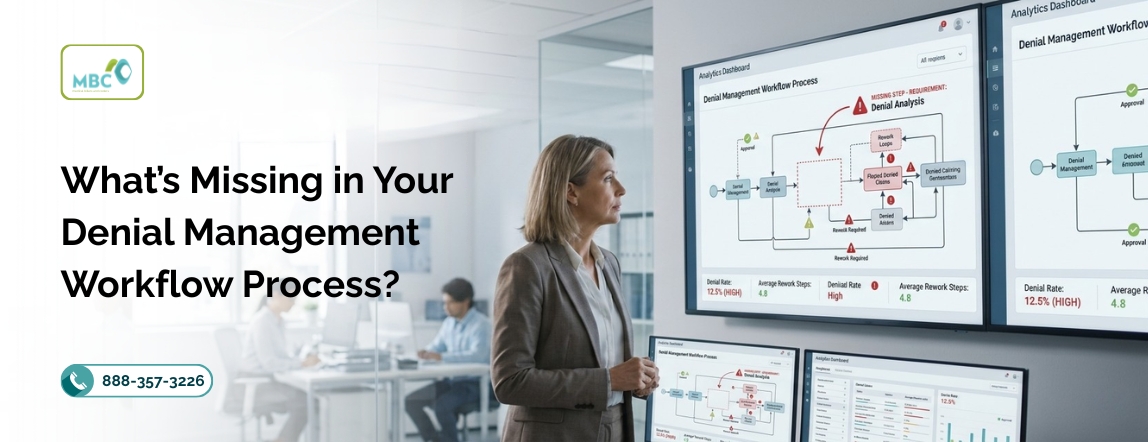
Your Denial Management Workflow is broken — and most practices don't realize it until they're staring at six figures in unrecovered revenue and a Days in AR number that won't budge.
According to the CMS FY 2025 National Health Expenditure Projections, U.S. healthcare spending is projected to reach $5.7 trillion by 2026 — yet billions of those dollars are quietly lost each year to preventable claim denials.
The American Medical Association (AMA) reports that commercial payer denial rates range from 1.63% to 23% depending on the payer and specialty. If your denial rate sits above 5%, your practice is bleeding revenue that a well-structured workflow should be protecting.
This blog breaks down the six most common gaps that quietly drain your collections — and what a high-performance Denial Management Workflow Process actually looks like in 2026.
The Six Critical Gaps Killing Your Denial Rate
1. You're Treating Denials as a Back-End Problem
The most expensive mistake in revenue cycle management is waiting for claims to come back denied before acting. High-performing facilities have already shifted upstream — identifying denial-prone CPT and ICD-10 code combinations, payer-specific prior authorization triggers, and documentation gaps before the claim ever leaves the building.
If your team is only "working denials" after the fact, you're paying twice: once in staff hours to rework, and again in delayed cash flow. Prevention is the real ROI.
2. No Structured IMMP Framework in Place
Most billing teams work denials the same way regardless of type — which is exactly why denial rates stay stuck. The IMMP framework (Identify → Manage → Monitor → Prevent) is the operational backbone of any serious Denial Management Services program.
Here's where most teams fall short:
- Identify: Reading a CARC/RARC code is not enough. Your team needs to interpret the root cause — was it a registration error, a coding mismatch, or a payer-specific rule change?
- Manage: Routing matters. A clinical denial requires provider-level documentation response. A coding denial goes straight to your coding team. Anything sitting in a general queue is a denial waiting to become a write-off.
- Monitor: If you're not tracking denials by type, payer, date received, and appeal disposition, you don't actually have a Denial Management Workflow — you have a hope-and-resubmit strategy.
- Prevent: This is the step most teams skip entirely. Root cause analysis + cross-department retraining is what drops your denial rate from 12% to under 5%.
3. Treating Every Denial the Same
Not all denials are equal — and treating them like they are burns staff time on claims you'll never recover while letting recoverable revenue age past appeal deadlines.
| Denial Type | Definition | Common Triggers | Correct Action |
| Soft Denial | Temporary; correctable without formal appeal | Missing modifier, truncated ICD-10, data error | Correct and resubmit immediately |
| Hard Denial | Irreversible; results in write-off | Timely filing exceeded, non-covered service, terminated coverage | Write off promptly; redirect staff time |
| Clinical Denial | Disputes medical necessity | Insufficient documentation, no clinical justification | Provider-to-reviewer escalation + clinical documentation |
| Prior Authorization Denial | Auth missing or expired | Missing pre-cert, wrong procedure billed | Authorization re-verification + payer appeal |
Effective medical billing and coding services build denial triage into the workflow — so soft denials are resolved within 48 hours and clinical denials trigger the right escalation chain immediately.
4. No Automation Protecting Your High-Dollar Claims
Is your billing team still manually checking claim status on payer portals? That's not a workflow — it's a bottleneck.
Modern revenue integrity solutions use AI-driven denial scoring to flag high-risk claims before submission. Predictive analytics assign a likelihood score to each claim based on payer rules, code combinations, and prior denial history — allowing your team to catch and fix issues before they become denials.
According to the OIG's FY 2025–2026 Work Plan, improper payments and billing errors remain a top audit priority — particularly in high-complexity specialties. If your team is manually managing claim follow-up without automation, you're exposed both to revenue leakage and compliance risk.
Key automation capabilities every practice should have in 2026:
- Real-time eligibility verification at point of scheduling
- Automated prior authorization tracking with payer-specific rule updates
- Denial likelihood scoring pre-submission
- AI-generated payer-specific appeal letters
5. Weak Regulatory Competency Across Your Team
Claim denials driven by regulatory gaps are the most preventable — and the most common. Billing professionals who can't navigate CMS guidance documents, NCCI edits, or payer-specific LCD policies will always be guessing on edit resolution.
Your team must have working access to and proficiency with:
- CMS Claims Processing Manual — The authoritative source for Medicare and Medicare Advantage billing rules.
- NCCI Edits (PTP + MUE) — Essential for avoiding procedure-to-procedure bundling denials and medically unlikely edit flags.
- OIG Work Plan (FY 2025–2026) — Identifies active and planned audit targets so you can proactively strengthen documentation before reviewers arrive.
If your billing team is referencing outdated guidelines or relying on payer summaries instead of primary sources, your Denial Management Workflow has a regulatory blind spot — and payers know it.
6. You Don't Have the Right Revenue Integrity Partner
Sometimes the most impactful decision a practice can make is recognizing what it can't build internally.
A true revenue integrity partner doesn't just resubmit denied claims. They audit your payer contracts for underpayment patterns, build specialty-specific coding protocols, deploy denial prevention infrastructure, and deliver CFO-grade dashboards showing real-time Net Collection Ratio, Days in AR, and denial rate by payer and code.
Generic RCM services catch denials after they happen. Specialized medical billing services with deep vertical expertise prevent denials from occurring in the first place — and recover the ones that slip through with a documented, defensible appeal process.
The difference shows up in your numbers: practices working with a specialized partner average 14–22% improvement in Net Collection Ratio within 90 days — translating to $300K–$600K in additional annual revenue for a mid-size multi-physician group.
Stop Reacting. Start Recovering.
If your denial rate is above 5%, your Days in AR are trending upward, or your team is spending more than 30% of their time on rework — your Denial Management Workflow needs a structural fix, not just more staff hours.
MBC's specialized RCM teams have helped practices across cardiology, orthopedics, wound care, ASC, and behavioral health recover millions in previously written-off revenue by building denial prevention infrastructure that works at the claim level, the coder level, and the payer contract level.
Ready to find out exactly where your workflow is leaking revenue?
Call MBC today: 888-357-3226
Email our RCM specialists: info@medicalbillersandcoders.com
Request your complimentary Denial Rate Diagnostic — a specialty-specific analysis of your top denial drivers, appeal success rates, and estimated annual revenue leakage. No commitment required.
FAQs
Q1. What is the acceptable denial rate for a medical practice?
Industry benchmarks from MGMA set the target below 5%. High-performing practices using structured denial prevention workflows consistently achieve rates of 3% or lower.
Q2. What is the difference between a claim rejection and a claim denial?
A rejection occurs at the clearinghouse level — the claim never reaches the payer due to a data error. A denial is a formal payment refusal issued by the payer after processing. Both require different resolution workflows.
Q3. How long does a provider have to appeal a Medicare denial?
Medicare allows 120 days from the date of the initial denial notice to file a first-level redetermination appeal. Commercial payer timelines vary from 60 to 180 days based on your specific contract terms.
Q4. What is the IMMP framework in denial management?
IMMP stands for Identify, Manage, Monitor, and Prevent. It is the structured process used by high-performing RCM teams to categorize denials by root cause, route them to the right responder, track appeal outcomes, and implement prevention strategies to stop repeat denials.
Q5. When should a practice outsource its denial management?
If your internal team's denial rate exceeds 8%, your appeal success rate is below 60%, or denial rework is consuming more than 25% of billing staff capacity — outsourcing to a specialized Denial Management Services partner typically delivers faster ROI than hiring additional in-house staff.