

 Specialities
 Services
 Resource Center
 Pricing
 About
About
 Contact
AI reduces preventable, rules-based denials (missing modifiers, formatting errors, mismatched codes), often cutting them by 15% to 30% at the pre-submission stage. It does not resolve denials that are already filed, since appeals require interpretation of clinical documentation and payer-specific language.
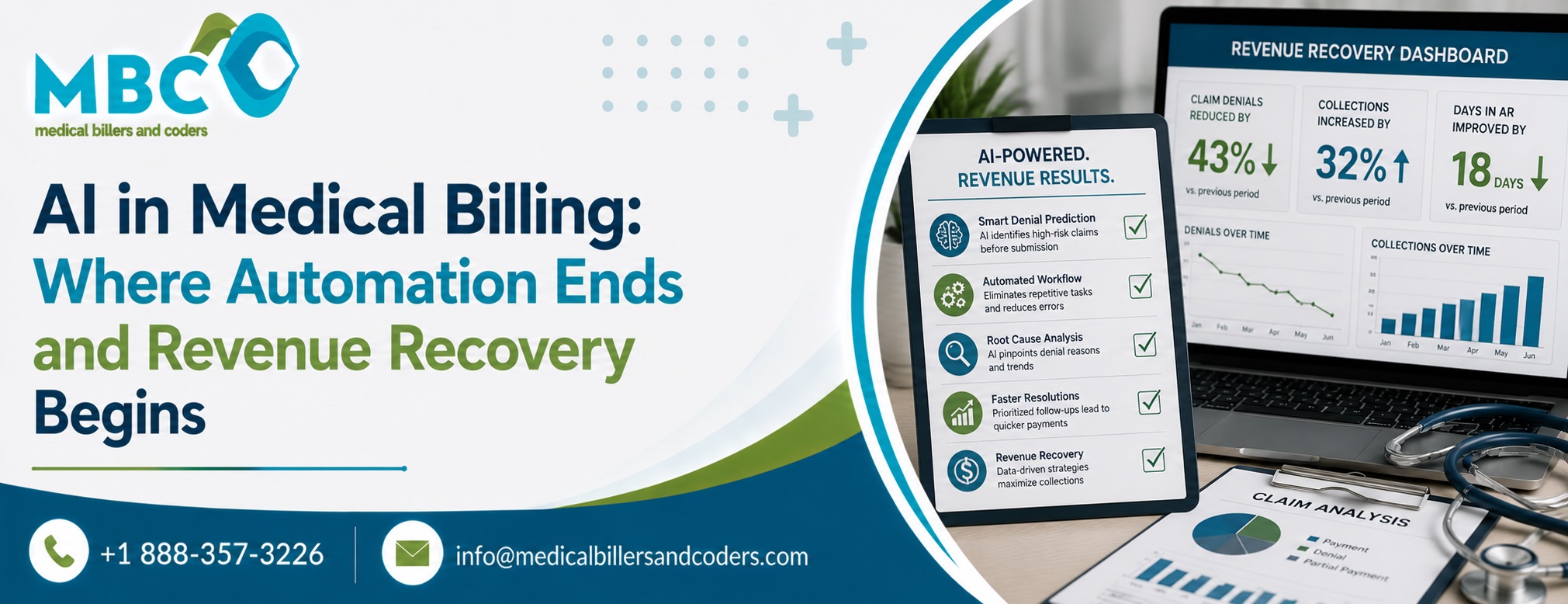
AI in medical billing is now table stakes for claim scrubbing, eligibility verification, and denial prediction, but it is not the reason multi-site groups close their AR gap. The revenue that gets recovered after a claim is denied, underpaid, or disputed still runs through trained specialists who can read a payer's intent, not just its code set.
For CFOs weighing an AI-only billing vendor against a hybrid revenue cycle management partner, that distinction is the difference between a cleaner claim rate and an actual improvement in Net Collection Ratio.
What AI Actually Fixes in the Revenue Cycle
Claim scrubbing engines trained on large claim datasets catch missing modifiers, mismatched diagnosis-to-procedure pairings, and payer-specific formatting errors before a claim ever leaves the building. Facilities that adopt intelligent pre-submission validation typically see preventable rejections drop in the 15% to 30% range.
That is a real, defensible gain, and it maps directly to the improper payment issues CMS tracks annually through its Comprehensive Error Rate Testing program, which measures how often Medicare Fee-for-Service claims fail to meet coverage, coding, or payment requirements.
Eligibility verification is the second place automation earns its keep. Batch-verifying active coverage, plan type, deductible status, and prior authorization requirements across hundreds of daily encounters is not a task a front-desk team can scale manually once a multi-site group crosses a few dozen appointments a day. Automating it reduces front-end write-offs and improves point-of-service collection before a claim is even generated.
Predictive denial analytics goes a step further, flagging which claims are statistically likely to be denied (by payer, by code, by procedure type) before submission. That shifts a billing operation from reactive appeals to proactive risk management, which is exactly the kind of upstream control a CFO wants visibility into.
All three of these are high-volume, rules-based tasks. The logic does not shift based on patient context, payer politics, or documentation nuance. That is precisely why AI performs well there, and precisely why it stalls everywhere else.
Where the Actual Revenue Recovery Happens
Once a claim is denied, the work stops being algorithmic. A denial reason has to be interpreted against the clinical documentation, against payer-specific contractual language, and against the individual payer's LCD and medical necessity criteria.
Technicality denials, timely filing disputes, and authorization gaps each demand a different response, and each response depends on a specialist who understands how a specific payer actually behaves, not just what its portal says. This is also the exact terrain the HHS Office of Inspector General monitors through its ongoing audits of billing accuracy and payment integrity, which is why appeal language has to hold up to more than automated logic.
Underpayment recovery is a related blind spot for automation. Payer contracts carry reimbursement schedules, carve-outs, and performance clauses that shift the moment a payer reimburses below the contracted rate. Catching that gap and pursuing the difference requires someone who can read both the contract and the payer's internal processing behavior, a combination that current AI tooling is not built to reconcile.
Patient-facing collections round out the picture. Explaining a balance, negotiating a payment plan, or working through a hardship case is a relationship exercise, not a data-matching one. Facilities that get this wrong see it show up later in aged AR and in patient satisfaction scores, both of which land on a CFO's dashboard eventually.
The Model That Actually Moves Net Collection Ratio
The operations seeing real margin improvement are not choosing between AI and human expertise — they are sequencing them deliberately. Automation absorbs the volume: scrubbing, eligibility, and pattern recognition. Specialists absorb the interpretation: appeals strategy, underpayment disputes, and payer relationships.
Multi-site groups that run this hybrid model consistently outperform those chasing full automation, because revenue cycle management was never only a data problem. It is a documentation problem, a relationship problem, and increasingly a compliance problem, and each of those still needs a human name attached to the outcome.
The practical question for a CFO evaluating vendors is not how much of the process can be automated. It is where automation should end so that trained specialists are working the claims that actually determine whether the facility gets paid in full.
|
Capability |
AI-Only Vendor |
Internal Team |
MBC Hybrid Model |
|
Claim scrubbing & eligibility |
Strong, high-volume |
Manual, inconsistent |
Automated + monitored |
|
Denial appeals & LCD interpretation |
Flags category only |
Limited payer-specific knowledge |
Specialist-drafted, payer-aware |
|
Underpayment & contract variance recovery |
Not reliably equipped |
Rarely tracked |
Contract analytics + recovery team |
|
CFO-level visibility |
Static reports |
Spreadsheets |
Executive dashboard, facility-specific KPIs |
If your clean claim rate is climbing but your Net Collection Ratio is flat, that gap is usually sitting exactly where automation stops and human judgment should start. MBC's revenue cycle management pricing is built around that hybrid model rather than a flat per-claim rate, because the two functions carry different costs and different returns.
Request a Facility Yield Audit to see where your automation is stopping short of full recovery.
Phone: 888-357-3226 | Email: info@medicalbillersandcoders.com
Sources:
