

 Specialities
 Services
 Resource Center
 Pricing
 About
About
 Contact
The case is reclassified from medical direction to medical supervision, which reimburses at a lower rate and can trigger recoupment if identified after payment.
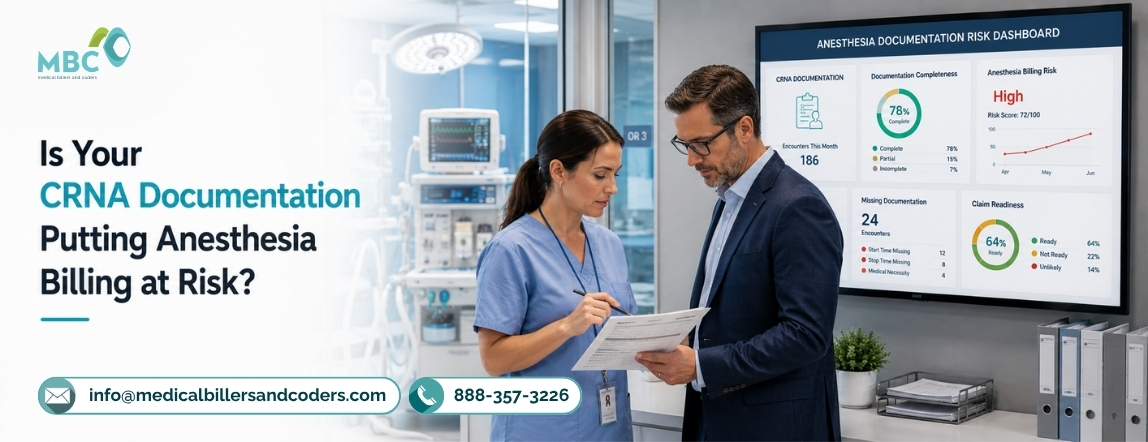
Yes. For most multi-provider anesthesia groups, CRNA documentation is the single largest source of billing risk in the department. When any one of the seven CMS medical direction elements is missing, incomplete, or untimed, the claim defaults from medical direction to medical supervision, and reimbursement drops accordingly. Federal audit activity in 2025 confirmed how often this happens in practice, and the financial exposure scales directly with case volume.
Why CRNA Documentation Carries Outsized Billing Risk
Anesthesia is one of the few specialties where the billing model is built entirely on documentation of concurrent, time-based involvement rather than a single procedure code. When an anesthesiologist works with CRNAs under a medical direction model, payment depends on proving, case by case, that the physician met every one of the CMS "seven requirements" under TEFRA.
This record is the evidence trail for that proof. A single missing signature, an untimed induction note, or a gap in the anesthesia record can convert a QK/QX medical direction claim into a lower-paying QZ or AA supervision claim, and in payer audits, unsupported documentation is treated as an overpayment, not a coding nuance.
For multi-OR facilities running four concurrent CRNA rooms per anesthesiologist, this isn't a rounding error. A documentation gap on even 10-15% of medically directed cases can quietly erode hundreds of thousands of dollars in annual anesthesia revenue while creating simultaneous compliance exposure, the worst combination for a CFO managing both margin and audit risk.
The Seven CMS Requirements Behind Every Compliant CRNA Claim
To bill medical direction (modifier QK for the anesthesiologist, QX for the CRNA), the directing anesthesiologist must document each of the following for every concurrently directed case:
- Performs a pre-anesthetic examination and evaluation
- Prescribes the anesthesia plan
- Personally participates in the most demanding procedures of the plan, including induction and emergence where applicable
- Ensures any procedures not personally performed are done by a qualified individual
- Monitors the course of anesthesia at frequent intervals
- Remains physically present and available for immediate diagnosis and treatment of emergencies
- Provides indicated post-anesthesia care
Medical direction under CMS rules applies when an anesthesiologist directs between two and four concurrent cases while meeting all seven of these standards, covering the pre-anesthetic evaluation, presence during critical portions of the case, and post-anesthesia care. Missing any single element, even one, is enough for a payer to reclassify the entire case as medical supervision, which reimburses at a materially lower rate and can trigger retrospective recoupment if discovered post-payment.
Where Documentation Breaks Down Most Often
MBC's Anesthesia Center of Excellence sees the same documentation failure points across facilities of every size:
- Induction and emergence gaps. Staggered room starts mean anesthesiologists frequently cannot be physically present for both induction and emergence in every concurrently directed room, and the anesthesia record often fails to note the exception or the qualified individual who covered it.
- Untimed or retrospectively completed anesthesia records. Time-stamped entries are non-negotiable for medical direction; documentation added after the fact without contemporaneous timestamps is a leading audit trigger.
- Missing sign-in from every participating provider. Every qualified individual involved in the case (resident, CRNA, or anesthesia assistant) must sign the record; a missing signature breaks the chain of evidence for element four.
- No documented emergency-availability standard. Facilities frequently lack a written protocol defining "immediately available," leaving element six unsupported if a payer challenges response time during an adverse event.
- Concurrency miscounts. Anesthesiologists directing more than four overlapping cases, even briefly, automatically fall out of medical direction and into supervision, a common and expensive scheduling error rather than a documentation one.
The OIG Is Actively Auditing Anesthesia Documentation
This risk isn't hypothetical. A July 2025 OIG audit found that Medicare Part B paid physicians $45.7 million for anesthesia administered during selected spinal pain management procedures that were at risk for noncompliance with Medicare requirements. A related prior OIG audit found that 27% of billed anesthesia services during those procedures lacked the supporting medical documentation needed to justify the anesthesia billed.
The same review found anesthesia was billed in 18% of roughly 3.9 million sessions, with fewer than 1% of those claims denied by Medicare Administrative Contractors before payment. The OIG has since carried this scrutiny forward: anesthesia modifier misuse, including QK/QX/QZ misapplication tied to unsupported medical direction documentation, is listed as an active monitoring priority in the OIG's 2026 Work Plan.
That last figure is the one that should concern every anesthesia group's leadership: pre-payment edits are not catching unsupported anesthesia documentation at scale, which means the exposure sits on the provider's books as a post-payment recoupment risk rather than a denied claim. Facilities that treat CRNA documentation as a clerical afterthought are, in effect, self-reporting a future audit finding.
What This Means for Facility Margins
Unsupported CRNA documentation doesn't just risk compliance penalties, it directly compresses Net Collection Ratio. Reclassified medical direction claims pay less, appealed claims extend Days in AR, and repayment demands on previously collected revenue hit the P&L twice: once as a clawback, and again as the staff time required to defend or correct the record.
For a multi-OR anesthesia group billing several thousand medically directed cases annually, even a modest documentation failure rate compounds into a seven-figure margin risk once denials, recoupments, and administrative burden are combined.
|
Documentation Element |
Common Failure Point |
Billing Consequence if Unsupported |
|
Pre-anesthetic evaluation |
Not documented before induction |
Element 1 fails; case at risk of QZ reclassification |
|
Induction/emergence presence |
No exception noted for staggered starts |
Element 3 fails; medical direction reduced to supervision |
|
Time-stamped monitoring entries |
Entries added retrospectively, undated |
Element 5 unsupported in audit review |
|
Immediate availability standard |
No written emergency-response protocol |
Element 6 cannot be evidenced if challenged |
|
Provider sign-in on record |
Missing CRNA, AA, or resident signature |
Element 4 broken; qualified-individual chain incomplete |
|
Concurrency count |
More than four overlapping directed cases |
Automatic default to medical supervision billing |
How MBC Strengthens CRNA Documentation and Anesthesia Billing Compliance
MBC's Anesthesia Center of Excellence builds compliant CRNA billing around three operational disciplines: real-time record review that flags missing elements before claim submission rather than after payer denial, modifier-specific coding protocols (QK, QX, QY, QZ, AA) validated against the anesthesia record for every concurrently directed case, and facility-specific concurrency monitoring that catches scheduling overlaps before they convert medical direction into lower-paying supervision. The result is a documentation-to-claim pipeline built to withstand OIG and MAC review, not just to get claims out the door.
Facilities evaluating their current model can review MBC's anesthesia billing service structure to compare how a documentation-first compliance approach affects both Net Collection Ratio and audit exposure.
Summary
CRNA documentation determines whether an anesthesiologist can legally bill medical direction (QK/QX) instead of the lower-paying medical supervision model. All seven CMS requirements under TEFRA must be met and documented for every concurrently directed case; missing even one element exposes the claim to reclassification, denial, or post-payment recoupment.
A July 2025 OIG audit confirmed this risk is active and material, finding tens of millions of dollars in at-risk anesthesia payments tied to documentation gaps. Facilities that build real-time documentation review, modifier-specific coding, and concurrency monitoring into their anesthesia billing workflow protect both margin and compliance standing.
Ready to assess your exposure?
Call MBC at 888-357-3226 or email info@medicalbillersandcoders.com to request a Facility Yield Audit of your anesthesia documentation and CRNA billing workflow.
