

 Specialities
 Services
 Resource Center
 Pricing
 About
About
 Contact
Prolonged services CPT codes are used when a healthcare provider spends significantly more time with a patient than is typical for a standard Evaluation and Management (E/M) service. These codes, such as 99354-99357, 99415-99416, and 99417/G2212, are billed in addition to the primary E/M codes when prolonged time thresholds are exceeded. Ensure that prolonged service codes are used only when necessary and in accordance with payer policies.
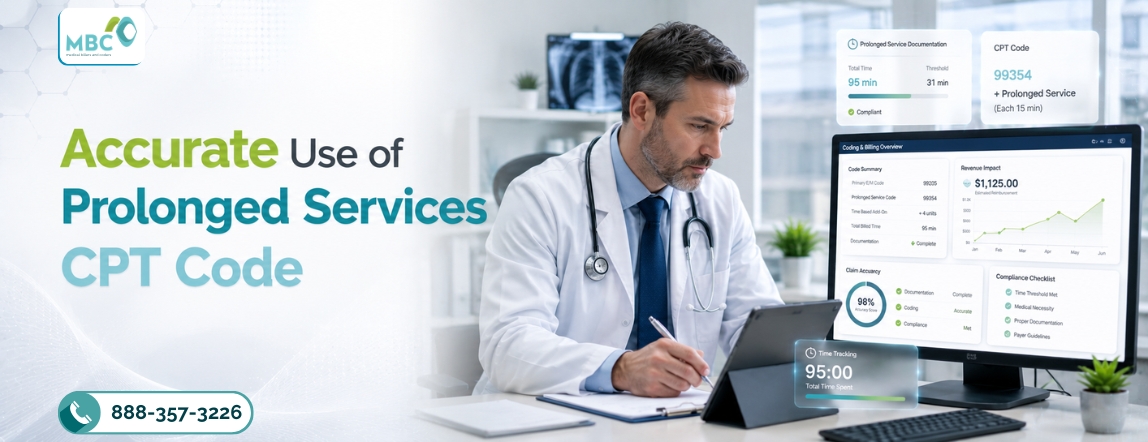
Accurate use of prolonged services CPT codes requires reporting only qualifying time beyond the primary E/M service, using the correct add-on code based on the payer and service setting, and maintaining complete time-based documentation. Codes such as 99417 and G2212 apply to prolonged office/outpatient E/M services, while other prolonged service codes are used for clinical staff, inpatient, or non-face-to-face services. Proper coding and payer-specific guidelines help prevent denials, compliance risks, and lost reimbursement.
Billing for Prolonged Services
Physicians have been billing prolonged services for a long time but in recent years the number of codes involved has grown and their requirements have changed, making them a potentially risky area for providers.
In this article, we shared coding guidelines for the accurate use of prolonged services CPT code. Before we dive in, it’s worth noting that prolonged services have appeared more than once on the list of audit targets pursued by the HHS Office of Inspector General (OIG).
The necessity of prolonged services are considered to be rare and unusual, the agency has opined in one of its past targeting memos. Agency also mentioned that they will determine whether Medicare payments to physicians for prolonged E/M services were reasonable and made in accordance with Medicare requirements.
Coding Guidelines for Prolonged Services
- Most of the time, private insurance will separately reimburse physicians or other qualified healthcare professionals for Prolonged Services when reported in conjunction with companion Evaluation & Management (E/M) codes or other services.
- In accordance with The Centers for Medicare and Medicaid Services (CMS) and American Medical Association (AMA), Prolonged Services without Direct Patient Contact (CPT codes 99358-99359) will not be separately reimbursed when reported with Care Management (CM) CPT codes 99484, 99487, 99489, 99490, 99492-99494, G2058 and Transitional Care Management (TCM) CPT codes 99495 and 99496.
- Private insurance carriers reimburse Prolonged Services when reported with E/M codes in which time is a factor in determining the level of service in accordance with CPT and or HCPCS guidelines.
- Physicians or other qualified health care professionals should report only Prolonged Services beyond the typical duration of the service on a given date, even if the time spent by the physician or other qualified health care professional is not continuous.
- Providers should not include the time devoted to performing separately reportable services when determining the amount of prolonged services time. For example, the time devoted to performing cardiopulmonary resuscitation (CPT code 92950) should not be included in prolonged services time. Prolonged service of less than 30 minutes total duration on a given date is not separately reported because the work involved is included in the total work of the evaluation and management codes.
- According to CPT and HCPCS, prolonged service codes 99354-99357, 99359, 99415-99416, 99437, 99439, and G0513-G0514, G2212 are considered add-on codes and should not be reported without the appropriate primary code.
- Medicare has assigned a status indicator of invalid to code 99417 and developed an HCPCS code to replace it, G2212.
- Prolonged services for labor and delivery are not separately reimbursable services. As described in the American Congress of Obstetricians and Gynecologists (ACOG) coding guidelines, prolonged services are not reported for services that do not have a time component such as labor and delivery management.
- In accordance with CMS and the AMA, Prolonged Services without Direct Patient Contact (CPT codes 99358-99359) will not be separately reimbursed when reported with CM CPT codes 99417,99484, 99487, 99489, 99490, 99492- 99494, G2058, and TCM CPT codes 99495 and 99496.
- According to CPT, modifier 25 may be appended to prolonged services codes if there is adequate supporting documentation that describes the service provided and indicates the service is significant and separately identifiable from another service or procedure on the same date of service.
2024–2025 Prolonged Services Code Changes: What Was Deleted, What Replaced It, and What It Costs to Miss the Transition
The most consequential structural change to prolonged services billing in recent years — and the one generating the highest volume of claim errors in 2024 and into 2025 — is the effective retirement of CPT codes 99354 and 99355 from office and outpatient E/M use.
As AAPC's 2024 prolonged services billing update (Billing Prolonged Services in 2024) confirms, these codes are no longer valid for reporting prolonged time with office or outpatient E/M services 99202–99215 — a transition that began with the 2021 E/M overhaul but continues to generate denials at practices whose billing teams have not fully migrated to the replacement code set.
The correct reporting pathway for prolonged office/outpatient E/M services is now +99417 (commercial payers) or +G2212 (Medicare and select commercial payers), with +99415 and +99416 covering clinical staff prolonged time under physician supervision.
Practices still appending 99354 to office visit claims are receiving automatic denials without appeal pathway at most major payers — and because these denials are processed as invalid code combinations rather than medical necessity denials, they frequently bypass the denial management workflow entirely and are written off rather than corrected.
CodingIntel's prolonged services coding analysis (Coding for Prolonged Services: CPT® and HCPCS Codes) estimates that practices with high-complexity patient panels — internal medicine, psychiatry, and geriatrics in particular — are forfeiting $28,000–$54,000 per-12-months in recoverable prolonged service reimbursement due to outdated code application, making this one of the highest-yield denial root-cause audit targets in E/M billing today.
Prolonged services billing represents one of the most concentrated yield EBITDA opportunities available to high-complexity specialties — internal medicine, psychiatry, geriatrics, and hospitalist practices in particular — precisely because the reimbursement is additive to the primary E/M code rather than a replacement for it.
Every encounter where total documented time crosses the applicable threshold for +99417 or +G2212 but those add-on codes are not appended represents a complete forfeiture of incremental revenue that required no additional patient visit to generate. For practices with complex patient panels where prolonged encounters occur 10 to 15 times weekly, the yield EBITDA impact of consistently capturing +99417 at one unit per 15-minute block versus writing off that time as included in the primary E/M code compounds to $28,000–$54,000 in annually recoverable margin.
The structural shift introduced in 2021 — moving prolonged service recognition from face-to-face time only to total time on the date of service, including pre- and post-visit activity — expanded the billable window significantly, yet most practices have not updated their documentation workflows or provider time-tracking habits to reflect that expansion, leaving yield EBITDA on the table at every complex encounter.
Prolonged Services CPT Code
+99417 and +G2212:
Add-on code +99417 relies on either 99215 or 99205 as the primary code. It becomes billable exactly one minute after the time threshold for 99215 or 99205 is exceeded. Thus to take 99205 as an example, one unit of +99417 is billable at 75 minutes. The 99205 accounts for the first 74 minutes.
This is different from how +G2212 works; +G2212 is used by Medicare payers, though not exclusively. Some commercial payers are accepting +G2212 instead of +99417. This may be because +G2212 cannot be billed until 15 minutes past the time threshold for 99215 or 99205.
Again, taking 99205 as an example, +G2212 becomes billable only 15 minutes after the first 74 minutes covered by 99205 – starting at 89 minutes. Effectively, the use of +G2212 tacks 15 minutes of additional time onto 99215 and 99205 and saves payers that 15 minutes of prolonged service time.
While both codes are billed at one unit per 15-minute time block, it’s important to verify applicable payer policies on which code to use. Remember that these prolonged services include non-face-to-face time spent before or after direct patient care if those times can be directly attributed to the patient encounter.
+99415 and +99416:
These two codes are used with office/outpatient E/M codes but are not limited to the level 5 codes only. These codes were revised in the year 2021 to clarify that they are no longer used with the older prolonged service codes 99354 and +99355. +99415 and +99416 describe prolonged service time spent by clinical staff during an E/M visit with direct patient contact.
Rather than being reported as one unit per 15-minute block of time, +99415 is reported to cover up to the first 60 minutes of time after the ‘highest time in the range of total time’ of the E/M service, according to CPT guidelines. This follows the logic CPT uses for +99417.
For each additional time block of up to 30 minutes, a unit of +99416 is supported. Remember that the CPT guidelines state the clinical staff should be spending time in direct patient contact under physician supervision.
99354 and +99355:
Prior to the year 2021, these codes were used in conjunction with office/outpatient E/M codes when prolonged time thresholds were met. After the year 2021, that function was transferred to the newly implemented add-on codes +99417 and +G2212 (as well as +99415 and +99416 for clinical staff time.
This leaves +99354 and +99355 fairly limited usage options, such as outpatient consultation codes 99241-99245 for those commercial payers still reimbursing these codes, and then a variety of less frequently utilized outpatient codes.
These include psychotherapy services (90837, 90847), domiciliary/rest home visits (99324-99337), home visits (99341-99350), and care planning services for cognitively impaired patients (99483).
99356 and +99357:
These codes are the inpatient/observation setting counterparts to 99354 and +99355. They were also revised in the year 2021 to account for the implementation of +99417 and +G2212, and the resulting changes to 99354 and +99355. 99356 and +99357 cover the total time spent by a physician or other provider at the patient’s bedside as well as on the patient’s floor or unit in the hospital or nursing facility, that exceeds the time threshold of the primary code (such as initial or subsequent hospital care). Please note that the time spent on the date of service does not have to be continuous.
99358 and +99359:
These two codes cover prolonged service time that does not involve direct patient contact, but was instead spent either before or after face-to-face patient contact. They were revised slightly to spell out that they are not to be used with 99202-99215.
Remember that part of the 2021 CPT changes to codes 99202-99215 include new language stating that when these services are reported based on the provider’s time spent on the date of service, the time before and after direct patient contact can be included.
Documentation Requirements for Prolonged Services: The Audit Standard That Determines Whether Claims Survive OIG Review
Prolonged services have appeared repeatedly on the HHS Office of Inspector General's audit target list precisely because documentation standards for these codes are specific, time-stamped, and non-negotiable — and because the gap between what providers document and what the codes require is wide enough to generate both recoupment liability and compliance exposure simultaneously.
The University of Rochester Medicine's compliance guidance on prolonged service codes (Prolonged Service Codes — URMC Compliance Office) identifies three documentation failures that account for the majority of prolonged service audit findings: total time not separately documented from the primary E/M service time, start and stop times absent or reconstructed rather than contemporaneous, and the prolonged service time not clearly attributed to a specific patient encounter rather than general administrative activity.
For +99417 and +G2212, the documentation must establish that the total time on the date of service — including non-face-to-face time before and after direct patient contact — crosses the applicable threshold for the primary code before the add-on code is claimable.
For 99356 and +99357 in inpatient settings, the time at bedside and on the unit must be separately logged from time spent off the floor. Practices that use templated EHR notes without time-stamped documentation fields are generating structurally non-compliant prolonged service claims regardless of whether the clinical time was actually spent — a distinction that carries no weight in a Medicare audit where the record as documented is the record as billed.
Revenue integrity for prolonged services is uniquely challenging because the compliance risks run in both directions simultaneously: undercoding forfeits reimbursement the practice earned, while overcoding — particularly in a code category that appears repeatedly on the HHS Office of Inspector General's audit target list — creates recoupment liability and potential fraud exposure.
The foundation of revenue integrity in this code set is accurate, contemporaneous time documentation that clearly separates prolonged service time from the primary E/M service time, records start and stop times rather than reconstructing them, and attributes all documented time specifically to a patient encounter rather than general administrative work.
Revenue integrity also requires that the correct add-on code pathway is applied consistently by payer — +99417 for most commercial payers, +G2212 for Medicare — and that legacy codes 99354 and +99355 are no longer appended to office or outpatient E/M claims 99202–99215, a transition error that continues to generate automatic denials processed outside the standard denial management workflow and written off rather than corrected.
Practices that lack a systematic payer-specific prolonged service billing protocol are simultaneously generating compliance exposure at the high end and forfeiting clean revenue at the low end — a dual revenue integrity failure that a structured coding audit surfaces within the first billing period reviewed.
A revenue diagnostic targeting prolonged services billing typically uncovers four distinct patterns of revenue loss that neither standard denial tracking nor routine coding audits identify.
- First, it quantifies the volume of encounters where documented total time on the date of service — including pre- and post-visit activity — crosses the +99417 or +G2212 threshold but the add-on code was never appended, either because providers are not tracking non-face-to-face time or because EHR templates do not capture it separately.
- Second, it identifies claims where 99354 was still appended to office E/M codes post-2021, generating automatic invalid-combination denials that bypass the appeal queue and are written off rather than rebilled under the correct code.
- Third, it examines whether +99415 and +99416 — the clinical staff prolonged service codes — are being used at all in practices where qualifying encounters with direct patient contact under physician supervision occur regularly, representing a category of add-on revenue most practices do not bill because they are unaware it exists.
- Fourth, the diagnostic reviews modifier 25 application patterns on dates where prolonged services and separately identifiable procedures were performed, identifying encounters where the modifier was absent and the prolonged service claim was bundled and denied without appeal.
For most high-complexity primary care and specialist practices, a structured revenue diagnostic of prolonged services billing identifies $28,000–$54,000 or more in annually recoverable revenue — making it one of the highest-return audit exercises available in the E/M coding category.
Medical Billers and Coders (MBC) is a leading medical billing company providing complete revenue cycle services. We hope this article has given you a good understanding of the accurate use of prolonged services CPT code. To know more about our medical billing and coding services, contact us at: info@medicalbillersandcoders.com/ 888-357-3226.
CPT Copyright 2022: American Medical Association.
Reference: National Alliance of Medical Auditing Specialists
