

 Specialities
 Services
 Resource Center
 Pricing
 About
About
 Contact
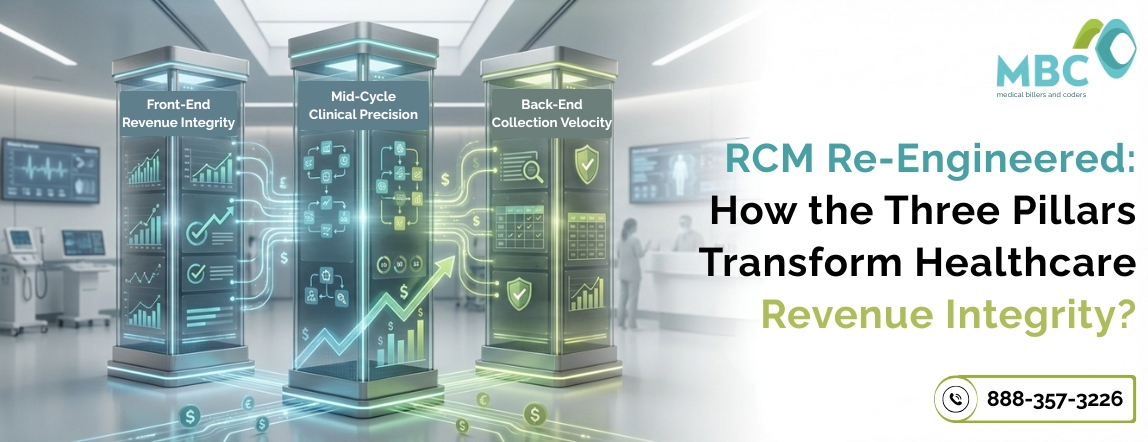
The healthcare revenue cycle has reached a critical inflection point. With median hospital operating margins hovering below 3% and 40% of hospitals reporting negative margins in early 2026, the stakes have never been higher for healthcare providers.
Traditional revenue cycle management approaches are no longer sufficient to navigate today's complex reimbursement landscape, where 41% of providers report denial rates exceeding 10% and claim complexities continue to mount.
The answer lies in a reimagined approach: RCM Re-Engineered through three strategic pillars that address revenue leakage at every critical juncture. This framework—Front-End Revenue Integrity, Mid-Cycle Clinical Precision, and Back-End Collection Velocity—represents a fundamental shift from reactive billing to proactive revenue optimization.
The Rising Cost of Inefficient Revenue Cycles
According to the U.S. revenue cycle management market, valued at $172.24 billion in 2024, is projected to reach $190.40 billion in 2026, reflecting the growing investment healthcare organizations are making to address mounting financial pressures. Yet despite this investment, many providers continue to struggle with fundamental revenue cycle challenges.
The data paints a concerning picture. Average denied claim amounts for hospitals rose 12% for inpatient claims and 14% for outpatient claims in recent years, while external payer audits increased by 30% year-over-year. For healthcare organizations already operating on razor-thin margins, these trends represent an existential threat to financial sustainability.
Pillar One: Front-End Revenue Integrity
The first pillar focuses on preventing revenue leakage before it occurs. Front-end revenue integrity encompasses eligibility verification, insurance discovery, prior authorization management, and accurate patient financial clearance—all executed at the point of service.
Think of this pillar as your first line of defense against denials. When patient demographics are captured accurately, insurance eligibility is verified in real-time, and prior authorizations are secured before service delivery, the foundation for clean claim submission is established. Healthcare providers report that 50% of claim errors stem from missing or inaccurate data, while 35% involve authorization issues.
Leading medical billing services are deploying advanced eligibility automation and propensity-to-pay analytics that stop denials before patients leave the office. This proactive approach reduces administrative burden downstream and accelerates the cash conversion cycle. With more than 40% of providers reporting it takes two months or longer to receive reimbursement, with Medicaid payments often stretching beyond six months, front-end precision becomes mission-critical.
The Centers for Medicare & Medicaid Services (CMS) continues to emphasize the importance of accurate patient access processes through various quality reporting programs and reimbursement methodologies. Providers who master front-end integrity position themselves to capture maximum compliant revenue while minimizing denials that plague the industry.
Pillar Two: Mid-Cycle Clinical Precision
The second pillar addresses what industry experts call "clinical-financial desync"—the disconnect between clinical documentation and billing that represents the number one cause of lost revenue for healthcare organizations.
Mid-cycle clinical precision requires AAPC-certified coders who understand both the clinical nuances of complex cases and the financial implications of proper documentation. This is particularly crucial for high-acuity surgical procedures, where comprehensive documentation directly impacts reimbursement levels.
Consider this: AAMC member teaching hospitals' Medicare margins averaged -17.5% in fiscal year 2021, compared with -10.2% for nonteaching hospitals, according to data from the Association of American Medical Colleges. This disparity exists despite teaching hospitals treating more complex patients—often because clinical documentation fails to capture the full scope of services rendered.
Professional coders serve as the critical bridge between clinical excellence and financial performance. They ensure that every procedure, diagnosis, and complication is accurately translated into codes that reflect the true complexity and resource intensity of patient care. This precision protects providers from both undercoding (leaving money on the table) and overcoding (risking compliance violations and audits).
The mid-cycle phase also encompasses charge capture, charge review, and claim scrubbing—processes that identify and correct errors before claims reach payers. With 68% of providers finding it more challenging to submit clean claims than a year ago, investing in mid-cycle precision becomes non-negotiable for revenue optimization.
Pillar Three: Back-End Collection Velocity
The final pillar focuses on accelerating cash flow through intelligent denial management, payment posting, and accounts receivable follow-up. This is where AI-driven workflow engines and predictive analytics demonstrate their greatest value.
Back-end collection velocity means reducing Days in Accounts Receivable (AR) through systematic, data-driven approaches to denial resolution. Rather than manually reviewing every denied claim, leading organizations deploy technology that prioritizes high-dollar denials, predicts overturn probability, and automates appeal generation with payer-specific language and supporting documentation.
The financial impact of back-end optimization cannot be overstated. Average at-risk amounts from external audits reached approximately $17,000 per hospital case, while Medicare Advantage-related denials increased 22.4% to about $1,000 per claim. Organizations that lack sophisticated denial management capabilities see these dollars disappear into write-offs.
According to CMS cost report data analyzed by the Medicare Payment Advisory Commission (MedPAC Report March 2024), hospital financial performance remains under pressure. This makes every dollar of denied revenue worth pursuing—but only through efficient processes that don't consume more in labor costs than they recover.
The most sophisticated revenue cycle operations use predictive analytics to identify claims likely to be denied before submission, enabling intervention that prevents denials rather than merely resolving them after the fact. This proactive stance, combined with rapid resolution of unavoidable denials, shortens the cash conversion cycle and improves working capital.
The Technology Imperative
While the three pillars provide the strategic framework, technology serves as the enabler. 67% of providers believe AI can improve the claims process, though only 14% currently use AI for denial reduction. Among early adopters, 69% report that AI solutions have reduced denials and increased resubmission success rates.
The technology landscape for revenue cycle management has evolved dramatically. Cloud-based platforms now offer real-time claim scrubbing, automated eligibility verification, intelligent payment posting, and AI-powered denial prediction—all integrated with existing electronic health record systems.
For organizations considering technology investments, the question isn't whether to adopt these tools but how quickly. With payers increasingly using AI to automate pre-authorization decisions and flag under-documented claims with machine learning, providers must match this sophistication or risk falling further behind.
Measuring Success: The Metrics That Matter
Implementing the three pillars requires disciplined performance measurement. Leading organizations track:
- Front-End Metrics: Registration error rates, insurance verification completion rates, prior authorization approval rates, point-of-service collection rates
- Mid-Cycle Metrics: Clean claim rates, coding accuracy percentages, charge lag days, claim submission timeliness
- Back-End Metrics: Days in AR by payer and age bucket, denial rates by reason code and payer, appeal success rates, net collection rates
The goal is comprehensive visibility into revenue cycle performance that enables data-driven decision-making. When executives can see exactly where revenue is being lost and why, they can allocate resources strategically to address the highest-impact issues.
The Outsourcing Advantage
Many healthcare organizations recognize that building and maintaining world-class revenue cycle capabilities in-house requires significant investment in technology, talent, and ongoing training. This realization is driving growth in RCM outsourcing.
A Healthcare IT News survey found that 40% of healthcare providers outsource RCM functions, primarily to reduce operational expenses, while a KPMG report indicates 56% of providers are outsourcing non-core functions to prioritize clinical excellence.
Outsourcing partners bring specialized expertise across all three pillars—from certified coders who stay current with the latest coding guidelines to denial management specialists who understand payer-specific nuances. They also invest in technology platforms that would be cost-prohibitive for individual practices or small hospital systems to acquire independently.
For practices evaluating outsourcing, the calculation is straightforward: can we achieve better financial outcomes, lower administrative costs, and reduced compliance risk by partnering with specialists? For many organizations, particularly those with fewer than 50 providers, the answer is increasingly yes.
Looking Forward: The Future of Revenue Cycle Management
The healthcare payment landscape will continue evolving in ways that demand greater revenue cycle sophistication. Value-based care models, price transparency requirements, patient responsibility growth, and ongoing regulatory changes all point toward increasing complexity.
Organizations that embrace the three-pillar framework position themselves not just to survive but to thrive in this environment. By preventing revenue leakage at the front end, ensuring clinical-financial alignment in the middle, and accelerating collections at the back end, they create a sustainable competitive advantage.
The alternative—maintaining legacy processes that evolved during simpler reimbursement eras—leads inevitably to financial distress. With hospital operating margins up only 4% year-to-date in 2026 compared to 2025, and small hospitals under 25 beds slipping into negative territory, there's no time to waste.
Healthcare finance leaders must ask themselves: Is our revenue cycle optimized across all three pillars? Are we leveraging technology effectively? Do we have the expertise required to maximize compliant revenue capture? If the answer to any of these questions is no, it's time to consider strategic partnerships with specialists who can deliver results.
Transform Your Revenue Cycle with Medical Billers and Coders
The three-pillar approach to revenue cycle management isn't theoretical—it's a proven framework that healthcare organizations across the United States are using to transform their financial performance. However, implementing this framework requires specialized expertise, advanced technology, and dedicated resources that many providers lack in-house.
Medical Billers and Coders brings over 25 years of revenue cycle excellence to healthcare providers nationwide. Our comprehensive services span all three critical pillars:
- Front-End Excellence: Advanced eligibility verification, insurance discovery, and prior authorization management that prevents denials before they occur
- Mid-Cycle Precision: AAPC-certified coding teams ensuring maximum compliant reimbursement for your clinical services
- Back-End Optimization: AI-powered denial management and AR follow-up that accelerates cash flow and reduces Days in AR by 15-20% on average
Our clients achieve industry-leading results: 99% clean claim rates, 97.8% net collection rates, and 58% reduction in cost-to-collect versus in-house operations. We seamlessly integrate with your existing EHR systems—Epic, Cerner, or Athena—eliminating technology debt and switching costs.
Ready to transform your revenue cycle performance?
Contact Medical Billers and Coders today for a complimentary revenue cycle assessment. Discover how our three-pillar approach can optimize your financial outcomes while you focus on what matters most—delivering exceptional patient care.
Frequently Asked Questions
Q1: What is Front-End Revenue Integrity in healthcare RCM?
Front-End Revenue Integrity encompasses all processes that occur before claim submission, including patient registration, insurance verification, prior authorization, and financial clearance. It prevents revenue leakage by ensuring accurate information capture at the point of service.
Q2: How does Mid-Cycle Clinical Precision impact reimbursement?
Mid-Cycle Clinical Precision ensures that clinical documentation accurately reflects the complexity and resource intensity of patient care. Proper coding by certified professionals bridges the gap between clinical services and maximum compliant reimbursement, preventing both undercoding and overcoding.
Q3: What is Back-End Collection Velocity and why does it matter?
Back-End Collection Velocity focuses on accelerating cash flow through efficient denial management, payment posting, and accounts receivable follow-up. It reduces Days in AR and prevents revenue leakage from denied claims, directly improving organizational cash position and financial stability.
Q4: Should healthcare providers outsource their revenue cycle management?
Outsourcing makes strategic sense for many providers, particularly smaller organizations. With 40% of providers already outsourcing RCM functions to reduce costs and access specialized expertise, outsourcing allows practices to focus on clinical care while ensuring optimal financial performance through partnership with RCM specialists.
Q5: How can AI improve healthcare revenue cycle performance?
AI improves RCM through predictive denial prevention, automated claim scrubbing, intelligent payment posting, and appeal generation. Among providers using AI solutions, 69% report reduced denials and increased resubmission success, though adoption remains low at just 14% industry-wide, presenting significant opportunity for competitive advantage.