

 Specialities
 Services
 Resource Center
 Pricing
 About
About
 Contact
No. Most medical billing outsourcing engagements work within the facility's existing EHR through interface configuration and clearinghouse connectivity, not platform replacement. An EHR change is only warranted when the current system is being sunset, cannot support specialty-specific coding, or creates fragmented reporting across multiple sites.
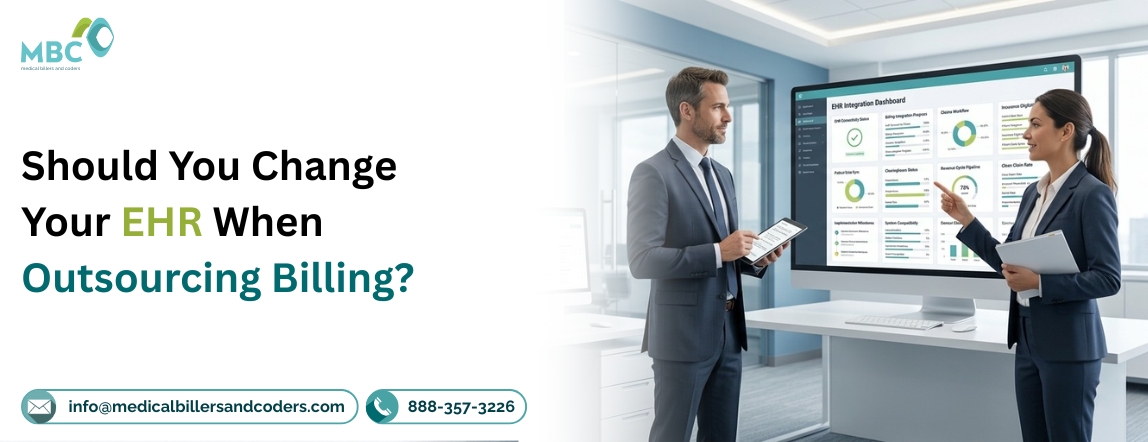
No, in most cases, you do not need to change your EHR when outsourcing billing. The stronger question for a CFO evaluating medical billing outsourcing in 2026 is whether your current EHR can support the integrations, reporting, and interoperability mandates your billing partner needs to protect margin, not whether the platform itself needs replacing.
That distinction matters more this year than it has in a decade. With CMS-0057-F operational requirements now in force and full FHIR API implementation due January 1, 2027, EHR interoperability has shifted from a nice-to-have to a compliance and cash-flow issue.
Multi-site groups, PE-backed platforms, and multi-OR facilities evaluating medical billing services are increasingly asking the wrong question first: "Do we need a new EHR?" instead of "Can our billing partner work inside the one we already have?"
Why the EHR Question Comes Up During Medical Billing Outsourcing
When facilities begin vetting medical billing outsourcing partners, the EHR conversation surfaces almost immediately, usually because a vendor either can't integrate cleanly with the incumbent system or oversells the benefits of switching. Both scenarios put revenue at risk.
An EHR transition is one of the most disruptive events a healthcare organization can undergo. Industry data on go-live periods consistently shows temporary productivity and collections dips during migration, driven by workflow relearning, data migration errors, and interface rebuilding. For a multi-site group already managing AR pressure, layering an EHR replacement on top of a billing transition compounds risk rather than reducing it.
The more useful framework is this: evaluate your EHR on its ability to support clean data exchange, not on its brand name or age. A well-configured, older EHR that integrates reliably with your billing partner's clearinghouse and coding workflows will outperform a modern EHR implemented poorly under time pressure.
What Actually Matters: EHR Compatibility, Not EHR Age
Facility leadership should assess three technical dimensions before assuming a platform change is required.
Interface and clearinghouse connectivity
Can the EHR generate clean 837 files, support real-time eligibility checks, and route remittance data (835s) back without manual intervention? Legacy EHRs with outdated interface engines create the manual workarounds that drive up Days in AR. The root cause is typically the absence of a maintained interface, not the EHR itself.
FHIR and API readiness ahead of CMS-0057-F
Under CMS-0057-F, impacted payers must operate Patient Access, Provider Access, Payer-to-Payer, and Prior Authorization FHIR APIs by January 1, 2027, with faster prior authorization turnaround requirements (72 hours urgent, seven calendar days standard) already active since January 1, 2026. Facilities whose EHR cannot consume or expose FHIR-based data will face friction on both the payer and provider sides of that exchange, regardless of who handles billing.
Reporting granularity for CFO-grade visibility
A billing partner delivering executive dashboards, denial trending by payer, and facility-specific KPIs needs an EHR that exports structured, procedure-level data. If the EHR only supports flat exports or requires manual reconciliation to isolate specialty-level performance, the reporting gap will show up as a visibility gap for finance leadership — not as a coding or billing failure.
None of these require a platform replacement in isolation. They require an integration assessment, which is a fundamentally different — and far less disruptive — engagement.
When an EHR Change Is Actually Warranted
There are legitimate scenarios where replacing the EHR should happen in parallel with, or shortly before, a billing transition:
- The current EHR is being sunset by its vendor, with support ending within 12–18 months
- The platform cannot generate compliant claims for ASC-specific or specialty-specific billing (implant tracking, global period documentation, high-acuity surgical coding)
- Multiple acquired sites are running fragmented, non-standardized EHR instances that block consolidated reporting across the enterprise
- The organization is pursuing value-based contracts that require clinical-financial data integration the current system cannot support
In these cases, sequencing matters. Facilities generally see better outcomes running the EHR transition first, stabilizing for a full billing cycle, and only then transitioning billing, rather than attempting both simultaneously. A billing partner experienced in multi-site RCM can operate through an EHR change, but doing so adds risk that a staged approach avoids.
EHR Change vs. EHR Optimization: A Side-by-Side View
|
Factor |
Full EHR Replacement |
EHR Optimization + Billing Partner Integration |
|
Typical timeline |
9–18 months |
30–60 days |
|
Collections disruption risk |
High during go-live |
Low, if interfaces are validated pre-transition |
|
Capital investment |
Significant (licensing, implementation, training) |
Minimal (interface and workflow configuration) |
|
CMS-0057-F readiness |
Depends on new vendor's roadmap |
Achievable through API middleware and interface upgrades |
|
Best suited for |
Sunset platforms, fragmented multi-site systems |
Facilities with a stable, functioning EHR seeking margin recovery |
The CFO's Real Decision Point
For most multi-site groups and PE-backed platforms, the decision isn't EHR-versus-no-EHR. It's whether the incoming billing partner has the technical depth to work inside your existing system without forcing a platform change you didn't budget for. A partner that leads with "you'll need to switch EHRs" before conducting an interface assessment is often signaling a limited integration capability, not a genuine technical requirement.
The facilities that protect margin best treat the EHR as infrastructure to be optimized around, not replaced by default. That approach avoids go-live disruption, keeps AR days stable through the billing transition, and positions the organization for CMS-0057-F compliance on a realistic timeline.
Specialty-specific billing complexity (implant capture in orthopedics, modifier accuracy in anesthesia, wound care documentation requirements) depends far more on the billing partner's coding protocols than on the EHR vendor.
Groups evaluating specialty billing partners can review capability breakdowns across specialties through MBC's specialty-specific billing services, and multi-site organizations operating across several states can check state-specific payer and compliance considerations through MBC's state-by-state billing services directory.
Request a Facility Yield Audit to get an interface-level assessment of whether your current EHR supports a clean billing transition, before assuming a replacement is required.
