

 Specialities
 Services
 Resource Center
 Pricing
 About
About
 Contact
GI practices handle complex procedures, coding combinations, documentation requirements, payer rules, and authorization processes that can create revenue leakage. Specialized Revenue Cycle Management focuses on these gastroenterology-specific challenges instead of applying a generic billing workflow. This allows practices to identify recurring denial patterns, coding issues, payer payment variances, and aging A/R that may otherwise remain hidden.
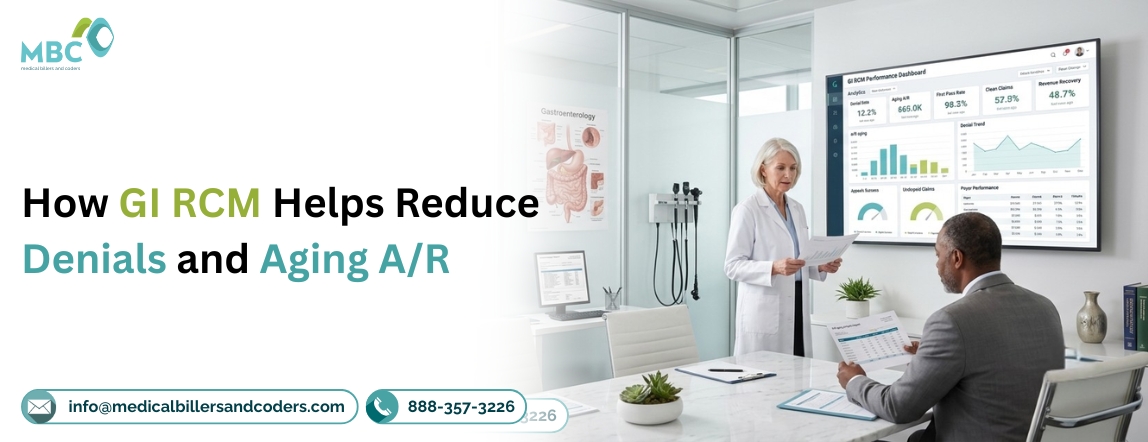
GI RCM helps reduce denials and aging A/R by replacing reactive claim chasing with a structured process that catches errors before submission and works denials the moment they arrive. Gastroenterology claims carry specific risk points, screening-versus-diagnostic colonoscopy coding, bundled endoscopy edits, and anesthesia pairing rules, that a generalist billing process often misses.
The direct answer: GI RCM lowers denial rates and shrinks aging A/R by combining specialty-specific coding accuracy with fast, structured denial follow-up, so fewer claims are ever exposed to the errors that turn into old AR recovery work later.
How GI RCM Prevents Denials Before They Happen
Most denials trace back to something that was fixable before the claim ever left the practice. This specialty process builds pre-submission checks specifically around gastroenterology CPT logic, catching mismatched modifiers, incomplete medical necessity documentation, and NCCI bundling conflicts.
A generalist billing process treats a colonoscopy claim like any outpatient visit, missing the screening-to-diagnostic distinction that determines whether a claim pays cleanly or gets flagged for review. A single missed modifier on a routine screening colonoscopy can shift full reimbursement into a patient copay dispute, which is exactly the kind of error a specialty review process is built to catch.
The Role of Denial Management in Shrinking Aging A/R
Denial management is the second half of what makes this process effective. Claims that do get denied need a fast, structured response: identify the root cause, correct the documentation or coding issue, and refile within the payer's resubmission window.
Practices without this discipline let denials sit for weeks, and by the time someone circles back, the claim has aged into a much harder old AR recovery situation — one that often requires a full re-verification of medical necessity before a payer will even reconsider it.
Common Gastroenterology RCM Challenges
|
RCM Area |
Common GI Challenge |
Potential Revenue Impact |
|
Medical Coding |
Incorrect CPT, ICD-10, or modifier reporting |
Denials or underpayments |
|
Colonoscopy Billing |
Screening-to-diagnostic conversion issues |
Delayed or reduced reimbursement |
|
Authorization |
Missing or incomplete authorization |
Preventable denials |
|
Claim Submission |
Missing or inconsistent information |
Rejections and delays |
|
Denial Management |
Delayed denial follow-up |
Aging A/R |
|
Payment Posting |
Incorrect adjustments or missed variances |
Hidden revenue leakage |
|
Old A/R Recovery |
Unworked aging claims |
Increased write-off risk |
RCM Services and Medical Coding Services Working Together
Specialty RCM services and medical coding services aren't separate functions; they work best as one connected process under GI RCM. Coders who understand gastroenterology-specific payer rules feed accurate claims into the billing cycle, while dedicated medical billing services handle submission, tracking, and follow-up on a consistent schedule — turning two functions that are often siloed into a single accountable workflow.
This coordination is what keeps aging A/R from building up in the first place rather than cleaning it up after the fact. A practice running colonoscopy, endoscopy, and consult claims through the same coordinated process typically sees far fewer claims slip through without a second review.
Gastroenterology Billing Services Built Around GI RCM Principles
Gastroenterology billing services structured around these principles apply consistent edit checks, denial workflows, and reporting across every claim a practice submits. This is where MBC's engagement-based pricing model, outlined on our revenue diagnostic and pricing page, becomes useful for practices comparing their current denial rate and AR aging against what a specialty-focused process could achieve.
Pricing scales with claim volume and complexity rather than a flat fee, so smaller practices and larger multi-provider groups pay for the level of oversight their claim mix actually needs.
Specialized RCM vs. General Billing Approach
|
Revenue Cycle Function |
General Billing Approach |
Specialized GI RCM Approach |
|
Coding |
Basic claim review |
GI procedure-specific coding review |
|
Denials |
Claim-by-claim correction |
Root-cause and payer trend analysis |
|
A/R |
General aging report |
A/R segmented by payer, procedure, and age |
|
Underpayments |
May go unnoticed |
Expected vs. actual reimbursement review |
|
Authorization |
Standard workflow |
Procedure and payer-specific monitoring |
|
Reporting |
Overall billing metrics |
GI-specific financial and operational analytics |
|
Old A/R |
Periodic follow-up |
Dedicated recovery strategy |
Pricing and Request Your Revenue Diagnostic
The price of Gastroenterology Revenue Cycle Management depends on claim volume, provider count, procedure complexity, payer mix, A/R condition, and the level of billing, coding, denial, and recovery support required. A practice with complex procedures and significant aging A/R may require a different scope than a GI practice with stable collections.
Request Your Revenue Diagnostic to identify your biggest revenue cycle gaps and determine whether GI Billing Services, Denial Management, Medical Billing Services, RCM Services, or Old A/R Recovery should be prioritized. The diagnostic can provide a clearer basis for deciding what level of support your practice actually needs.
Conclusion
GI RCM helps reduce denials and aging A/R by addressing both ends of the problem: stronger coding accuracy before submission and faster denial management after it. Practices relying on generalist billing processes tend to see claims accumulate in the 90-plus day bucket simply because gastroenterology-specific errors go unnoticed until it's too late — a pattern that repeats every quarter until someone changes the underlying process.
A structured approach, supported by specialty RCM Services and consistent old AR recovery discipline, keeps that from happening and protects revenue that would otherwise be written off.
Reference - CMS National Correct Coding
Want to see how much GI RCM could cut your denial rate and aging A/R? Call 888-357-3226 or email info@medicalbillersandcoders.com
