Specialities
 Services
 Resource Center
 Pricing
 About
About
 Contact
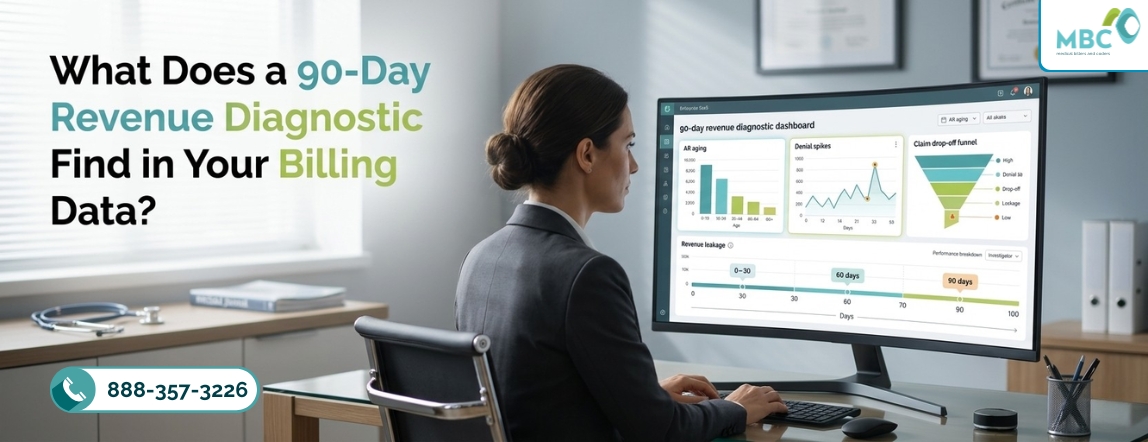
A 90-day revenue diagnostic finds denial root causes, payer-level underpayments, charge capture gaps, and AR aging patterns that monthly billing statements never surface — and delivers a dollar-quantified recovery roadmap before you commit to any operational change.
For multi-provider groups, PE-backed networks, and multi-site facilities managing $5M+ in annual collections, the gap between what your revenue cycle submits and what it actually protects is rarely visible in standard reporting. That gap has a recoverable value. The diagnostic finds it.
The Billing Performance Problem That Standard Reports Hide
Most enterprise healthcare groups are operating with a structural blind spot. Your billing vendor reports clean claim rates, Days in AR, and monthly collections, but none of those metrics tell you why revenue is leaking or how much is recoverable.
Industry data confirms the scale of the problem. Initial claim denial rates reached 11.8% in 2024, up from 10.2% just a few years prior, with Medicare Advantage denials spiking 4.8% in that same period, driven directly by payers deploying AI-driven audit tools at claim volume scales that manual review cannot match.
The OIG has documented that Medicare Advantage organizations deny prior authorization requests that meet Medicare coverage rules at a rate of 13%, compounding provider revenue exposure with every payer contract cycle. (Source: OIG Report OEI-09-19-00580 — Medicare Advantage Prior Authorization Denials)
This is the environment in which a 90-day revenue diagnostic operates — not as a routine audit, but as a structured forensic analysis of the specific failure points costing your facility recoverable revenue right now.
The Triple Threat Driving Revenue Leakage in High-Volume Practices
A properly structured 90-day revenue diagnostic consistently surfaces the same three operational failures across multi-specialty and surgical groups:
- Payer-Level Underpayment Acceptance: Payer contracts are negotiated at the enterprise level, but claims are adjudicated at the procedure level. Without CPT-level payment variance tracking against contracted rates, groups routinely accept underpayments of 8–12% on high-dollar procedures with zero system-generated alerts.
- Charge Capture Gaps at the Point of Service: OR logs, procedure documentation, and billing handoffs rarely reconcile in real time. For high-acuity specialties including orthopedics, gastroenterology, and interventional pain, unbilled or under-coded procedures represent $120K–$240K in annual leakage for a busy multi-provider group.
- Denial Pattern Accumulation Without Root-Cause Engineering: Most medical billing services work denials reactively. They appeal individual claims without identifying the structural payer behavior, coding pattern, or front-end workflow generating the denial volume. The result: the same denial categories recur every quarter at growing cost.
What a 90-Day Diagnostic Finds vs. What Standard Billing Reports Show
| Performance Dimension | Standard Monthly Billing Report | MBC 90-Day Revenue Diagnostic |
| Denial Reporting | Aggregate denial rate | Denial root cause by payer, CPT, and denial category |
| AR Visibility | Days in AR overall | AR aging segmented by payer, service line, and denial bucket |
| Payment Accuracy | Gross collections | Contracted rate variance by procedure and payer |
| Charge Capture | Claims submitted count | Procedure reconciliation against OR/encounter logs |
| Compliance Exposure | None | OIG audit risk flag by billing pattern |
| Recovery Opportunity | Not quantified | Dollar-quantified leakage by category with priority roadmap |
The distinction matters at the CFO level. Standard billing reports tell you what was collected. A 90-day revenue diagnostic tells you what should have been collected and precisely where the difference lives.
How the Diagnostic Delivers Measurable Results Within 90 Days
The diagnostic is structured in three operational phases:
Days 1–30: Revenue Forensics
Full payer contract audit against actual adjudication data, CPT-level denial mapping, and charge capture reconciliation across your highest-volume service lines. Most multi-site groups surface $80K–$180K in identifiable underpayments and missed charges in this phase alone.
Days 31–60: Structural Gap Resolution
High-priority denial categories are addressed with payer-specific appeals and coding protocol corrections. RCM services infrastructure is recalibrated to eliminate the upstream workflow errors driving first-pass denial volume. Quick-win recoveries generate measurable cash flow impact before the diagnostic concludes.
Days 61–90: Performance Roadmap Delivery
A prioritized, dollar-quantified recovery plan with payer-specific contract renegotiation targets, specialty coding protocol updates, and CFO-grade performance dashboards tracking NCR, Days in AR, and first-pass yield — the metrics that actually protect margin.
Enterprise groups that engage MBC as a revenue integrity partner through this process average a 94–98% Net Collection Ratio within 90 days of diagnostic completion, compared to the industry average of 85–89%.
Where Your Facility Sits: A Self-Diagnostic for Revenue Cycle Directors
Before requesting a diagnostic, benchmark your current performance against these three indicators:
- Is your denial rate above 5% on first-pass submissions? Best-in-class targets are sub-3% for high-acuity specialties.
- Is your AR over 90 days exceeding 20% of total receivables? At that threshold, collection probability drops to 10–15% per claim.
- Does your monthly reporting include payer-level NCR breakdowns? If not, underpayment acceptance is almost certainly occurring at scale.
Any one of these conditions present in your current medical billing services operation signals recoverable revenue exposure.
Why the 90-Day Timeframe Matters for Enterprise Groups
The 90-day structure is not arbitrary. Payer contracts have annual renegotiation windows. OIG Targeted Probe and Educate cycles run quarterly.
AR beyond 120 days becomes materially harder to recover, and beyond 180 days, most of that revenue is permanently written off under CMS regulatory provisions and payer contract terms. (Source: CMS Medicare Claims Processing Manual, Chapter 1)
Acting within a structured 90-day window maximizes both the recovery opportunity and the compliance protection that revenue integrity solutions are designed to deliver simultaneously.
Request Your Complimentary 90-Day Revenue Diagnostic
If your case volume is stable but your margin is flat, or your denial rate is climbing while your AR ages, the revenue your facility is owed is recoverable. It requires a structured diagnostic, not a new contract.
MBC’s 90-Day Revenue Diagnostic finds payer-level underpayments, denial root causes, and charge capture gaps across your highest-volume service lines and delivers a dollar-quantified recovery roadmap before you make any billing commitment.
Call MBC: 888-357-3226 | Email: info@medicalbillersandcoders.com
FAQs
It finds payer contract underpayments, denial root causes mapped by CPT code and payer, charge capture reconciliation gaps, and AR aging patterns by denial bucket, delivering a dollar-specific recovery roadmap rather than a general performance summary.
A standard billing audit reviews process compliance. A 90-day revenue diagnostic identifies the financial gap between what your revenue cycle submits and what it should collect, quantified by denial category, payer, and service line, with a prioritized action sequence tied to measurable NCR and AR improvement.
Immediately if your first-pass denial rate exceeds 5%, your AR over 90 days crosses 20% of total receivables, or your Net Collection Ratio sits below 92%. These three thresholds together signal structural RCM failure generating $150K–$400K in annual recoverable revenue exposure.
Yes. The diagnostic includes an OIG audit risk assessment by billing pattern, specifically flagging CPT distribution outliers, modifier usage anomalies, and documentation gaps that would trigger RAC or UPIC review, protecting both revenue recovery and compliance posture simultaneously.
MBC clients operating through the full diagnostic-to-implementation cycle average 94–98% Net Collection Ratio, a reduction in Days in AR to 18–22 days, and $180K–$420K in annual recovered revenue, with payer-level underpayment recovery often surfacing within the first 30 days.
A Strategic Revenue Diagnostic is a comprehensive evaluation of your revenue cycle processes to identify inefficiencies, uncover missed revenue opportunities, and improve overall financial performance. It helps healthcare organizations optimize billing, coding, and collections through data-driven insights.

With almost 12 years of experience in healthcare revenue cycle management, this Revenue Cycle Specialist brings deep expertise in medical billing, claims optimization, and practice profitability. Shares industry-backed insights focused on improving collections, reducing denials, and driving operational excellence.