Specialities
 Services
 Resource Center
 Pricing
 About
About
 Contact
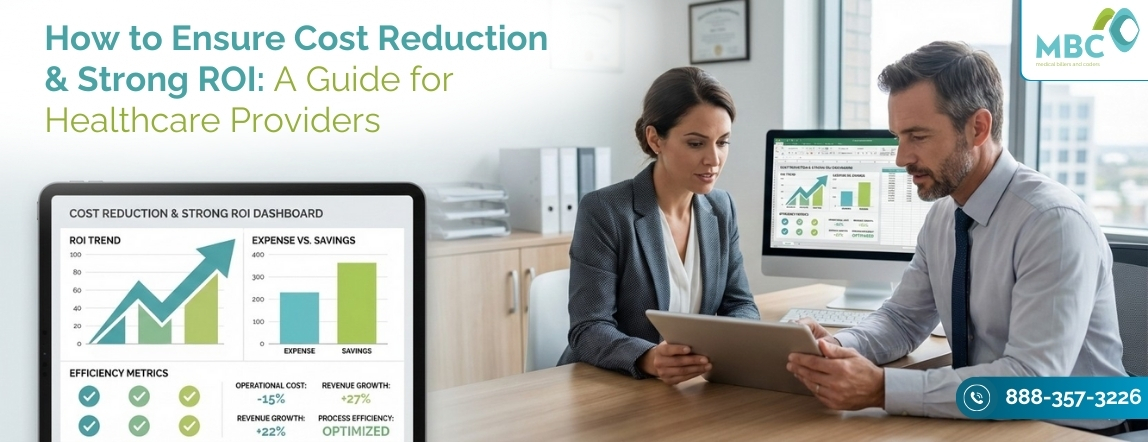
Cost Reduction and Strong ROI are the twin pillars of financial sustainability for healthcare providers navigating the complex reimbursement landscape of 2026. In the healthcare landscape of 2026, the traditional approach to Revenue Cycle Management (RCM) is no longer sufficient for survival.
With rising operational costs and increasingly sophisticated payer algorithms, independent practices and large health systems alike are facing a “triple threat” of inflation, declining reimbursement rates, and significant revenue leakage. For modern providers, achieving Cost Reduction and Strong ROI is not just a financial goal—it is a strategic necessity to defend your practice’s EBITDA and ensure long-term viability.
This guide outlines a transition from standard billing practices to a Revenue Integrity model, focusing on how specialized medical billing services can transform your financial health from the front desk to the final payment.
1. Redefining Metrics for Cost Reduction and Strong ROI
For years, the industry standard for a “healthy” billing department was a high Clean Claim Rate (CCR). However, in the current environment, a 98% Clean Claim Rate has become a vanity metric. A claim may be “clean” because it meets basic technical requirements, but that does not guarantee it will be paid at the full contracted rate.
To ensure Cost Reduction and Strong ROI, providers must shift their focus to Realized Yield and the True Net Collection Ratio (NCR).
- Net Collection Ratio (NCR): This measures what you actually collect versus what you are legally entitled to collect based on your payer contracts. According to the Centers for Medicare & Medicaid Services (CMS), accurate claim submission and comprehensive tracking are essential for maximizing reimbursement under the Medicare Claims Processing Manual guidelines. Top-performing systems achieve a 98.7% True Net Collection Ratio by implementing rigorous payer contract compliance protocols.
- Payer Variance Tracking: ROI is often lost in the gap between the “allowed amount” and the “paid amount.” As outlined in the CMS Claims Processing Manual, Chapter 1, Section 80.2.1, providers have the right to appeal underpayments and ensure accurate reimbursement based on contracted rates. Tracking these variances ensures you are paid 100% of your contracted rate, rather than just accepting whatever the payer’s automated system offers.
2. Defeating “Algorithmic Downcoding” to Protect Strong ROI
The primary reason many large medical groups are losing 4–7% of their annual revenue is a phenomenon known as Algorithmic Downcoding. Payers are now utilizing advanced Natural Language Processing (NLP) to scan clinical notes and auto-deny claims for “medical necessity” or “downcode” them to lower-reimbursing levels.
A strong ROI strategy requires out-computing these payer algorithms. You aren’t just being denied; you are being out-computed. According to the U.S. Department of Health and Human Services (HHS), providers have specific rights under federal regulations to challenge claim denials and seek appropriate reimbursement for medically necessary services.
By utilizing medical billing services that employ AI-powered appeal automation, providers can fight back. These “Appeal Bots” integrate directly with EHRs like Epic, Cerner, and Athena to identify and challenge these automated denials instantly, recovering revenue that would otherwise be lost to “hidden variance leakage.”
3. Achieving Cost Reduction through Technological Efficiency
Cost Reduction is most effectively achieved by lowering your Cost-to-Collect. For many organizations, manual workflows, repetitive tasks, and high staffing turnover make the cost of collecting revenue prohibitively expensive.
According to the U.S. Bureau of Labor Statistics (BLS), the median annual wage for Medical Records Specialists was $47,180 in 2024, with high turnover rates in the healthcare administrative sector adding significant replacement and training costs.
Strategic Revenue Integrity frameworks focus on three areas of efficiency:
- EHR-Agnostic Interoperability: You do not need to replace your existing technology; you need to optimize it. Integrating AI-driven tools into your current EHR can reduce the labor hours required for claim follow-up and appeals. The Office of the National Coordinator for Health Information Technology (ONC) emphasizes that interoperability standards can significantly reduce administrative burden and improve data exchange efficiency.
- Automated Appeal Workflows: According to the CAQH Index Healthcare Administrative Savings Report, automating eight core administrative tasks can save approximately $49.48 per patient encounter. By automating the identification and submission of appeals, practices have seen their cost-to-collect drop by as much as 18%. Electronic claim status inquiries cost only $1 to $2 compared to $12 to $16 for manual versions, demonstrating clear pathways to Cost Reduction and Strong ROI.
- Scalable Infrastructure: Partnering with an enterprise-scale provider that processes over $2.4B in annual claims allows even smaller practices to leverage “health system scale” technology without the massive upfront capital investment.
4. Protecting EBITDA and Strong ROI with Risk Mitigation
A strong ROI is meaningless if it is wiped out by a federal audit or a compliance penalty. Specialized medical billing services include a “shield” of compliance that protects your bottom line:
- Audit-Proof Infrastructure: According to CMS, providers must maintain comprehensive documentation and compliance protocols to defend against Recovery Audit Contractor (RAC) audits and potential payment recoupments. Proactive compliance scrubbing and RAC Audit Defense protocols protect your organization from federal clawbacks and “No Surprises Act” violations as mandated by the Consolidated Appropriations Act, 2021.
- Enterprise Credentials: Trust is built on security. The Health Insurance Portability and Accountability Act (HIPAA) Security Rule, as enforced by the HHS Office for Civil Rights, requires administrative, physical, and technical safeguards for Protected Health Information (PHI). Ensure your billing partner is SOC 2 Type II Certified and offers HIPAA Vault-Level Security to handle PHI with end-to-end encryption.
For a 40-provider orthopedic group, implementing this comprehensive framework resulted in a +$1.2M impact on EBITDA over 12 months, simply by recovering undetected downcoding and reducing operational friction.
5. Interactive Assessment for Cost Reduction and Strong ROI
To truly understand your potential for Cost Reduction and Strong ROI, you must first identify your current Revenue Leakage. Most groups that do not track NCR are losing an average of $180,000 annually per provider. You can use an Interactive Assessment tool to calculate your leakage based on:
- Total Annual Billings
- Current Denial Rate
- Specialty-specific benchmarks (e.g., Cardiology, Oncology, or Orthopedic Surgery)
A disciplined analysis usually reveals that 82% of identified leakage is recoverable through a transition to AI-driven revenue integrity.
Conclusion: From Outsourcing to Optimizing
The goal for healthcare providers in 2026 should not be to simply “outsource” their challenges, but to optimize their yield. By focusing on Realized Yield, combating algorithmic denials with advanced technology, and maintaining a rigorous compliance framework aligned with federal regulations, practices can reclaim revenue they have already earned.
With over 25 years of experience, Medical Billers and Coders (MBC) delivers enterprise-grade solutions designed to protect your EBITDA and help your practice thrive.
Ready to unlock the full potential of your revenue cycle?
Schedule your free strategy call with Medical Billers and Coders today and uncover hidden revenue opportunities.
FAQs
A: Algorithmic downcoding occurs when insurance payers use Artificial Intelligence and Natural Language Processing (NLP) to scan clinical notes and automatically deny or lower the reimbursement level of a claim. This process can lead to a hidden revenue loss of 4–7% annually, directly reducing your overall ROI and EBITDA.
A: While a high Clean Claim Rate (CCR) indicates technical accuracy, it is considered a vanity metric because it doesn’t guarantee full payment. The Net Collection Ratio (NCR) measures what you actually collect against what you are contractually owed, providing a true picture of your Realized Yield.
A: According to the CAQH Index, automation significantly lowers the “Cost-to-Collect” by replacing manual, time-consuming labor. Automating eight core tasks can save approximately $29.84 per patient encounter, while electronic claim status inquiries cost only $1 to $2 compared to $12 to $16 for manual versions.
A: To identify financial trends and bottlenecks early, providers should track Key Performance Indicators (KPIs) like Days in A/R and denial rates on a monthly basis. A comprehensive audit of the total Cost Reduction and Strong ROI strategy should be conducted quarterly.
Reference Links:
- Centers for Medicare & Medicaid Services (CMS) – Claims Processing Manual
- U.S. Bureau of Labor Statistics (BLS) – Occupational Outlook Handbook
- U.S. Department of Health and Human Services (HHS) – HIPAA Security Rule
- Office of the National Coordinator for Health Information Technology (ONC)
- CMS – Recovery Audit Contractor (RAC) Program

With almost 12 years of experience in healthcare revenue cycle management, this Revenue Cycle Specialist brings deep expertise in medical billing, claims optimization, and practice profitability. Shares industry-backed insights focused on improving collections, reducing denials, and driving operational excellence.