Specialities
 Services
 Resource Center
 Pricing
 About
About
 Contact

Incorrect modifier usage impacts preventive care billing by causing 22–35% denial rates on wellness visits with same-day problem evaluations, resulting in $1.2M to $2.8M annual revenue loss for multi-specialty practices collecting $3M+ monthly—not because services lack medical necessity, but because documentation fails to demonstrate the “significant, separately identifiable” service requirement Medicare Administrative Contractors and commercial payers demand when auditing Modifier 25 claims.
The Revenue Impact of Modifier 25 Documentation Failures
Multi-specialty practices performing 1,500–2,000 preventive visits per month incur systematic losses when 40–55% of patients present additional problems during wellness exams.
Revenue at Stake Per Encounter:
| Service | Reimbursement |
| Preventive visit (99396) | $185–$225 |
| Problem E/M with Modifier 25 (99213) | $130–$165 |
| Denied E/M – practice receives only | $185–$225 |
| Loss per denied claim | $130–$165 |
Annual Impact:
- 800 Modifier 25 denials monthly (32% denial rate)
- Monthly revenue loss: $104,000–$132,000
- Annual loss: $1,248,000–$1,584,000
Three Critical Modifier 25 Documentation Failures
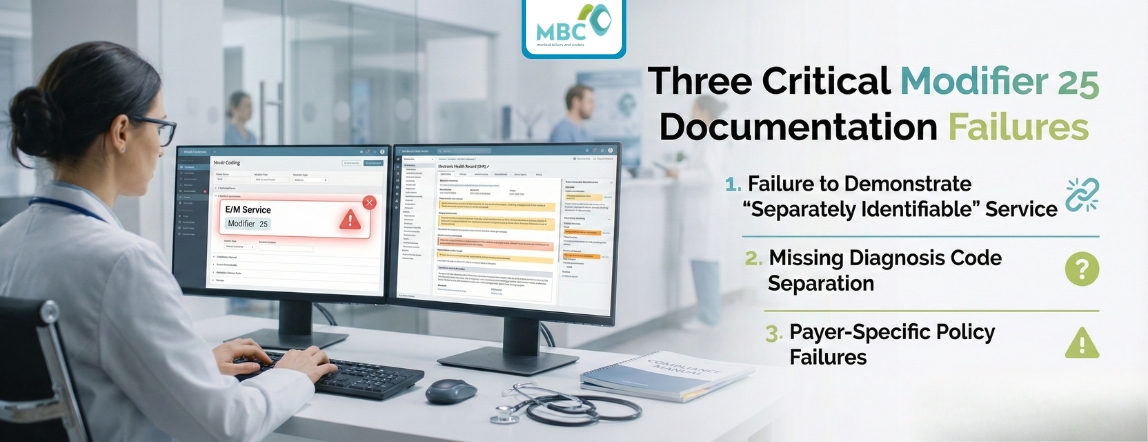
1. Failure to Demonstrate “Separately Identifiable” Service
The Problem: CMS requires problem-oriented E/M services to be “significant, separately identifiable” from preventive services.[^1]
What Auditors Require:
- A distinct chief complaint for the problem
- Organ-specific history of present illness
- Focused examination beyond the screening exam
- Medical decision-making for the specific issue
- Separate assessment and plan
Documentation That Fails Audit:
Annual Physical performed.
Patient also complaining of knee pain.
Exam: Constitutional normal, mild knee tenderness
Plan: Refer to orthopedics
Audit-Defensible Documentation:
ANNUAL PREVENTIVE EXAM:
[Complete preventive documentation]

SEPARATE EVALUATION: ACUTE RIGHT KNEE PAIN
Chief Complaint: Right knee locking × 2 weeks
HPI: Acute onset post-basketball, locking in flexion,
giving way on stairs, pain 6/10
Focused Exam: Joint line tenderness, positive McMurray's
MDM: Suspect meniscal tear, differential includes patellar
subluxation, loose body
Plan: X-ray, MRI if negative, ortho referral, crutches
Time: 15 minutes beyond preventive exam
Medical Billers and Coders trains providers using EHR templates that visually separate preventive from problem documentation, reducing denials from 32% to <5%.
2. Missing Diagnosis Code Separation
The Problem: Services linked to identical diagnosis codes appear duplicative.
Correct Linking:
| Service | CPT Code | Diagnosis |
| Preventive exam | 99396 | Z00.00 (Health examination) |
| Problem E/M | 99213-25 | M25.561 (Knee pain), M23.261 (Meniscal tear) |
Revenue Impact:
- 40–55% denial rate with improper diagnosis linking
- For 800 monthly claims: $416,000–$726,000 annual revenue at risk
3. Payer-Specific Policy Failures
Commercial Payer Variation:
Medicare:
- Pays the full amount for both services with proper documentation
- High audit rate requiring meticulous separation
UnitedHealthcare:
- Applies a 25–50% payment reduction to problem E/M
- Expected $130 E/M reduced to $65–$98
Blue Cross Blue Shield:
- Some plans bundle E/M into preventive payment entirely
- Zero additional payment regardless of documentation
Revenue Gap:
- 600 commercial encounters monthly
- Payer policy failures: $48,000–$78,000 monthly
- Annual loss: $576,000–$936,000
Medical Billers and Coders maintain real-time payer policy databases, ensuring billing aligns with payer-specific requirements.
The G2211 Complexity Add-On Opportunity
As of January 1, 2025, CMS allows G2211 (complexity add-on) with Modifier 25 for ongoing longitudinal care.[^3]
Revenue Opportunity:
- G2211 adds $16–$22 per appropriate encounter
- 600 qualifying encounters monthly
- Monthly additional revenue: $9,600–$13,200
- Annual revenue: $115,200–$158,400
Requires Documentation: “Patient requires ongoing coordination between endocrinology, nephrology, ophthalmology for diabetic complications; care plan integrates input from multiple specialists addressing polypharmacy risks.”
Infrastructure Solutions
Real-Time Documentation Quality Monitoring
EHR alerts at the point of service:
- Alert when the problem qualifies for Modifier 25
- Prompt for separate HPI, exam, and MDM documentation
- Validate completeness before encounter closure
Result: Denials reduced from 32% to <5% within 90 days
Pre-Submission Claim Scrubbing
Automated quality checks verify:
- Modifier 25 appended to problem E/M
- Different diagnosis codes linked
- Separate documentation sections present
- Medical necessity demonstrated
Medical Billers and Coders configure claim scrubbing to prevent $1.2M–$2.8M in annual preventable denials.
Recover $1.2M–$2.8M in Lost Preventive Care Revenue
If your multi-specialty practice collects $3M+ monthly and experiences systematic Modifier 25 denials, incorrect modifier usage costs you $1.2M to $2.8M annually in revenue that properly documented services should generate. Medical Billers and Coders’ Preventive Care Billing Optimization delivers audit-defensible documentation templates that ensure the “separately identifiable” standard, automated claim scrubbing that flags errors before submission, payer-specific policy integration to prevent payment surprises, and G2211 complexity add-on capture, resulting in $115,200–$158,400 in annual savings.
Request your Preventive Care Billing Diagnostic to identify exact revenue leakage from modifier failures and operational issues, enabling the fastest recovery. Contact Medical Billers and Coders today to eliminate preventable Modifier 25 denials while maintaining CMS compliance.
Frequently Asked Questions
Incorrect modifier usage creates three revenue losses: immediate claim denial when documentation fails the “separately identifiable” test ($1,248,000–$1,584,000 annually for practices with 800 monthly denials), commercial payer payment reductions of 25–50% without policy awareness ($576,000–$936,000 annually), and audit-triggered recoupment of previously paid services. Medical Billers and Coders prevent losses through documentation templates, payer policy integration, and pre-audit compliance reviews.
Separate documentation must include a distinct chief complaint, an organ-specific HPI, a focused exam beyond screening, medical decision-making for the problem, and an explicit assessment/plan. Auditors use “clip test”—if problem section reads as complete E/M service independently, it passes; if it relies on preventive documentation, it fails.
No. Medicare pays the full amount with adequate documentation, but conducts frequent audits. Commercial payers apply 25–50% reductions in payment or bundle services entirely. Medical Billers and Coders verify payer policies before service delivery.
Embedding problem evaluation within the preventive exam without separate sections. Fix requires EHR subheadings like “SEPARATE EVALUATION: ACUTE KNEE PAIN” with complete problem-oriented documentation, including chief complaint, HPI, focused exam, MDM, and management plan.
G2211 can be billed with Modifier 25 for ongoing longitudinal chronic care requiring coordination across specialists. Documentation must explicitly state complexity elements. Adds $16–$22 per encounter, totaling $115,200–$158,400 annually for 600 monthly qualifying visits.
References
- Centers for Medicare & Medicaid Services (CMS). (2024). Medicare Claims Processing Manual, Chapter 12, Section 30.6.1.
- Centers for Medicare & Medicaid Services (CMS). (2024). CY 2025 Physician Fee Schedule Final Rule – G2211.

Catering to more than 40 specialties, Medical Billers and Coders (MBC) is proficient in handling services that range from revenue cycle management to ICD-10 testing solutions. The main goal of our organization is to assist physicians looking for billers and coders, at the same time help billing specialists looking for jobs, reach the right place.