Specialities
 Services
 Resource Center
 Pricing
 About
About
 Contact
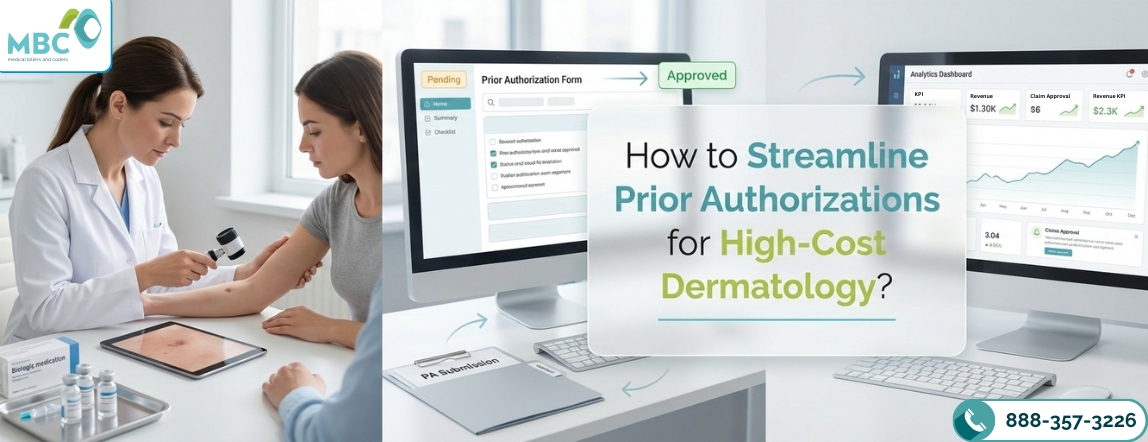
Streamlining prior authorizations for high-cost dermatology requires implementing electronic prior authorization (ePA) workflows, AI-powered payer communication platforms, and specialized denial root-cause engineering protocols—because dermatology practices collecting $1M–$5M+ monthly lose $1.2M–$3.4M annually to the 51% denial rate on complex biologic requests, 12-day median approval delays creating patient abandonment, and 3.5 hours daily staff time consumed by manual PA processing that directly suppresses EBITDA and net realized revenue growth.
For high-volume dermatology practices, prior authorization bottlenecks constitute the largest controllable revenue-cycle inefficiency. Understanding how to systematically eliminate these delays is essential to protecting financial performance metrics.
The Financial Impact of Prior Authorization Delays
Total Medicare dermatology drug spending increased from $768 million in 2013 to $2.95 billion in 2022—a 384% increase driven almost entirely (98.4%) by specialty medications despite representing less than 3% of prescriptions.
Table 1: Prior Authorization Revenue Impact by Practice Volume
| Monthly Collections | Biologic Patient Volume | Avg. PA Denial Rate | Annual Denied Revenue | Staff Time Cost (3.5 hrs/day) | Total Annual Impact |
| $1M–$2M | 40–60 patients | 51% | $1.2M–$1.8M | $182,000 | $1.38M–$1.98M |
| $2M–$3M | 80–120 patients | 51% | $2.0M–$2.8M | $273,000 | $2.27M–$3.07M |
| $3M–$5M+ | 150–240 patients | 51% | $3.2M–$4.8M | $364,000 | $3.56M–$5.16M |
EBITDA Compression:
According to research published by the National Institutes of Health, complex dermatology PA requests face denial rates as high as 51%, with 12% patient abandonment and 17% of cases requiring less effective alternative treatments.
Risk mitigation requires a systematic redesign of the PA workflow rather than incremental process improvements.
Four Technological Efficiency Solutions for PA Streamlining
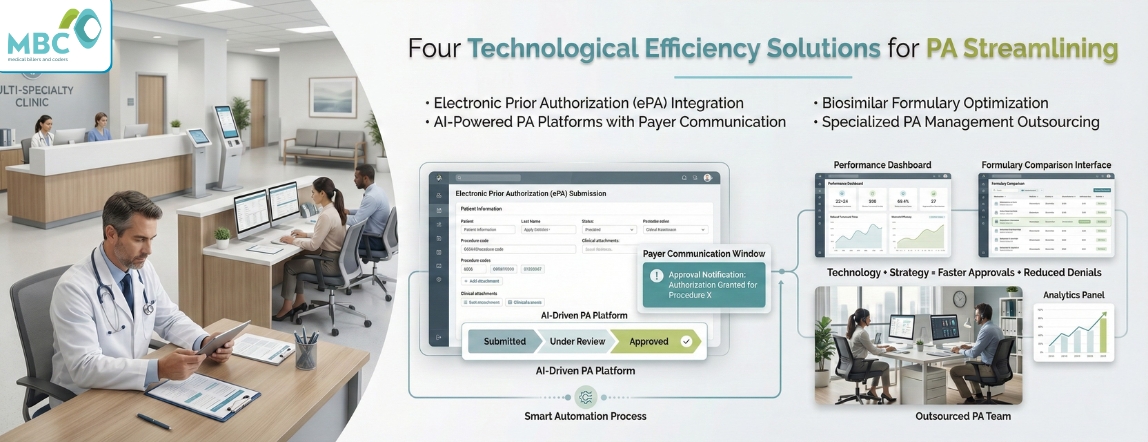
1. Electronic Prior Authorization (ePA) Integration
Manual fax-based PA submissions consume 3.5 hours daily per staff member. Electronic platforms reduce approval timelines by 25% through direct EHR-to-payer integration.
ePA Workflow Advantages:
- Real-time payer formulary checking at prescribing
- Auto-populated clinical documentation from EHR
- Automated status tracking eliminates phone follow-up
- Digital appeals with structured resubmission
Financial Performance Metrics Impact:
For practice processing 80 monthly biologic PAs:
- Manual process: 3.5 hours × 22 workdays × $35/hour = $2,695 monthly
- ePA process: 1.2 hours × 22 workdays × $35/hour = $924 monthly
- Monthly savings: $1,771
- Annual staff efficiency gain: $21,252
2. AI-Powered PA Platforms with Payer Communication
Technological efficiency through AI platforms provides:
- Real-time PA status monitoring across all payers
- Predictive approval probability scoring
- Automated payer outreach for pending requests
- Clinical documentation gap identification
Payer Variance Detection Benefits:
Different payers have widely varying PA requirements for identical biologics. AI platforms track:
- Which clinical data points does each payer requires
- Historical approval/denial patterns by payer
- Step therapy sequence variations
- Appeal success rates by denial reason
Medical Billers and Coders’ 25+ years of dermatology billing experience enable AI-assisted PA management without requiring changes to the EMR system.
3. Biosimilar Formulary Optimization
The introduction of interchangeable biosimilars like Cyltezo® for Humira® offers lower-cost alternatives with reduced PA friction.
Strategic Biosimilar Utilization:
| Brand Biologic | Biosimilar Alternative | PA Approval Timeline | Cost Reduction | Revenue Impact |
|---|---|---|---|---|
| Humira (adalimumab) | Cyltezo, Amjevita | 3–5 days vs. 12 days | 30–40% | Faster patient start |
| Enbrel (etanercept) | Erelzi, Eticovo | 4–6 days vs. 10 days | 25–35% | Reduced abandonment |
| Remicade (infliximab) | Inflectra, Renflexis | 3–5 days vs. 9 days | 30–45% | Improved cash flow |
Net Realized Revenue Growth Strategy:
Biosimilar utilization reduces both PA denial rates and approval timelines while maintaining clinical outcomes—creating dual revenue protection through faster patient therapy initiation and lower payer resistance.
4. Specialized PA Management Outsourcing
Root-cause analysis of denials reveals that 60% of dermatologists interrupt patient visits to address PA demands, thereby directly reducing billable encounter capacity.
Outsourced PA Management Benefits:
- Dedicated PA specialists handling all payer communication
- 24–48 hour response times vs. internal 5–7 day backlogs
- Appeal preparation expertise increases overturn rates from 35% to 72%
- Provider time recaptured for clinical revenue generation
Provider Capacity Recovery:
When PA interruptions are eliminated:
- Average provider sees 2 additional patients daily
- Each additional encounter generates $180–$280 (E/M + procedures)
- Monthly additional revenue per provider: $7,920–$12,320
- Annual capacity-based revenue recovery: $95,040–$147,840
The 2026 CMS Documentation Requirements
According to the CMS 2026 Physician Fee Schedule updates, tighter documentation expectations now apply to specialty medication medical necessity justification.
Required Documentation Elements:
For Dupixent (atopic dermatitis):
- IGA score ≥3 documented within 60 days
- Failed conventional therapy documented (topicals + immunosuppressant)
- Disease impact on quality of life (DLQI score)
- Photographic evidence of active disease
For Skyrizi/Tremfya (psoriasis):
- PASI score ≥10 or BSA ≥10%
- Failed methotrexate or phototherapy (minimum 3 months each)
- Contraindication documentation if step therapy is not completed
- Specialist attestation for off-label indications
Payer Variance Detection Requirement:
While CMS establishes Medicare standards, commercial payers maintain proprietary criteria. UnitedHealthcare may require different documentation than Aetna for identical biologics, creating systematic denials when practices use generic PA templates.
Medical Billers and Coders maintains up-to-date payer-specific PA requirement matrices, resulting in first-submission approval rates of 88–92%, compared with the industry average of 49%.
Eliminate $1.2M–$3.4M in Annual PA-Related Revenue Loss
If your dermatology practice is collecting $1M–$5M+ monthly experiences systematic prior authorization delays, denials, or patient abandonment on high-cost biologics, inefficient PA workflows are costing you $1.2M–$3.4M annually in denied revenue, staff time consumption, and lost provider capacity.
Medical Billers and Coders, the leading medical billing company in the USA with 25+ years of specialized Dermatology Billing Services experience, streamlines prior authorizations for high-cost dermatology through comprehensive Dermatology Billing Services, Medical Billing Services, Old AR Recovery, RCM Services, and Denial Management Services—all managed by a dedicated account manager using your existing EMR without system changes.
Our prior authorizations for high-cost dermatology infrastructure implement electronic prior authorization workflows, reducing approval timelines 25%. AI-powered payer communication platforms provide real-time status tracking, denial root-cause analysis, identification of payer-specific documentation gaps, and payer-specific variance-detection protocols, ensuring that submissions align with each payer’s proprietary requirements.
With a proven 30% A/R reduction across dermatology specialties, our streamlined prior authorizations for high-cost dermatology processes deliver net realized revenue growth, recoup provider clinical capacity, protect EBITDA from PA staff time, and achieve 88–92% first-submission approval rates.
Request your Prior Authorization Efficiency Assessment to quantify exact revenue losses from PA delays, denials, and staff time across your biologic patient population and identify which technological efficiency solutions deliver the fastest revenue recovery.
Contact Medical Billers and Coders today to implement prior authorizations for high-cost dermatology infrastructure, thereby eliminating bottlenecks and maximizing access to biologic therapies for your patients.
Frequently Asked Questions
Prior authorizations reduce dermatology revenue through high biologic denial rates, 12-day approval delays that lead to patient attrition, and significant staff time diverted from billable activities, resulting in substantial annual losses.
Denials are high because each payer requires different step-therapy documentation, severity scoring (PASI, IGA, DLQI), and detailed documentation; submissions that don’t match payer-specific criteria are frequently rejected.
Median approval time is approximately 12 days for complex biologics, whereas biosimilars such as Cyltezo are often approved within 3–5 days, thereby significantly improving therapy initiation timelines.
Practices should request a clear denial reason, submit a targeted appeal with supporting clinical evidence, and escalate to peer-to-peer review, which significantly increases approval rates when the denial cause is directly addressed.
Biosimilars lower drug costs, face less payer resistance, and achieve faster approvals, helping practices accelerate treatment initiation, reduce abandonment, and stabilize cash flow.
References
- National Library of Medicine. (2024). Medicare dermatology drug spending trends. PubMed.
- National Institutes of Health. (2024). Prior authorization impact on dermatology patient outcomes. NIH Research Publications.
- Centers for Medicare & Medicaid Services. (2026). Physician Fee Schedule Final Rule: Specialty Medication Documentation Requirements.

Catering to more than 40 specialties, Medical Billers and Coders (MBC) is proficient in handling services that range from revenue cycle management to ICD-10 testing solutions. The main goal of our organization is to assist physicians looking for billers and coders, at the same time help billing specialists looking for jobs, reach the right place.