Specialities
 Services
 Resource Center
 Pricing
 About
About
 Contact
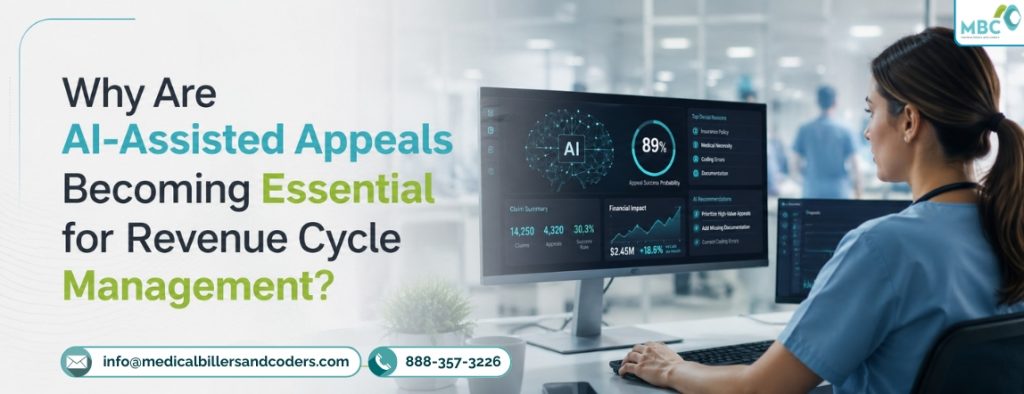
AI-assisted appeals are becoming essential for Revenue Cycle Management because they cut the time it takes to challenge a claim denial from weeks to hours, while pulling the exact payer policy and medical necessity language that gets denials overturned.
As Medicare Advantage plans lean harder on automated tools to deny claims, practices need equally fast tools to fight back, and that shift is exactly what is reshaping denial management and appeals across every specialty in 2026.
The Denial Problem AI-Assisted Appeals Are Solving
Insurers are not hiding their use of automation anymore. Medicare Advantage organizations made close to 53 million prior authorization determinations in a single recent year, denying roughly 4.1 million of them.
Only a small share of denied patients or providers ever filed an appeal, yet when they did, the vast majority of those denials were overturned. That gap between how often denials get appealed and how often they get reversed is the entire business case for AI-assisted appeals.
A federal watchdog report released earlier this year found that a group of Medicare Advantage organizations denied roughly one in eight requests for skilled nursing facility admission, and when patients appealed, nearly all of those denials were reversed.
That pattern repeats across post-acute care, imaging, and specialty drug categories. The denials are not random; they are often generated or supported by the same kind of algorithmic screening tools payers use to process claims at scale, which means providers appealing by hand are, in effect, fighting software with spreadsheets.
Why Manual Appeals Can’t Keep Up Anymore
A manual appeal typically means a biller or coder pulling the chart, reading the denial code, searching for the right LCD or NCD reference, drafting a letter, and tracking the resubmission deadline, often two to four hours of work per claim.
Multiply that across a practice generating dozens of denials a week and the math stops working. Staff either fall behind, or they triage, appealing only the highest-dollar claims and writing off the rest. That written-off revenue rarely gets reported anywhere, but it shows up quietly in a shrinking Net Collection Ratio.
AI-assisted appeals compress that entire workflow. The system reads the denial reason code, cross-references it against payer-specific medical policy and CMS coverage criteria, pulls supporting documentation from the chart, and drafts a citation-backed appeal letter in minutes instead of hours. Staff still review and approve before submission, but the heavy research work is already done.
What’s Changing on the Regulatory Side in 2026
CMS finalized new prior authorization rules that took effect January 1, 2026, requiring impacted payers to give specific, understandable reasons for every denial rather than vague boilerplate language. Standard decisions must be issued within seven calendar days and expedited decisions within 72 hours.
CMS has also stated directly that payers may use algorithms to assist coverage decisions, but a Medicare Advantage organization cannot base a denial solely on an algorithm without accounting for the individual patient’s medical history and circumstances.
That is a meaningful shift for providers. Specific denial reasons give AI-assisted appeals tools cleaner, more structured data to work with, which means faster, more targeted rebuttals instead of generic form letters.
Several states have gone further, requiring clinician review before an automated denial can stand, which strengthens a provider’s hand whenever a denial looks templated rather than individualized.
Manual Appeals vs. Automated Appeals, Side by Side
The table below breaks down where the real time and revenue differences show up.
| Aspect | Manual Appeals Process | AI-Assisted Appeals |
| Turnaround Time | 3-6 weeks per appeal | 24-72 hours for draft generation |
| Denial Reason Matching | Manual chart review, prone to gaps | Automated match to LCD/NCD and payer policy |
| First-Level Success Rate | Often below 50%, varies by staff | Higher overturn rate with structured evidence |
| Staff Hours per Appeal | 2-4 hours of biller or coder time | 20-30 minutes of review and submission |
| Documentation Consistency | Depends on individual staff knowledge | Standardized, citation-backed appeal letters |
Where This Fits Into a Bigger RCM Strategy
AI-assisted appeals work best as one piece of a broader denial management and appeals strategy, not a standalone fix. Practices still need clean front-end documentation, accurate coding, and eligibility verification to keep denial volume down in the first place.
For the denials that do happen, treating appeals as an automated, trackable workflow rather than a manual afterthought is what separates practices that recover revenue from practices that quietly absorb the loss.
This is also where outsourced medical billing services earn their keep. Full-service medical billing and coding services that build AI-assisted appeals into their standard denial workflow catch revenue that in-house teams, stretched thin across scheduling, coding, and collections, often do not have the bandwidth to chase down.
Getting Started With a Revenue Integrity Partner
Protecting revenue from AI-driven denials starts with an honest look at how many appealable dollars are currently going unappealed.
Medical Billers and Coders (MBC) acts as a revenue integrity partner for physician groups, ASCs, and specialty practices, building AI-assisted appeals directly into denial management and appeals workflows so fewer dollars get written off and fewer staff hours get burned on paperwork.
Full engagement details, including current service plans and pricing, are available for practices ready to see where their appeal gaps are costing the most.
Request a Denial & Appeals Revenue Review
MBC’s Revenue Cycle Management team will review 90 days of your denial history, identify which claims had appeal potential, and show exactly where AI-assisted appeals could have recovered revenue that was written off.
Call 888-357-3226 or email info@medicalbillersandcoders.com to schedule your Denial & Appeals Revenue Review.
FAQs: AI-Assisted Appeals
AI-assisted appeals use machine learning tools to read denial codes, match them against payer policy and medical necessity criteria, and generate structured appeal letters with supporting documentation, cutting the manual research time billing staff normally spend on each claim.
Federal data shows a large share of appealed Medicare Advantage denials get overturned once the right documentation is presented. AI-assisted appeals improve those odds by pulling the exact policy citations and clinical evidence payers look for, instead of a generic rebuttal letter.
Yes, within limits. CMS has clarified that algorithms may assist coverage decisions, but Medicare Advantage organizations cannot base a denial solely on an algorithm without accounting for a patient’s individual circumstances and medical records.
Under CMS-0057-F, impacted payers must give specific, understandable reasons for prior authorization denials and meet defined response timeframes. That specificity gives providers cleaner data to build faster, stronger appeals.
Practices of any size benefit, since the tool mainly saves staff time and prevents missed deadlines. A lean billing team often has the most to gain, since it cannot absorb hours of manual appeal work per denied claim.

With almost 12 years of experience in healthcare revenue cycle management, this Revenue Cycle Specialist brings deep expertise in medical billing, claims optimization, and practice profitability. Shares industry-backed insights focused on improving collections, reducing denials, and driving operational excellence.