Specialities
 Services
 Resource Center
 Pricing
 About
About
 Contact
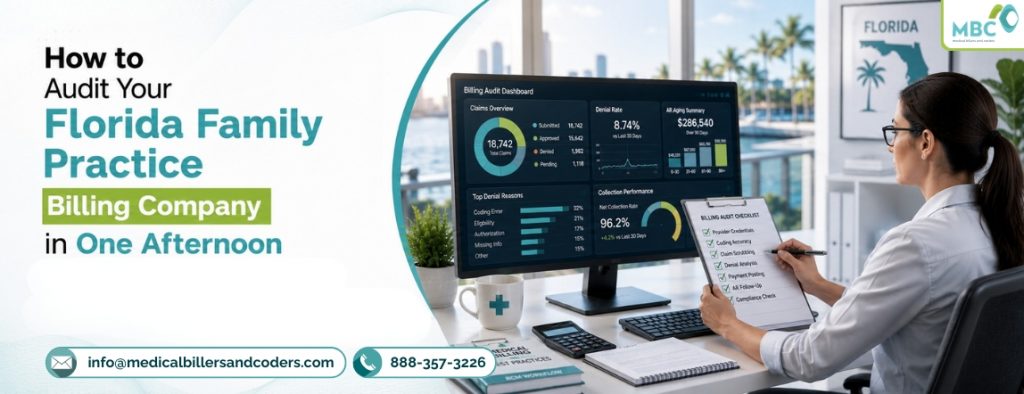
You can audit your Florida family practice billing company in one afternoon — and the four reports you pull will tell you whether your vendor is protecting your net realized revenue or quietly absorbing it through E/M undercoding, missed CCM capture, Florida Medicaid managed care routing errors, and prior authorization denials aging into permanent write-offs.
Most Florida family practice owners discover billing company failures at the wrong moment: when an NCR below 88% surfaces during a payer contract renegotiation, or when a 90-day AR spike triggers a write-off conversation that should have been a recovery conversation 60 days earlier. The audit below surfaces those failures on a Tuesday afternoon — before they become an annual revenue event.
What You Need Before You Start
Pull four reports from your practice management system: a Year-to-Date Collections by Payer report; a Current AR Aging report segmented by payer and 0–30, 31–60, 61–90, and 90-plus day buckets; a Denial Summary report for the trailing 90 days segmented by denial reason code; and a CPT Frequency report for the trailing six months showing your top 20 billed procedure codes with average reimbursement per code.
If your billing company cannot produce all four within 24 hours of request, that is the first audit finding — and it requires no further analysis.
Step 1 — Run the E/M Coding Distribution Test (30 Minutes)
Find the distribution of office visit E/M codes in your CPT Frequency report: 99212 through 99215 for established patients. In a family practice with mixed adult chronic disease volume, the expected established patient distribution is approximately 5% at 99212, 35% at 99213, 45% at 99214, and 15% at 99215.
If your distribution shows more than 50% at 99213 and fewer than 10% at 99215, your billing company is undercoding — applying documentation-volume logic instead of Medical Decision Making complexity as the 2021 AMA revision requires. At $35 to $65 per undercoded Level 4 or Level 5 visit across 600 monthly complex encounters, the gap runs $252,000 to $468,000 per 12 months — and generates zero denials. It appears only in the CPT distribution, which is why most practice owners never look at it.
Florida-specific flag: Florida’s Medicare Advantage penetration is among the highest of any state. Undercoded visits in MA encounters are not just a revenue loss — they are a RAF score suppression event that reduces capitation-based revenue in value-based care arrangements simultaneously.
Step 2 — Run the CCM Capture Rate Test (20 Minutes)
Pull total claims submitted under CPT 99490, 99487, and 99439 in the trailing six months. Divide by the number of Medicare patients with two or more chronic conditions in your EHR’s chronic disease registry. The result is your CCM capture rate.
Above 80% indicates functional CCM billing infrastructure. Below 60% indicates a manual CCM process with inconsistent submission — the most common configuration in Florida family practices using generalist billing vendors without CCM-specific workflow integration.
At $62 to $66 per patient per month for CPT 99490 and $130 to $137 for CPT 99487, a Florida family practice with 180 CCM-eligible Medicare patients at a 55% capture rate is leaving $67,000 to $146,000 per 12 months in uncaptured revenue on the table — revenue CMS specifically created to compensate family practices for chronic disease coordination time physicians are already delivering.
Step 3 — Run the Florida Medicaid Managed Care Denial Test (25 Minutes)
Filter your Denial Summary for Florida Medicaid managed care payers: Humana Medicaid, Molina Healthcare of Florida, Simply Healthcare, Sunshine Health, and Florida Complete Care. Calculate the denial rate as a percentage of submitted claims for each plan separately.
A denial rate above 10% on any single Florida Medicaid managed care plan is a plan-specific billing infrastructure failure — not a general Medicaid collections challenge. Florida’s Medicaid managed care plans each operate under distinct prior authorization requirement lists, referral authorization structures, and preventive service billing rules that differ materially from the statewide Medicaid fee schedule. A billing company applying uniform Medicaid billing logic across all five plans generates plan-specific denial patterns that look like Medicaid volatility — but are payer-specific routing errors with defined correction paths.
For how these denial patterns compare to broader prior authorization trends, see Prior Auth Denial Trends 2026 and Florida Medical Billing Services.
Step 4 — Run the 90-Day AR Write-Off Test (25 Minutes)
Identify the total balance in your 90-plus day AR bucket by payer. Then ask your billing company one question: of the claims in the 90-plus day bucket, what percentage have been actively worked in the trailing 30 days — meaning a denial appeal filed, a corrected claim submitted, or a peer-to-peer review requested?
The standard for an actively managed AR is 85% or more of the 90-plus day bucket worked in the trailing 30 days. If your billing company cannot produce a worked-claims percentage with documentation, the 90-plus day bucket is a write-off queue — not a recovery workflow. A Florida family practice carrying $300,000 in 90-plus day AR with a 40% active-work rate is accepting $180,000 in potential permanent write-offs without a structured Old AR Recovery audit determining which portion is genuinely uncollectable and which has a defined correction path.
For how billing company red flags surface in AR aging reports, see Medical Billing Company Red Flags and Questions Every Family Practice Should Ask Before Hiring a Billing Company.
What Your Audit Results Mean
If your E/M distribution is bottom-heavy, your CCM capture rate is below 70%, your Florida Medicaid managed care denial rate exceeds 10% on any plan, or your 90-plus day AR active-work rate is below 85% — you are not dealing with a billing market challenge. You are dealing with a billing company performance gap with a defined revenue cost and a defined corrective action.
How MBC Closes Florida Family Practice Billing Gaps
MBC’s Family Practice Billing Services for Florida practices delivers MDM-accurate E/M coding, CCM workflow integration, Florida Medicaid managed care plan-specific billing logic for all five major plans, and Old AR Recovery as a standard service — not a project fee. Our system-agnostic RCM Services infrastructure operates independently of your EHR platform, and our dedicated account manager reports Yield EBITDA monthly by revenue category — E/M coding distribution, CCM capture rate, Medicaid managed care denial rate by plan, and 90-day AR active-work rate — as standard monthly performance indicators, not as an afternoon discovery exercise.
With MBC’s 97% clean claim rate and proven 30% A/R reduction within 90 days, Florida family practices that complete this four-step audit and transition to MBC recover an average of $180,000 to $420,000 per 12 months in revenue their previous billing company was systematically missing.
Practices completing MBC’s Complimentary 90-Day AR Diagnostic receive all four audit reports analyzed against Florida-specific family practice benchmarks — with a documented gap analysis, a revenue recovery estimate, and a 90-day correction roadmap delivered before the next billing cycle closes.
Request Your Free Revenue Diagnostic — contact us at info@medicalbillersandcoders.com or call 888-357-3226.
Medical Billing Services | medicalbillersandcoders.com | 888-357-3226
Frequently Asked Questions
Q1. How do I know if my Florida family practice billing company is undercoding E/M visits?
Pull a CPT Frequency report for the trailing six months and examine the established patient E/M distribution across 99212 through 99215. If more than 50% of established patient visits are coded at 99213 and fewer than 10% at 99215, your billing company is applying documentation-volume logic rather than Medical Decision Making complexity — systematically undercoding your highest-revenue encounter types without generating a single denial.
Q2. What is a healthy CCM capture rate for a Florida family practice?
A CCM capture rate above 80% of qualifying Medicare patients — those with two or more chronic conditions who have provided documented consent — indicates functional CCM billing workflow integration. A capture rate below 60% indicates a manual process with inconsistent submission, typically producing $67,000 to $146,000 per 12 months in uncaptured revenue for a practice with 180 eligible Medicare patients.
Q3. Why do Florida Medicaid managed care plans generate higher denial rates than traditional Medicaid?
Florida’s five major Medicaid managed care plans — Humana Medicaid, Molina, Simply Healthcare, Sunshine Health, and Florida Complete Care — each operate under plan-specific prior authorization lists, referral structures, and preventive service billing rules that differ materially from the statewide Medicaid fee schedule. A billing company applying uniform Medicaid billing logic across all five plans generates plan-specific denial patterns that have defined correction paths — but only if the billing team is trained on each plan’s individual requirements.
Q4. What percentage of 90-plus day AR should be actively worked each month?
A billing company managing AR correctly works 85% or more of the 90-plus day bucket within any trailing 30-day period — meaning denial appeals filed, corrected claims submitted, or peer-to-peer reviews requested on the majority of aging claims. Any active-work rate below 70% indicates a passive write-off queue rather than a structured Old AR Recovery workflow, and it warrants an immediate audit of which aging claims have recoverable correction paths before their payer filing windows close.
Q5. How long does a Florida family practice billing audit take to complete?
The four-step audit described in this guide — E/M coding distribution test, CCM capture rate test, Florida Medicaid managed care denial test, and 90-day AR write-off test — takes approximately two hours using reports your practice management system already generates. The bottleneck is not the analysis time; it is whether your billing company can produce all four required reports within 24 hours of request, which is itself a performance indicator worth tracking.
Family Practice Billing Services in Florida
Phone: 888-357-3226Fax: 888-316-4566
Email: sales@medicalbillersandcoders.com

Catering to more than 40 specialties, Medical Billers and Coders (MBC) is proficient in handling services that range from revenue cycle management to ICD-10 testing solutions. The main goal of our organization is to assist physicians looking for billers and coders, at the same time help billing specialists looking for jobs, reach the right place.