Specialities
 Services
 Resource Center
 Pricing
 About
About
 Contact
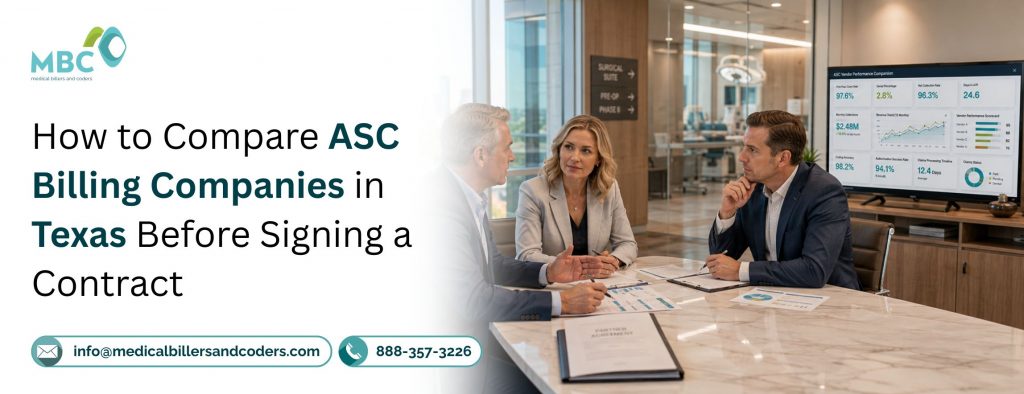
Comparing ASC billing companies in Texas before signing a contract is not a price-per-claim exercise — it is a structured operational audit that reveals whether the vendor can handle Texas’s specific ASC payer complexity before an 18-to-24-month contract locks your surgery center into the same implant revenue leakage, prior authorization denial pattern, and payer variance exposure your current billing workflow is already producing.
Texas ASCs operate in one of the most concentrated ambulatory surgical markets in the country. Houston, Dallas-Fort Worth, San Antonio, and Austin each carry high-density orthopedic, spine, ophthalmologic, and multi-specialty ASC markets where BlueCross BlueShield of Texas, UnitedHealthcare, Aetna, and Humana apply payer-specific ASC facility fee contract terms, prior authorization requirement lists, and implant reimbursement structures that differ materially from their national policy frameworks. A billing company without Texas-specific ASC payer infrastructure produces preventable denial patterns on every billing cycle — and reports them as market volatility rather than correcting them as plan-specific routing failures.
This guide provides the structured comparison framework every Texas ASC administrator and CFO should apply before signing a billing contract in 2026.
The Six Criteria That Separate High-Performing Texas ASC Billing Companies From Adequate Ones
Criterion 1 — Texas-Specific Payer Contract Knowledge
The correct capability: documented billing infrastructure for BCBS of Texas, UnitedHealthcare, Aetna, Humana, and Texas Medicaid managed care plans — with ASC-specific facility fee contract terms mapped by procedure category, payer-specific implant reimbursement thresholds documented by CPT and HCPCS code, and prior authorization requirement lists updated continuously by Texas payer and procedure code.
What inadequate looks like: a billing company applying national payer policy to Texas ASC contracts. BCBS of Texas ASC facility fee contracts differ from BCBS national ASC policy on multi-procedure discounting rules, implant cost passthrough thresholds, and prior authorization requirements for high-acuity orthopedic and spine cases. A billing company applying BCBS national policy to BCBS of Texas ASC claims generates systematic underpayment and denial patterns on every claim affected by the Texas-specific contract deviation — without generating a Texas-specific alert.
How to evaluate: ask the vendor to produce its current BCBS of Texas ASC facility fee contract summary, its UnitedHealthcare Texas ASC prior authorization requirement list by procedure category, and its Texas Medicaid managed care ASC coverage policy for your facility’s top 10 procedure codes. A vendor that cannot produce all three documents within 48 hours does not have Texas-specific ASC payer infrastructure.
Criterion 2 — Implant Revenue Capture Infrastructure
The correct capability: real-time OR log integration capturing implant use at case completion, automated invoice reconciliation against Texas payer-specific implant reimbursement thresholds, and concurrent implant claim submission with the facility fee claim. BCBS of Texas and UnitedHealthcare each apply distinct implant cost passthrough mechanisms that differ from CMS ASC implant separately payable rules.
What inadequate looks like: a billing company capturing implant costs from physician-submitted implant logs rather than OR system integration. Physician-submitted logs produce a 10% to 18% capture failure rate at high-volume orthopedic and spine ASCs — driven by documentation lag, implant substitution at the time of surgery, and multi-implant case complexity that manual log submission consistently underreports.
Revenue at risk: a Texas ASC performing 150 orthopedic and spine cases monthly with a 12% implant capture failure rate loses $259,200 to $648,000 per 12 months in unbilled implant costs. At a 4-OR Texas ASC performing 250 cases monthly, the implant capture gap runs $432,000 to $1,080,000 per 12 months — invisible on denial reports because no claim was submitted for the unbilled implant.
Criterion 3 — Prior Authorization Management for Texas High-Revenue Surgical Cases
The correct capability: real-time PA requirement tracking by Texas payer and procedure code — updated continuously, not quarterly — with proactive authorization follow-up before the case date, 24-hour denial triage classifying every PA denial by failure mechanism, and structured appeal workflows distinguishing authorization expiration denials from mismatch denials from clinical medical necessity denials.
What inadequate looks like: a billing company managing PA reactively — submitting authorization requests when physicians order them, tracking status through a shared spreadsheet, and filing all PA denials through a standard appeal path. In Texas, where UnitedHealthcare and BCBS of Texas have expanded PA requirements on orthopedic, spine, and ophthalmologic cases materially since 2022, a reactive PA workflow generates unauthorized-service denials on $3,200 to $18,000 per-case facility fee revenue with appeal windows as compressed as 14 days on Texas Medicare Advantage plans.
Revenue at risk: a Texas ASC with a 12% prior authorization denial rate on 200 monthly high-revenue cases carries $768,000 to $4,320,000 per 12 months in PA-denied facility fee revenue — of which 30% to 40% converts to permanent write-offs when authorization expiration denials are misrouted to clinical appeal paths. For how Texas payer-specific prior authorization patterns are compressing ASC revenue in 2026, see Prior Auth Denial Trends 2026 and Payer-Specific Denial Patterns: How UHC and BCBS Are Denying Claims in 2026.
Criterion 4 — Payer Variance Detection on Texas ASC Facility Fee Claims
The correct capability: a payer variance detection protocol comparing contracted facility fee rates against actual payments by revenue code, CPT code, and payer on every remittance cycle — with Texas payer-specific contracted rates mapped at the procedure-category level so that BCBS of Texas multi-procedure discount application, UnitedHealthcare implant cost passthrough adjustments, and Aetna facility fee repricing events are identified and disputed within the applicable filing window.
What inadequate looks like: a billing company that reviews payments only when a denial is generated. BCBS of Texas and UnitedHealthcare have documented patterns of applying internal payment edits that reduce facility fee payments on complex multi-procedure cases — spinal fusion with instrumentation, total joint replacement, multi-level pain management — below contracted allowables without generating a denial.
Revenue at risk: a Texas ASC processing 200 surgical cases monthly with a 6% payer variance incidence rate and an average facility fee underpayment of $480 per case absorbs $691,200 per 12 months in Texas payer variance revenue — invisible on denial reports and unrecoverable after the applicable filing window closes without a contracted-rate dispute process.
Criterion 5 — Texas ASC-Specific Reporting and CFO Dashboard
The correct capability: monthly ASC performance reporting separating Net Collection Rate by procedure category (orthopedic, spine, ophthalmologic, general surgery, pain management) and by Texas payer (BCBS of Texas, UnitedHealthcare, Aetna, Humana, Texas Medicaid managed care) — with Days in AR by case type, implant capture rate by OR, prior authorization denial rate by procedure code, and payer variance rate by contracted payer presented as separate KPIs benchmarked against Texas ASC payer-specific performance norms.
What inadequate looks like: a monthly collections summary. A Texas ASC CFO reviewing a single collections figure cannot identify whether declining revenue is driven by BCBS of Texas multi-procedure discounting, UnitedHealthcare PA denial escalation on spine cases, or implant capture failure in OR 3 — three different problems requiring three different corrective actions that a collections summary treats as one undifferentiated revenue event. For the full RCM reporting framework behind ASC financial performance, see Revenue Cycle Management in Healthcare.
How to evaluate: ask the vendor to produce a sample ASC performance dashboard for a Texas facility in your procedure mix category. A vendor that cannot produce a procedure-category and payer-specific KPI dashboard — not a collections report — does not have ASC-specific reporting infrastructure.
Criterion 6 — Old AR Recovery as Standard Contract Term
The correct capability: Old AR Recovery built into the standard billing contract — not a project engagement billed at contingency — with quarterly ASC AR audits classifying 90-plus day implant claims, facility fee bundling edit denials, and PA expiration denials by failure mechanism, and recovery worked within the applicable Texas payer filing window before permanent loss.
What inadequate looks like: a billing company presenting 90-day AR as a write-off threshold. Texas commercial payers — BCBS of Texas, UnitedHealthcare, and Aetna — apply corrected claim timely filing limits as short as 90 days from date of service, meaning an implant claim in the 90-plus day bucket without active recovery work has 30 days or fewer before the corrected claim window closes permanently. A billing company treating 90-day AR as a write-off threshold permanently forfeits 20% to 35% of recoverable Texas ASC AR without a structured audit determining which portion has a defined correction path. For how 90-day AR misclassification drives permanent revenue loss in ASC practices, see Medical Billing Company Red Flags.
The Texas ASC Billing Company Evaluation Scorecard
Before signing a Texas ASC billing contract, score each candidate vendor on the six criteria above using a three-point scale: 3 points for fully documented and demonstrable capability; 2 points for partial capability with documented gaps; 1 point for no demonstrated capability.
A vendor scoring below 15 of 18 points should not receive a contract — regardless of price per claim. A vendor scoring below 12 of 18 points should not advance past initial evaluation.
Price per claim is not a scorecard criterion. A Texas ASC billing company charging 4% of collected revenue with an 18-point scorecard delivers more net realized revenue than a company charging 3.5% with a 12-point scorecard — because the 3.5% vendor is absorbing $691,200 per 12 months in payer variance, $648,000 in implant capture failure, and up to $1,080,000 in PA-denied facility fee revenue that the 4% vendor’s infrastructure prevents.
How MBC Performs on the Texas ASC Billing Company Evaluation Scorecard
MBC’s ASC Billing Services scores 18 of 18 on the Texas ASC billing company evaluation scorecard — delivering Texas-specific payer contract knowledge for all major commercial and Medicaid managed care ASC payers, real-time OR log integration for implant revenue capture, proactive PA management with 24-hour denial triage, payer variance detection on every remittance cycle, a monthly CFO-grade ASC KPI dashboard benchmarked against Texas payer-specific performance norms, and Old AR Recovery as a standard contract term.
Our dedicated account manager maps your Texas ASC’s payer contract terms at the procedure-category level before the first claim is submitted — eliminating Texas-specific payer contract deviation failures that generalist billing companies produce on BCBS of Texas and UnitedHealthcare facility fee claims from day one. With MBC’s 97% clean claim rate and proven 30% A/R reduction within 90 days, Texas ASCs transitioning to MBC’s billing infrastructure recover an average of $420,000 to $1,800,000 per 12 months in revenue their previous billing vendor was systematically missing.
For Texas-specific medical billing context, see Texas Medical Billing Services.
Practices completing MBC’s Complimentary 90-Day AR Diagnostic receive a Texas ASC-specific revenue gap analysis scored against all six evaluation criteria — populated with actual OR and claims data, benchmarked against Texas payer-specific ASC performance norms, and reviewed with a dedicated account manager before the contract signing decision is made.
Request Your Free Revenue Diagnostic — contact us at info@medicalbillersandcoders.com or call 888-357-3226.
Medical Billing Services | medicalbillersandcoders.com | 888-357-3226
Frequently Asked Questions
Q1. What makes Texas ASC billing more complex than ASC billing in other states?
Texas ASC billing complexity is driven by three market-specific factors: BCBS of Texas, UnitedHealthcare, and Aetna each apply Texas-specific ASC facility fee contract terms that differ from their national policy frameworks on multi-procedure discounting, implant cost passthrough thresholds, and prior authorization requirements; Texas Medicaid managed care plans add a second payer complexity layer for ASCs serving dual-eligible and CHIP patient populations; and Texas’s high-density orthopedic, spine, and ophthalmologic ASC markets generate high per-case facility fee revenue on procedure categories that carry the highest PA denial rates and payer variance incidence in the state.
Q2. How do I evaluate whether a Texas ASC billing company has real OR log integration versus manual implant tracking?
Request a live demonstration of the vendor’s implant capture workflow using a sample Texas ASC case with multiple implants — orthopedic hardware or spine instrumentation. A vendor with real OR log integration demonstrates automated implant capture from the OR system at case completion and automated invoice reconciliation against payer-specific thresholds. A vendor using manual implant tracking presents a process where clinical staff submit implant logs to billing staff after the case — a workflow producing 10% to 18% capture failure rates at high-volume ASCs.
Q3. What is the revenue impact of signing a Texas ASC billing contract with a vendor scoring below 15 on the six-criterion evaluation scorecard?
A Texas ASC billing vendor scoring 12 of 18 on the evaluation scorecard — adequate on reporting and standard denial management, but without Texas-specific payer contract knowledge, real OR log integration, and Old AR Recovery as standard — produces an estimated revenue gap of $691,200 in payer variance, $432,000 to $1,080,000 in implant capture failure, and $460,800 to $1,296,000 in PA-denied facility fee permanent write-offs per 12 months relative to an 18-point vendor. The contract price differential between the two vendors is typically $48,000 to $96,000 per 12 months — a net realized revenue gap of $1,584,000 to $3,067,200 in favor of the 18-point vendor after accounting for both the revenue recovery and the price differential.
Q4. Why should Old AR Recovery be a contract term rather than a separate project engagement for Texas ASCs?
Texas commercial payers — BCBS of Texas, UnitedHealthcare, and Aetna — apply corrected claim timely filing limits as short as 90 days from date of service. A billing vendor treating Old AR Recovery as a separate project engagement bills for the recovery work only after the practice identifies a revenue problem — by which point 60 to 90 days of the applicable filing window have already elapsed. An ASC billing vendor with Old AR Recovery built into the standard contract runs quarterly AR audits proactively, works the recoverable portion within the applicable window as part of its standard service obligation, and reports recovery by failure mechanism — preventing the permanent write-off event rather than billing to recover from it.
Q5. What Texas ASC-specific KPIs should appear on a monthly billing company dashboard?
A Texas ASC monthly billing dashboard should present: Net Collection Rate by procedure category (orthopedic, spine, ophthalmologic, pain management, general surgery) and by Texas payer (BCBS of Texas, UnitedHealthcare, Aetna, Humana, Texas Medicaid managed care) separately; implant capture rate by OR with variance from expected implant cost per case by procedure category; prior authorization denial rate by procedure code and Texas payer; payer variance rate by contracted payer with dollar amount by revenue code; Days in AR by case type; and 90-plus day AR as percentage of total AR by payer — all benchmarked against Texas ASC payer-specific performance norms, not national ASC averages.
ASC Billing Services in Texas
Phone: 888-357-3226Fax: 888-316-4566
Email: sales@medicalbillersandcoders.com

Catering to more than 40 specialties, Medical Billers and Coders (MBC) is proficient in handling services that range from revenue cycle management to ICD-10 testing solutions. The main goal of our organization is to assist physicians looking for billers and coders, at the same time help billing specialists looking for jobs, reach the right place.