Specialities
 Services
 Resource Center
 Pricing
 About
About
 Contact
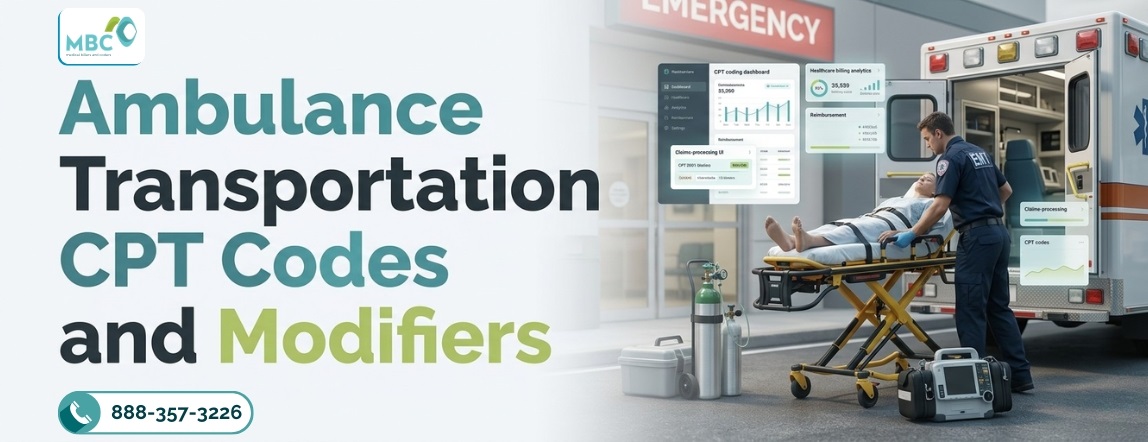
Ambulance transportation is billed with seven ground codes: A0425 for mileage, A0426 to A0429 for ALS Level 1 and BLS, A0433 for ALS Level 2, and A0434 for specialty care transport. Each claim also carries a two-letter modifier, where the first letter shows the origin and the second shows the destination.
Key Takeaways
- Ambulance transportation CPT codes and modifiers report medically necessary ambulance services using A0425, A0426, A0427, A0428, A0429, A0433, and A0434.
- A0428 and A0429 are Basic Life Support non-emergency and emergency, and A0426 and A0427 are ALS Level 1 non-emergency and emergency.
- A0425 is ground mileage per statute mile, A0433 is ALS Level 2, and A0434 is Specialty Care Transport.
- Every ground ambulance claim needs a two-letter origin and destination modifier, such as SH for scene to hospital or HH for hospital to hospital.
- Second modifiers add claim context, such as GA (ABN required and obtained), GY (statutorily excluded service), and QL (patient pronounced dead after the ambulance was called).
- Medicare Part B covers ground ambulance transport to a hospital, critical access hospital, or skilled nursing facility when other transport could endanger the patient’s health.
- Non-emergency transports must be supported by a Physician Certification Statement or signed order confirming the patient cannot be safely transported another way.
Ambulance transportation CPT codes and modifiers are used to report medically necessary ground and air ambulance services for patients requiring transportation to or from healthcare facilities. The most commonly used ambulance transportation billing codes include A0425, A0426, A0427, A0428, A0429, A0433, and A0434, while origin and destination modifiers identify where the transport began and ended.
Accurate code and modifier selection is essential for proper documentation, Medicare compliance, correct claim submission, and timely reimbursement.
Ambulance transportation services that are covered in Medicare part B covers ground ambulance transportation when a patient needs to be transported to a hospital, critical access hospital, or skilled nursing facility for medically necessary services while the transportation in another vehicle could be hazardous for patient’s health. However, ambulance transportation has certain risks.
The risk involved in Ambulance transportation
Emergency Medical Services (EMS) is included in Ambulance and patient transport services while private ambulance services which supply various services such as emergency prehospital care, basic medical support and roadside transport to hospitals for patients experiencing medical emergencies, However, ambulance transportation has certain risk such as high speeds and the use of lights, sirens, which potentially results in ambulance crashes that may injure or cause the death of patients, providers, pedestrians.
To make ambulance transport safer various guidelines are currently being developed
- Drive cautiously at safe speeds, observing traffic laws,
- Encourage the utilization of the Department of Transportation National Highway Traffic Safety Administration Emergency Vehicle Operating Course (EVOC), and National Standard Curriculum
An immediate response is one in which the ambulance supplier begins as quickly as possible to take the steps necessary to respond to the call and emergency ambulance services are provided after the sudden medical condition.
Role of Emergency Medical Technician for prehospital ambulance transport
Generally, hospitalists directly interact with ambulance transport teams who have picked patients up from their homes or other nonmedical settings and brought them to the hospital. But an emergency medical technician (EMT) may be the primary provider on prehospital ambulance transport.
EMTs are typically undergone approximately 40 to 100 hours of medical training in which a small portion may be pediatric. Moreover, These EMTs have limited assessment and interventional capabilities, also local statutes govern what procedures EMTs can perform during transport.
While a higher level of EMS transport involves paramedics who have approximately 1 year of medical training and usually at least 16 hours and a limited practicum involving pediatrics.
Origin/Destination Modifier Pairs, BLS vs. ALS Level Billing, and the Non-Emergency Medical Necessity Trap
Where most ambulance billing guides stop at listing modifier codes, the three areas that directly determine whether a claim pays or denies go consistently unaddressed, and each represents a distinct revenue risk for ambulance suppliers billing under Medicare Part B.
The first is origin and destination modifier pairs. Medicare requires every ground ambulance claim to carry a two-letter modifier identifying where the transport began and where it ended, and these modifiers are not interchangeable. The most frequently used pairs include SH (scene to hospital), SD (scene to hospital for a patient receiving renal dialysis), HH (hospital to hospital), and GH (residential facility to hospital).
Submitting a claim without the correct pairing, or selecting a modifier that does not match the documentation in the Patient Care Report, results in automatic denial with no appeal pathway unless the documentation is corrected at source.
The second is the BLS versus ALS level distinction, which is not a clinical judgment call but a billing-level determination governed by specific CMS criteria. BLS (A0425/A0427) is appropriate when the patient requires monitoring and basic interventions; ALS-1 (A0426/A0427) applies when the patient requires one or more ALS interventions; and ALS-2 (A0433) requires three or more separate ALS interventions or an ALS assessment plus at least one ALS intervention during transport.
Billing ALS-2 without crew documentation of the specific interventions performed is among the top OIG audit targets in ambulance billing. The third is the non-emergency medical necessity threshold, where the financial exposure is largest for high-volume non-emergency transport providers.
Medicare requires that non-emergency transports be supported by a Physician Certification Statement (PCS) or a signed order confirming the patient cannot be safely transported by any other means — and in 2025–2026, MAC contractors including Novitas Solutions have intensified post-payment reviews specifically targeting non-emergency claims lacking a compliant PCS on file at the time of transport.
MBC’s ambulance billing specialists manage origin/destination modifier pairing, BLS/ALS level validation, and PCS compliance as core pre-submission checkpoints, ensuring your claims survive MAC scrutiny and convert transports into protected revenue.
Reimbursement for Ambulance Services
All insurance companies including Medicare and Medicaid pay for ambulance and emergency services. However, the unique and detailed modifiers and the various modes of transport include ground, water, fixed-wing, and rotary-wing make coding and billing for ambulance transportation services complicated.
Healthcare providers should record correct clinical documentation during the case for reimbursement. Moreover, coding and billing are strictly based on this recorded documentation, so the documentation must be complete and accurate.
CPT codes that are used in ambulance transportation billing are relatively low but we can witness various unique modifiers and the complicating factors which have a significant impact on reimbursement.
The CPT codes for ambulance Transportation:
There are seven categories of ground ambulance services which include both land and water transportation. The selection of codes is based on the patient’s condition at the time of transport as well as services rendered.
- A0425 Ground mileage, per statute mile
- A0426 Ambulance service, (ALS), non-emergency transport (Level 1)
- A0427 – ALS (Level 1), Emergency
- A0428 – Basic Life Support, Non-Emergency
- A0429 – Basic Life Support, Emergency
- A0433 –Advanced life support, level 2 (ALS2)
- A0434- Specialty Care Transport (SCT)
Now, let’s look at some modifiers as these modifiers are two characters that represent origin and destination, and they are designed to show first the origin and second the destination:
Some of the modifiers for Ambulance Transportation
- D –Diagnostic or therapeutic site excluded P or H when these are used as origin codes
- E- Residential, domiciliary, custodial facility excluded 1819 facility
- G –Hospital-based ESRD facility
- H –Hospital
- I –Site of transfer between modes
- J –Freestanding ESRD facility
- N Skilled nursing facility
- P Physician’s office
- R Residence
- S Scene of accident or such acute event
- X Intermediate stop at physician’s office along the way to the hospital
Some second modifiers for Ambulance Transportation
Now let’s look at some second modifiers to be included after the origin and destination modifier. These can include but are not limited to:
- CR – Related to a catastrophe or declared disaster
- GA – ABN was required and obtained
- GM – Multiple patient modes of transport
- GW – Hospice patient, unrelated to the hospice diagnosis
- GX – ABN was optional and obtained
- GY – Service that is statutorily excluded
- GZ – ABN was required but not obtained
- QJ – Incarcerated patient
- QL – Patient pronounced dead after ambulance called
- QM – Under the arrangement
Stuck at medical billing? Know what are challenges in Credentialing, Charge Entry, Payment Posting, Benefits/Eligibility Verification, Prior Authorization, Filing claims, AR Follow-Ups, Old AR, Claim Denials, resubmitting rejections with Medical Billing Company – Medical Billers and Coders (MBC).
MBC is a professional medical billing company, with over 2 decades years of experience. MBC caters to Clinics, Hospitals, and Providers in more than 40 specialties to enhance profitability and boost revenue.
Our teams of professional coders and billers are proficient in handling services that range from Revenue Cycle Management to ICD-10.
We provide:
- Billing service for a group practice with your current software
- Credentialing services
- Assistance in handling your AR, Old AR
- Billing Service for Medicaid and Medicare
- Previous billing errors
- Cleaning up claims
- Resubmission of claims
- Possible appeals to maximize your revenue
Need Professional Ambulance Billing Services?
As a leading medical billing and coding company, we provide specialized ambulance billing services designed to improve reimbursement rates, enhance billing and coding accuracy, reduce claim denials, and optimize revenue cycle performance.
Our experienced team handles claim submission, coding validation, modifier accuracy, denial management, AR follow-up, and compliance monitoring to help ambulance providers maximize collections and streamline operations.
Contact our team today to learn how our ambulance billing services can support your organization’s financial success.
Phone: 888-357-3226 | Email: info@medicalbillersandcoders.com
FAQs
Medicare Part B covers ground ambulance transportation when it is medically necessary, such as transporting a patient to a hospital, critical access hospital, or skilled nursing facility, especially when other forms of transport would endanger the patient’s health.
Ambulance transportation can involve risks, including high speeds, lights, and sirens, which may increase the potential for crashes. These incidents can result in injuries to patients, providers, and pedestrians.
Emergency Medical Technicians (EMTs) or paramedics typically provide prehospital care during ambulance transport. EMTs have basic medical training, while paramedics undergo more extensive training and can perform advanced procedures during transport.
Ambulance transportation is billed using specific CPT codes based on the level of service provided, such as Basic Life Support (BLS) or Advanced Life Support (ALS). Reimbursement is determined by the type of transport, medical necessity, and proper documentation.
Common CPT codes for ambulance services include A0425 for ground mileage, A0427 for ALS emergency services, and A0429 for BLS emergency services. These codes help specify the level of care and type of transport provided.
Ambulance billing uses origin and destination modifiers, such as H for Hospital, R for Residence, and N for Skilled Nursing Facility, to indicate where the transport began and ended. Additional modifiers (e.g., CR for disaster-related services) may also apply.
Yes, most private insurance companies, as well as Medicare and Medicaid, cover ambulance transportation services, provided the transport is medically necessary and proper billing and documentation are submitted.

A Medical Coding Subject Matter Expert with over 16 years of experience in ICD-10 and CPT coding, clinical documentation, and revenue cycle management. Shares actionable insights to improve billing accuracy and support compliance-driven healthcare practices.