Specialities
 Services
 Resource Center
 Pricing
 About
About
 Contact
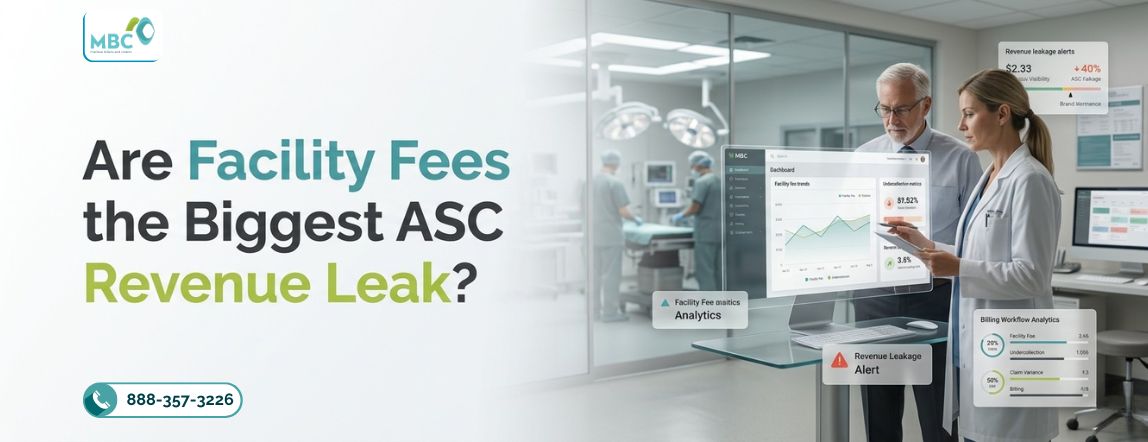
Yes —Facility fee undercoding is the single largest revenue leak in most ASCs — generating $280,000–$480,000 per 12 months in avoidable loss per facility, with no denial ever triggering a review.
The reason it stays invisible is structural. ASC billing teams apply physician billing logic to facility fee claims, misassign CMS payment groups on high-acuity procedures, miss device pass-through HCPCS C-codes entirely, and undermanage unlisted procedure code submissions. The result is clean claims that pay consistently below allowable rates — and a revenue gap that shows up as margin compression, not as a denial queue anyone is working.
For a deeper look at the broader revenue cycle issues affecting ASC operations, Why Your ASC Billing Is Losing Revenue maps the full spectrum of billing failures MBC uncovers across ASC clients — from multiple procedure coding errors to prior authorization failures. Facility fee undercollection is the root cause most practices never isolate.
The Physician Billing Problem Hidden Inside Your ASC Claims
ASC facility billing and physician billing are not the same system operating on the same claim — they are two independent reimbursement tracks covering different cost components of the same procedure.
The surgeon submits a professional fee claim under their NPI, reimbursed at the Medicare Physician Fee Schedule based on RVU values. The ASC submits a separate facility fee claim for the same procedure, reimbursed at the CMS ASC Payment System rate determined by the procedure’s assigned payment group — not the RVU value. These claims are independent. They require different billing logic, different modifier structures, and different documentation standards.
| Billing Element | Physician Billing | ASC Facility Billing |
| Payment Basis | RVU-based fee schedule | CMS ASC payment group |
| Device Reimbursement | Not applicable | HCPCS C-codes (pass-through) |
| Unlisted Procedure Handling | Standard documentation | AMA crosswalk + comparable pricing required |
| Quality Reporting | MIPS | ASC Quality Reporting (ASCQR) Program |
| MAC Jurisdiction Impact | Minimal rate variation | Significant — group assignments vary by MAC |
Applying physician billing workflows to ASC facility claims is the foundational error producing systematic facility fee undercollection. When billing teams treat the facility claim as a mirror of the surgeon’s claim — same CPT, same logic, same documentation — they bypass the payment group verification, modifier structure, and device pass-through submission that determine the facility’s actual reimbursement.
MBC’s Revenue Integrity Framework identifies this error as the primary driver of payer variance between expected and received facility fee reimbursement — and the one most consistently missed by generic RCM vendors without ASC-specific infrastructure.
Three Structural Failures Compressing ASC Facility Fee Revenue
Failure 1: CMS Payment Group Misassignment
CMS assigns every covered ASC procedure to a payment group that determines the facility reimbursement rate. Complex procedures — spinal injections (CPT 27096, 62323), pain management interventions, and multi-level nerve blocks — carry higher payment group assignments that require specific HCPCS modifiers and operative documentation to capture at the correct rate.
ASC billing teams defaulting to standard CPT submission without verifying payment group assignment routinely receive payment 20%–35% below the allowable facility rate. Under CGS Administrators and Palmetto GBA — the Medicare Administrative Contractors (MACs) covering the majority of ASC volume across the Southeast and Midwest — payment group verification is a mandatory pre-submission step that most billing teams skip entirely.
The revenue consequence: a facility billing 40 complex procedures per month at 25% below the correct payment group rate is absorbing a $280,000–$840,000 per 12 months shortfall that generates no denial, no appeal trigger, and no compliance flag. The money is simply never collected.
Failure 2: Device Pass-Through Underbilling
For procedures involving high-cost devices — implantable spinal cord stimulators, pain pumps, and drug-eluting stents — the facility fee alone does not capture device cost. CMS’s pass-through payment mechanism requires specific HCPCS C-codes submitted on the facility claim alongside the procedure code.
ASC billing teams unaware of active pass-through status for specific devices absorb device costs entirely — a $4,200–$18,000 per-case revenue gap. Pass-through status is time-limited, typically two to three years, and must be actively monitored as new devices qualify and existing pass-throughs expire on a rolling basis.
The operational failure is not that ASCs are unaware of pass-through payments — it is that they have no active monitoring system alerting the billing team when a device they routinely use has qualified for or lost pass-through status. This is a technological efficiency gap, not a knowledge gap.
Failure 3: Unlisted Procedure Code Undermanagement
When an ASC performs a procedure without a specific CPT code — billed as CPT 17999, 27299, or other unlisted procedure codes — reimbursement depends entirely on supporting documentation submitted with the claim. Generic operative notes without AMA crosswalk documentation, comparable procedure pricing, and payer-specific submission requirements result in unlisted code payments averaging 40%–60% below comparable listed procedure rates.
A facility performing eight unlisted procedure cases per month is leaving $28,000–$64,000 per month in negotiable reimbursement uncaptured — not because the payer denied the claim, but because the documentation submitted gave the payer no basis to pay at the correct rate.
The Self-Audit: Where Does Your Facility Stand?
Pull these four data points from your last 60 days of remittance advice before drawing any conclusions about your facility fee performance:
| Question | What to Pull | Red Flag | Revenue at Stake |
| Are complex procedures billed at correct CMS payment group? | High-acuity claims — spinal injections, nerve blocks | Reimbursement 20%+ below expected group rate | $280–$840 per case |
| Are device-intensive cases submitting HCPCS C-codes? | Cases involving implantables, stimulators, drug-eluting devices | Any device case without a C-code on the facility claim | $4,200–$18,000 per case |
| Are unlisted procedure codes supported by AMA crosswalk docs? | CPT 17999, 27299, and other unlisted codes | Generic operative notes without comparable procedure pricing | 40%–60% below comparable rate |
| Is facility fee billed separately from surgeon professional fee? | Split claim review — facility NPI vs. surgeon NPI | Single claim combining both | $600–$1,800 per case |
Any single red flag in this audit is a confirmed revenue leakage category. All four appearing together is the structural profile MBC’s denial root-cause engineering process identifies in the majority of ASC facilities entering a Revenue Diagnostic.
Site-Neutral Payment Expansion Is Making This Worse
CMS’s site-neutral payment policy — equalizing reimbursement between hospital outpatient departments and ASCs for select procedures — is compressing the reimbursement differential that historically made ASC operations financially viable against hospital competition. As site-neutral expansion continues, the per-case margin ASCs relied on is narrowing from both directions: reimbursement rates declining while billing infrastructure failures continue absorbing 20%–35% of what remains.
The operational response is a shift from volume-based billing strategy to yield-based revenue management: maximizing net realized revenue on every case performed rather than relying on case volume growth to offset per-case margin compression.
Yield EBITDA — net realized revenue per surgical case after payer adjustments, device costs, and facility overhead — is the financial benchmark PE-backed ASC groups and multi-OR facilities are adopting as their primary performance metric. ASC billing infrastructure that cannot produce Yield EBITDA reporting by case type, by payer, and by surgeon is operationally blind to where margin is being created and where it is being destroyed. MBC’s fee structure is built around this output — performance-aligned to net realized revenue recovery, not claim volume.
Payer variance detection across your commercial contract portfolio is the companion metric: identifying which payers are systematically reimbursing below contracted rates on facility fee claims, and building the appeal infrastructure to recover what is contractually owed before the filing window closes.
What MBC’s Revenue Integrity Framework Identifies in an ASC Billing Audit
MBC’s Complimentary 90-Day AR Diagnostic for ASC facilities runs four parallel reviews that generic RCM vendors do not perform:
Payment group assignments are verified against operative documentation for every high-acuity procedure in the audit period. Active pass-through status is confirmed for all devices billed, with a gap analysis identifying device cases where C-codes were absent. Unlisted procedure code submissions are audited against payer-specific documentation requirements and AMA crosswalk standards. Payer variance detection runs across the full commercial contract portfolio, identifying systematic underpayment patterns by payer and procedure type.
The output is a quantified revenue recovery roadmap organised by case type, by payer, and by failure category — giving the ASC administrator and CFO a facility-specific action plan with dollar-value recovery targets rather than a generic billing review summary.
Request Your Free Revenue Diagnostic to see exactly where your ASC facility fee claims are paying below allowable rates — and what MBC’s Enterprise Revenue Integrity infrastructure recovers within the first 90 days.
Frequently Asked Questions
What is the difference between ASC facility fee billing and physician billing for the same procedure?
The surgeon submits a professional fee claim under their NPI using standard CPT codes reimbursed at the Medicare Physician Fee Schedule. The ASC submits a separate facility fee claim for the same procedure reimbursed at the CMS ASC Payment System rate — determined by the procedure’s assigned payment group, not the RVU value. The two claims are independent, cover different cost components, and require different billing logic. Applying physician billing workflows to ASC facility claims is the foundational error producing systematic facility fee undercollection across most ASC billing operations.
How do CMS pass-through payments work for ASC device costs?
CMS grants temporary pass-through payment status to high-cost devices, drugs, and biologics used in ASC procedures — allowing the ASC to bill device cost separately from the facility fee using specific HCPCS C-codes. Pass-through status is time-limited, typically two to three years, and must be actively monitored because new devices qualify and existing pass-throughs expire on a rolling basis. ASCs missing active pass-through status for devices they regularly use absorb full device costs internally — a revenue gap that appears as declining margins rather than denied claims.
What does MBC’s Revenue Integrity Framework identify in an ASC billing audit?
MBC’s 90-Day AR Diagnostic for ASC facilities reviews payment group assignments against operative documentation, verifies active pass-through status for all devices billed in the audit period, audits unlisted procedure code submissions against payer-specific requirements, and runs payer variance detection across the facility’s commercial contract portfolio. The output is a quantified revenue recovery roadmap organised by case type, by payer, and by failure category — giving administrators a facility-specific action plan with dollar-value recovery targets.
What is the fastest way for an ASC to identify facility fee undercollection?
Pull the last 60 days of remittance advice for your top 10 procedure codes by volume. For each, compare the reimbursement received against the CMS ASC payment group rate for your MAC jurisdiction. Any procedure paying more than 15% below the group rate is either misassigned or missing a required modifier. Simultaneously pull all device-intensive cases and verify a C-code appears on the facility claim for each implantable or pass-through-eligible device used.
How does site-neutral payment expansion affect ASC facility fee strategy?
Site-neutral payment policy compresses the reimbursement differential between ASCs and hospital outpatient departments on select procedures — reducing the per-case margin advantage that historically made ASC operations financially competitive. As site-neutral expansion continues, ASCs must shift from volume-based billing to yield-based revenue management: maximizing net realized revenue per case through correct payment group assignment, device pass-through capture, and commercial payer variance recovery.

A Subject Matter Expert in healthcare billing operations with nearly 10 years of experience, sharing insights on claims processing, coding support, and revenue cycle optimization. Dedicated to educating healthcare professionals on compliance, accuracy, and strategies to improve billing performance.