Specialities
 Services
 Resource Center
 Pricing
 About
About
 Contact

Yes—global period gaps are costing your OB-GYN practice $830,880 per 12 months when global maternity packages bundle services that should bill separately, post-global encounters get written off incorrectly, and diagnostic ultrasounds go unbilled despite payer contracts allowing separate payment.
Your practice loses $1,680 per high-risk pregnancy, $420 per post-global visit, and $1,840 per complication requiring diagnostic imaging—creating systematic revenue leakage invisible in standard denial reports because these services never enter the billing system.
The 60-Second Global Period Test
Pull last month’s delivery count. Multiply by $4,200 (average global package payment).
Now pull last month’s actual maternity collections.
Table 1: What Your Gap Reveals
| Expected vs. Actual | What’s Happening | Loss Per 12 Months |
| Within 5% | Accurate global billing | Minimal loss |
| 15–25% gap | Moderate unbundling failures | $180,000–$420,000 |
| 25–40% gap | Severe global period confusion | $420,000–$960,000 |
| 40%+ gap | Critical coding chaos | $960,000–$1,800,000+ |
If actual collections are 15%+ below expected, global period gaps are destroying revenue.
Three Global Period Gaps Destroying OB-GYN Revenue
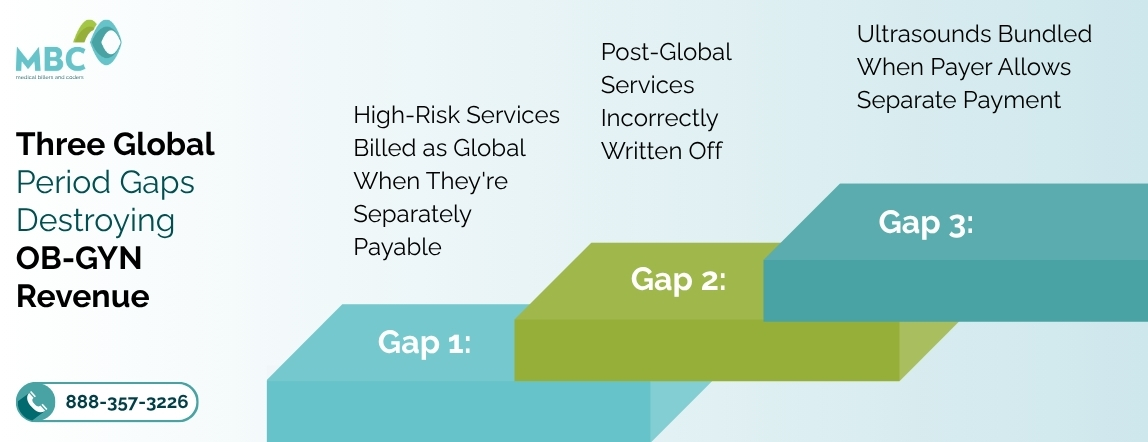
Gap 1: High-Risk Services Billed as Global When They’re Separately Payable ($362,880 Loss)
The $1,680 per pregnancy gap:
Patient has gestational diabetes requiring weekly monitoring, insulin management, and fetal surveillance.
Standard global package (59400): Covers routine prenatal, delivery, postpartum for $4,200.
What gets billed: 59400 only.
What should bill separately:
Weekly NSTs (59025): $85 × 12 weeks = $1,020
Insulin management (99211-99214): $140 × 8 visits = $1,120
Diabetes education (98960): $180 × 2 sessions = $360
Total unbilled services: $2,500 minus global package credit = Net additional $1,680
Why OBGYN Billing Services miss this:
Billing staff see pregnancy, automatically code global package, never review chart for separately billable high-risk services.
Payer rules most practices miss:
Services for pre-existing conditions or pregnancy complications are separately billable even during global period when:
Condition existed before pregnancy (chronic hypertension, diabetes)
Complication develops requiring management beyond routine care (preeclampsia, IUGR)
Separate diagnosis code supports medical necessity
Real practice volume:
Monthly deliveries: 45
High-risk pregnancies: 18 (40%)
Average separately billable services per high-risk case: $1,680
Monthly unbilled: 18 × $1,680 = $30,240
Loss per 12 months: $362,880
The Chart Flag Fix:
Create EHR alert triggered by diagnosis codes O24 (gestational diabetes), O10-O16 (hypertensive disorders), O36.5 (poor fetal growth), O42 (premature rupture of membranes).
Alert displays: “High-risk pregnancy—review for separately billable services beyond global package.”
Specialized OBGYN Billing Services implement these diagnosis-triggered protocols preventing automatic global bundling when complications support separate service billing.
Recovery: Captures $363,000 per 12 months in previously bundled services.
Gap 2: Post-Global Services Incorrectly Written Off ($70,560 Loss)
The global period rule: 59400 includes routine postpartum care through 6 weeks (42 days) post-delivery.
The gap: Patient returns Day 58 with postpartum complications. Billing writes it off as “still in global period.”
Wrong. Global period ended Day 42. This is separately billable.
What gets missed:
Patient Day 52: Postpartum depression screening (96127) = $32
Patient Day 58: Endometritis evaluation (99213) = $140
Patient Day 65: LEEP procedure for abnormal Pap (57522) = $380
Total unbilled: $552 per patient with post-global visits
Why Medical Billing Services miss this:
EHR shows “recent delivery”—billing assumes still global, doesn’t verify exact day count.
The day-count calculation:
Global period = Day of delivery + 42 days postpartum
Delivery April 1 = Global period ends May 13 (42 days later)
Visit May 20 (Day 49) = Separately billable (7 days past global)
Real practice volume:
Monthly deliveries: 45
Patients with post-global visits: 14 (31%)
Average unbilled per patient: $420
Monthly loss: 14 × $420 = $5,880
Loss per 12 months: $70,560
The Calendar Alert Fix:
When delivery coded, system auto-calculates global end date (delivery date + 42 days).
Any encounter after that date triggers alert: “Post-global visit—billable separately. Do not bundle.”
OBGYN Billing Services with calendar automation prevent systematic post-global bundling errors costing $70,560 per 12 months.
Recovery: $70,560 per 12 months from post-global visit capture.
Gap 3: Ultrasounds Bundled When Payer Allows Separate Payment ($397,440 Loss)
The wrong assumption: All prenatal ultrasounds are included in global package.
The reality: Diagnostic ultrasounds for complications are separately billable for most commercial payers.
Routine anatomy scan (76805): Included in global—do NOT bill separately
Diagnostic scans (separately billable):
Growth scan for IUGR (76816): $280
Biophysical profile (76818): $320
Fetal echocardiogram (76825): $480
Real scenario:
Patient with placenta previa requires:
Monthly growth scans (76816): $280 × 3 = $840
Weekly biophysical profiles third trimester (76818): $320 × 8 = $2,560
Total separately billable ultrasounds: $3,400
What gets billed: $0 (staff assumes “included in global”)
Payer variance (critical for RCM Services):
Medicare: Most ultrasounds bundled in global
Commercial (UnitedHealthcare, Aetna, Blue Cross): Diagnostic ultrasounds separately billable when:
- Medical necessity documented
- Complication diagnosis code supports (O44 placenta previa, O36.5 IUGR)
- Modifier 59 applied showing “separately identifiable”
Real practice volume:
Monthly deliveries: 45
High-risk requiring diagnostic ultrasounds: 18 (40%)
Average separately billable ultrasounds: $1,840
Monthly unbilled: 18 × $1,840 = $33,120
Loss per 12 months: $397,440
The Payer Matrix Solution:
Create reference chart:
Ultrasound Billing—Global vs. Separate by Payer
Medicare: Bundle all (except targeted organ exams)
UnitedHealthcare: Separate when diagnostic with complication code
Aetna: Separate with Modifier 59 and medical necessity
Blue Cross: Separate when ordered for complication management
Staff checks matrix before coding each ultrasound.
Experienced RCM Services maintain payer-specific ultrasound billing matrices preventing $397,440 loss per 12 months from incorrectly bundled diagnostic imaging.
Recovery: $397,440 per 12 months from diagnostic ultrasound capture.
How OBGYN Billing Services Eliminate Global Period Gaps
Specialized OBGYN Billing Services recognize that global period gaps aren’t visible in denial reports because services never enter billing systems.
Medical Billing Services with OB-GYN expertise implement diagnosis-triggered alerts flagging high-risk codes (O24, O10-O16, O36.5) prompting review for separately billable services beyond global package, create automated global end-date calculators preventing post-global bundling errors, and develop payer-specific ultrasound billing matrices showing which commercial plans allow separate diagnostic imaging payment.
RCM Services focusing on global period optimization compare chart documentation (high-risk services provided) against claims submitted (what actually billed) revealing the $830,880 gap between services performed and revenue captured per 12 months.
MBC’s Revenue Integrity Partner Approach
MBC’s Revenue Diagnostic evaluates your billing through global period analysis identifying high-risk pregnancies missing separately billable service codes, post-global encounters incorrectly bundled, and diagnostic ultrasounds written off when payer contracts allow separate payment.
MBC helps Yield your EBITDA by maximizing reimbursement through payer-specific global period protocols ensuring services beyond routine care bill appropriately. As your Revenue Integrity Partner, we implement diagnosis-triggered alerts recovering $363,000 from high-risk service capture, global end-date calculations recovering $70,560 from post-global visit billing, and payer ultrasound matrices recovering $397,440 from diagnostic imaging.
MBC’s fee structure includes global period training, payer-specific billing protocols, and quarterly high-risk service audits detailed at https://www.medicalbillersandcoders.com/pricing.
Request Your Free Revenue Diagnostic for global period gap analysis, high-risk service review, and ultrasound billing assessment quantifying exact recovery opportunity.
Contact Medical Billers and Coders to recover $830,880 per 12 months lost to global period confusion through specialized OBGYN Billing Services.
References
American College of Obstetricians and Gynecologists. (2024).
American Medical Association. (2024).
Key Takeaways
- Global Period Gaps cost OB-GYN practices an estimated $830,880 annually due to incorrect bundling of services and missed billing opportunities.
- High-risk pregnancies can lead to $1,680 losses when separately billable services are coded as part of the global package.
- Post-global care often gets written off erroneously, resulting in a loss of $70,560 per year if not billed separately.
- Diagnostic ultrasounds, which may be billable, often get bundled incorrectly, costing practices approximately $397,440 annually.
- Implementing diagnosis-triggered alerts and automated calculators can help eliminate these Global Period Gaps, improving revenue recovery significantly.
Frequently Asked Questions
Yes—when practices bill only global package (59400 at $4,200) for high-risk pregnancies requiring separately billable services ($1,680 average), miss post-global encounters ($420 per patient), and bundle diagnostic ultrasounds payers allow separately ($1,840 average), combined losses reach $830,880 per 12 months for practices with 45 monthly deliveries performing proper high-risk care but failing to bill appropriately through OBGYN Billing Services systematic capture protocols.
Services for pre-existing conditions (chronic diabetes, hypertension management), pregnancy complications beyond routine care (gestational diabetes requiring insulin, IUGR requiring weekly monitoring), diagnostic procedures (amniocentesis, fetal echocardiogram), and therapeutic interventions (cerclage placement) bill separately with appropriate diagnosis codes even during global period when medical necessity documented and complication codes support separate service requiring Medical Billing Services expertise in payer-specific global period rules.
Global maternity period (59400) includes delivery day plus 42 postpartum days—delivery April 1 means global ends May 13; any encounter after global end date (May 14 onward) is separately billable and should code appropriate E/M level (99211-99215) rather than writing off as “included in global package” creating $70,560 loss per 12 months when 31% of patients have post-global visits requiring OBGYN Billing Services automated day-count calculation.
Medicare bundles most prenatal ultrasounds in global package, but commercial payers (UnitedHealthcare, Aetna, Blue Cross) allow separate billing for diagnostic ultrasounds (76816 growth scan, 76818 biophysical profile, 76825 fetal echo) when complication diagnosis codes support medical necessity and Modifier 59 applied, creating $397,440 recovery per 12 months when 40% of pregnancies require diagnostic imaging currently bundled incorrectly requiring RCM Services payer-specific matrices.
Implement diagnosis-triggered EHR alerts flagging high-risk codes (O24, O10-O16, O36.5) prompting review for separately billable services, create automated global end-date calculator (delivery date plus 42 days) preventing post-global bundling errors, and develop payer-specific ultrasound billing matrix showing which plans allow separate diagnostic imaging payment through specialized OBGYN Billing Services recovering combined $830,880 per 12 months from three systematic gaps at https://www.medicalbillersandcoders.com/pricing.

Catering to more than 40 specialties, Medical Billers and Coders (MBC) is proficient in handling services that range from revenue cycle management to ICD-10 testing solutions. The main goal of our organization is to assist physicians looking for billers and coders, at the same time help billing specialists looking for jobs, reach the right place.