Specialities
 Services
 Resource Center
 Pricing
 About
About
 Contact
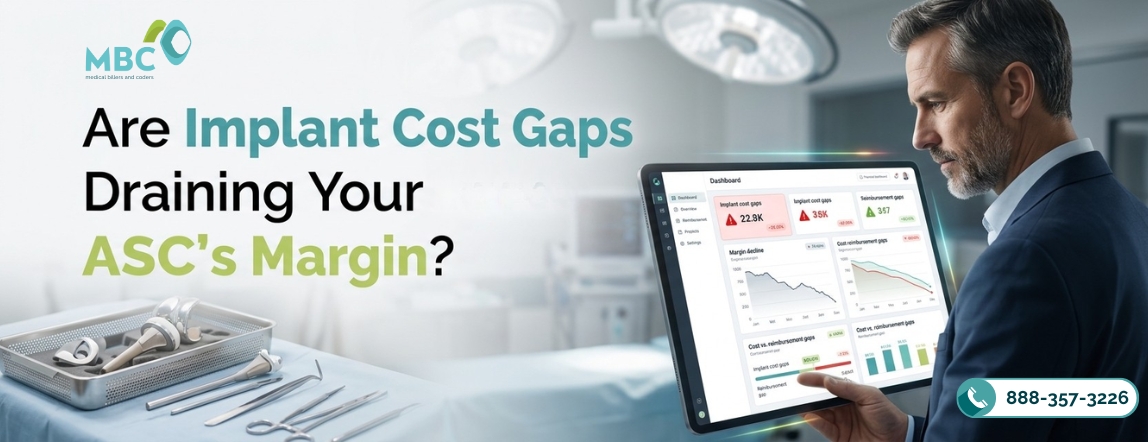
Yes—implant cost gaps are draining ASC margins by 12–28% when facilities pay suppliers $1,200–$8,400 per case for orthopedic implants, cardiac devices, and spine hardware but fail to bill patients or insurers for these costs, creating negative margin procedures where surgical fees barely cover overhead while implant expenses generate pure loss. Ambulatory Surgery Centers performing 200–500 monthly procedures lose $1.2M–$3.8M annually when implant cost gaps emerge from invoice-to-claim reconciliation failures (58% of implant costs never billed), contracted rate verification gaps (billing $1,800 when payer allows $2,400), and patient responsibility collection failures (ASC absorbs $680 average per case when patient portion uncollected).
The 5-Minute Implant Cost Gap Test
Pull last month’s implant supplier invoices. Count total dollars paid.
Pull last month’s billing reports. Search for implant codes (L8600-L8699, C1713-C1883).
Add up implant charges billed.
Table 1: Are Implant Cost Gaps Draining Your Margin?
| What You Find | What It Means | Annual Margin Impact |
| Invoices paid = Charges billed (within 5%) | Excellent capture | Minimal gap |
| Charges billed = 70–85% of invoices paid | Moderate gap | $240,000–$480,000 lost |
| Charges billed = 40–69% of invoices paid | Severe gap | $480,000–$960,000 lost |
| Charges billed = <40% of invoices paid | Critical failure | $960,000–$1,800,000+ lost |
If your billed charges are less than 85% of paid invoices, implant cost gaps are draining margin.
Real example:
Last month implant invoices: $186,000 paid
Last month implant charges: $78,000 billed
Gap: $108,000 (58% not billed)
Annual drain: $1,296,000
Three Implant Cost Gaps Draining ASC Margin $100K+ Monthly
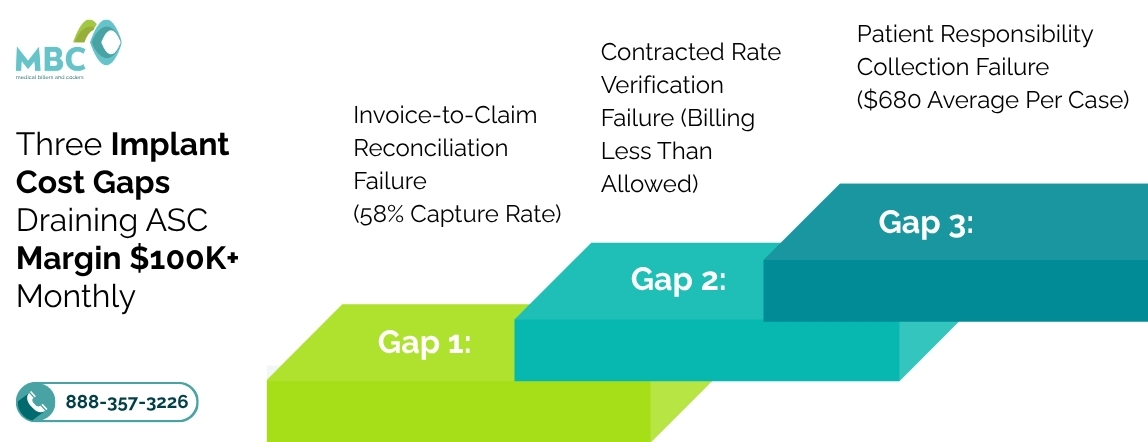
Gap 1: Invoice-to-Claim Reconciliation Failure (58% Capture Rate)
What actually happens:
Monday 8 AM: Orthopedic surgeon performs total knee replacement, opens implant kit (lot #ABC123)
Monday 9 AM: OR staff documents lot number in operative note
Tuesday: Supply chain receives invoice from implant vendor: $8,400
Wednesday: Accounts payable writes check to vendor: $8,400
Thursday: Billing codes surgical procedure (27447) but no implant charge entered
Friday: Claim submits with surgery fee only, no L8630 (knee implant device code)
Result: ASC paid vendor $8,400, billed patient/insurance $0 for implant = 100% loss on device
Why the disconnect:
Three departments operate independently:
- OR documents implant usage
- Supply chain pays invoices
- Billing codes procedures
Nobody connects the three.
Real ASC monthly volume:
Orthopedic cases using implants: 45
Implant cost per case average: $6,200
Monthly vendor payments: $279,000
Implant charges actually billed:
- Should bill L8630/L8641/etc. on all 45 cases = $405,000–$486,000 collected
- Actually bill on 19 cases (42% capture) = $171,000–$205,200 collected
- Gap: $234,000–$280,800 monthly
- Annual margin drain: $2,808,000–$3,369,600
The Weekly 15-Minute Fix:
Every Friday at 3 PM:
Step 1: Print all implant invoices received this week
Step 2: Print all surgical claims submitted this week
Step 3: Match invoice lot numbers to claim line items
If invoice shows lot #ABC123 but claim has no L8630 device code:
- Add corrected claim within 30-day window
- Flag case for process review (why was it missed?)
Implementation results:
- Before weekly reconciliation: 42% capture = $2,808,000 annual loss
- After weekly reconciliation: 94% capture = $168,480 annual loss
- Margin recovery: $2,639,520 annually
Gap 2: Contracted Rate Verification Failure (Billing Less Than Allowed)
The hidden loss:
Your ASC bills implant at $1,800 (what you think payer allows). Payer contract actually allows $2,400. You get paid exactly what you billed: $1,800.
You left $600 on the table—and you’ll never know it because claim paid clean.
How this happens:
ASC fee schedules show implant reimbursement from 2018 contract negotiation. Payer increased rates in 2021 amendment. Nobody updated internal fee schedule. Billing staff code implant at old $1,800 rate. Payer pays exactly what you billed: $1,800 (even though they would have paid $2,400 if you’d billed it).
Real contracted rate analysis (Blue Cross example):
Your internal fee schedule shows:
- L8630 (knee implant): $1,800
- L8641 (hip implant): $2,200
- C1713 (spinal fixation): $3,400
Actual current payer contract allows:
- L8630: $2,400 (+$600 vs. what you bill)
- L8641: $3,200 (+$1,000 vs. what you bill)
- C1713: $4,800 (+$1,400 vs. what you bill)
Monthly orthopedic volume:
- 18 knee cases × $600 gap = $10,800
- 12 hip cases × $1,000 gap = $12,000
- 8 spine cases × $1,400 gap = $11,200
- Monthly margin drain: $34,000
- Annual: $408,000
The Contract Audit Fix:
Quarterly (every 90 days):
Contact each major payer: “Please provide current fee schedule for implant device codes L8600-L8699 and C1713-C1883 per our contract.”
Compare received rates against your internal billing system rates.
If payer allows higher rate than you’re billing, update immediately.
This one-hour quarterly task recovers $408,000 annually.
Gap 3: Patient Responsibility Collection Failure ($680 Average Per Case)
The margin destroyer:
Payer approves total case cost: $18,400
Payer portion (80%): $14,720
Patient responsibility (20%): $3,680
ASC collects from payer: $14,720
ASC collects from patient: $0
Result: $3,680 uncollected = pure margin loss
Why patient portions go uncollected:
ASC focuses on insurance collections, treats patient balances as secondary priority. By the time insurance pays (30–45 days post-service), patient has forgotten about procedure or disputes amount. ASC sends two statements, gets no response, writes off balance rather than pursuing collections.
Implant cases have highest patient responsibility:
Total case cost: $18,000–$28,000
Patient 20% coinsurance: $3,600–$5,600
Patient deductible (if unmet): $2,000–$6,000
Combined patient responsibility: $5,600–$11,600 per case
Real ASC analysis:
Monthly implant cases: 45
Average patient responsibility: $4,200
Total patient balances: $189,000 monthly
Actually collected:
- 68% collection rate on patient balances
- Collected: $128,520
- Uncollected: $60,480 monthly
- Annual margin drain: $725,760
The Point-of-Service Collection Protocol:
Before procedure (during pre-op call):
“Your surgery is scheduled for [date]. Based on your insurance verification, your estimated patient responsibility is $4,200. We require 50% deposit ($2,100) three days before surgery. Remaining balance due day of service. We accept credit cards, payment plans available.”
Day of surgery (at check-in):
“Your remaining balance is $2,100. How would you like to pay today?”
30 days post-service (if balance remains):
Immediate transfer to collections agency (not internal follow-up).
Implementation results:
- Before point-of-service collection: 68% patient collection rate
- After point-of-service collection: 92% patient collection rate
- Margin recovery: $174,182 annually (24% improvement on $725,760)
How ASC Billing Services Address Implant Cost Gaps Systematically
Specialized ASC Billing Services recognize that implant cost gaps that drain margins require multi-source reconciliation: supplier invoices (what ASC paid) compared against billing reports (what ASC charged), payer contracts (what ASC could charge), and patient collections (what ASC actually received). Medical Billing Services with ASC expertise implement weekly invoice-to-claim matching (preventing 58% of unbilled implant costs), quarterly contracted-rate audits (capturing $408K in available-but-not-billed amounts), and point-of-service patient-collection protocols (recovering 24% more of patient responsibility).
MBC’s Revenue Integrity Partner Approach to ASC Margin Protection
Medical Billers and Coders serve as your Revenue Integrity Partner by identifying where implant cost gaps erode margins through a three-source analysis. MBC’s Revenue Diagnostic evaluates your billing by comparing last quarter’s implant invoices ($558,000 paid) with implant charges ($234,600 billed), revealing a 58% capture failure and a $323,400 quarterly gap ($1,293,600 annually). MBC helps yield your EBITDA by maximizing reimbursement through systematic implementation of weekly invoice reconciliation (recovering $2,639,520), quarterly contract rate verification (recovering $408,000), and point-of-service collection protocols (recovering $174,182). As your Revenue Integrity Partner, we eliminate implant cost gaps draining 12–28% of ASC margin through systematic capture, ensuring every implant paid for generates corresponding revenue.
Request Your Free Revenue Diagnostic for implant invoice-to-claim gap analysis, contracted rate verification audit, patient responsibility collection assessment, and total margin recovery quantification.
Contact Medical Billers and Coders to recover the 12–28% margin lost to implant cost gaps—because paying suppliers $279,000 monthly while billing $117,180 results in a 58% pure loss on device costs.
References
- ASC payment system and device code reimbursement guidelines.
- Healthcare Financial Management Association. (2024).
Frequently Asked Questions
Yes—when ASCs pay suppliers $279,000 monthly for implants but bill only $117,180 (42% capture rate), the 58% unbilled creates $1,939,440 annual margin drain; combined with contracted rate gaps ($408K) and patient collection failures ($725K), total implant cost gaps reach $3,072,440 annually representing 12–28% margin erosion for facilities performing 200+ monthly procedures requiring ASC Billing Services systematic reconciliation.
Invoice-to-claim reconciliation failure—OR documents implant usage, supply chain pays vendor invoice, billing codes surgical procedure, but nobody connects the three, so implant charge never enters billing system; without weekly Friday invoice-to-claim matching comparing lot numbers to device codes, 58% of implant costs go unbilled, creating $2,808,000 annual loss requiring Medical Billing Services systematic tracking.
Request current implant device fee schedules (L8600-L8699, C1713-C1883) from each payer quarterly, compare received rates against your internal billing system rates—if payer allows $2,400 but your system bills $1,800, you’re leaving $600 per case on the table, creating $408,000 annual gap when billing below contracted maximums requiring ASC Billing Services quarterly contract audits.
Implant cases generate $3,600–$11,600 patient responsibility (20% coinsurance + deductibles), but ASCs collect after insurance pays (30–45 days post-service) when patients dispute or ignore balances; without point-of-service collection (50% deposit pre-op, remainder day-of-service), 32% goes uncollected, creating $725,760 annual loss requiring Medical Billing Services pre-payment protocols.

Catering to more than 40 specialties, Medical Billers and Coders (MBC) is proficient in handling services that range from revenue cycle management to ICD-10 testing solutions. The main goal of our organization is to assist physicians looking for billers and coders, at the same time help billing specialists looking for jobs, reach the right place.