Specialities
 Services
 Resource Center
 Pricing
 About
About
 Contact
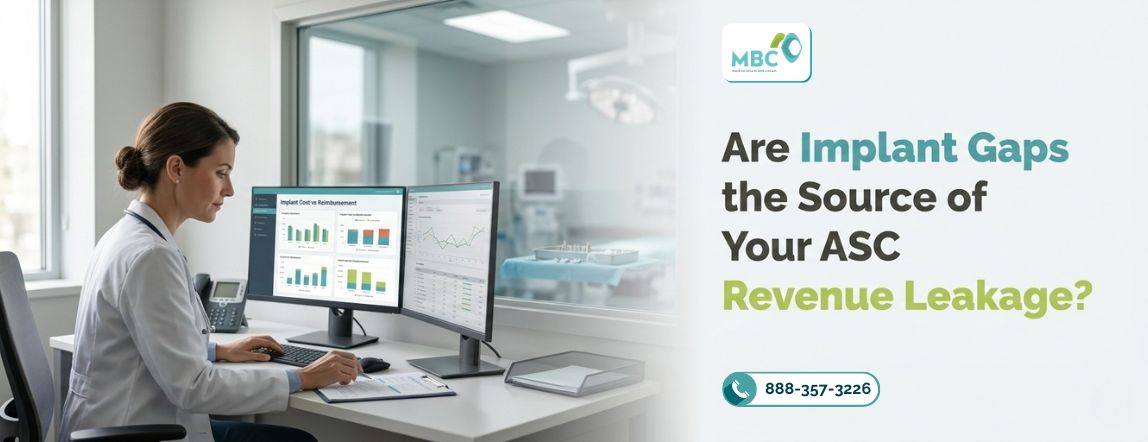
Yes — implant gaps are the primary source of ASC revenue leakage, with Ambulatory Surgical Centers collecting $1M–$5M per month losing $1.2M–$3.8M in 12-month revenue when 35–52% of implantable devices lack real-time charge capture documentation.
The leakage compounds across three failure points: $8,500–$24,000 implant costs left unbilled per missed capture, invoice-to-claim reconciliation gaps leaving $180,000–$420,000 per month in unmatched charges, and payer variance detection failures where commercial insurers deny properly billed implants despite contractual allowances — directly suppressing EBITDA and net realized revenue growth.
For multi-OR Ambulatory Surgical Centers, building the denial root-cause engineering and technological efficiency infrastructure that closes these three gaps is the most direct path to protecting financial performance metrics and recovering revenue that is already being earned in the OR.
The Three Implant Gaps Driving ASC Revenue Leakage
Gap 1: Real-Time OR Charge Capture Failures
The Problem: Surgeons open implants during procedures, but documentation does not reach billing until end-of-month invoice reconciliation — if it reaches billing at all. For ASCs running 200–500 monthly procedures with 60% implant utilization, a 40% capture failure rate eliminates $40,000–$240,000 in billable device revenue each month.
| Monthly Procedures | Implant Cases (60%) | 40% Capture Failure | Avg. Implant Cost | Monthly Revenue Lost |
| 200–300 | 120–180 | 48–72 missed | $8,500–$24,000 | $408,000–$1,728,000 |
| 300–500 | 180–300 | 72–120 missed | $8,500–$24,000 | $612,000–$2,880,000 |
Table 1: Monthly Implant Charge Capture Failure Impact by ASC Procedure Volume
MBC Solution: Real-time OR charge capture integration — barcode scanning during procedure, auto-populated billing with device catalog number and lot number, and alert triggers for undocumented implants — improves capture rates from 60% to 96%, recovering $408,000–$2.8M per month depending on procedure volume.
Gap 2: Invoice-to-Claim Reconciliation Gaps
The Problem: Vendor invoices arrive showing $420,000 in monthly implant costs, but submitted claims capture only $240,000 — leaving $180,000 unbilled each month. For ASCs purchasing $5M in 12-month device inventory, a 30–40% reconciliation gap represents $1.5M–$2M in unbilled procedures within that same period.
The denial root-cause engineering breakdown behind reconciliation gaps is consistent across ASCs: 68% of cancelled procedures where an implant was already opened are never rebilled to insurance, 22% involve implants used but not linked to the correct patient claim, and 10% result from documentation delays that cause timely filing violations and permanent claim forfeiture.
MBC Solution: Automated reconciliation dashboards with weekly vendor invoice upload, claim-matching logic, and 48-hour investigation flags for unmatched implants reduce the reconciliation gap from 35% to 8% — recovering $100,000–$180,000 per month in previously unbilled device charges.
Gap 3: Payer Variance Detection Failures
The Problem: The same implant generates four different billing outcomes depending on the payer. Without a payer variance detection protocol applied before each procedure, ASCs submit claims blind — absorbing denials, delayed cash flow, and contract-driven underpayments that compound across every OR case involving a high-cost device.
| Payer | Implant Billing Policy | Without Proper Protocol | Monthly Cash Flow Impact |
| Medicare | Pays separately for devices >$500 with proper HCPCS documentation; device-intensive procedure rules apply | 4–6% denial rate with correct coding | Recoverable with appeal |
| UnitedHealthcare | Requires device-specific prior authorization for high-cost implants >$10,000 | 100% initial denial without pre-auth | $340,000–$680,000 delayed per month |
| Aetna | Bundles certain orthopedic hardware into procedure payment; contract review required | 85–92% denial on separate billing | Permanent loss without contract escalation |
| Blue Cross Blue Shield | Varies by state — some separate, some bundled; requires pre-service verification per plan | 40–55% denial rate on billing errors | $120,000–$280,000 per month at risk |
Table 2: Payer-Specific Implant Reimbursement Variance — Without Pre-Procedure Protocol
MBC Solution: Payer-specific implant reimbursement matrices — pre-procedure coverage verification, automated prior authorization alerts, and contract language analysis distinguishing bundled from separately payable devices — reduce payer-driven denials from 42% to 9%.
The Implant Documentation Chain of Custody
Preventing ASC revenue leakage from implant gaps requires a five-stage documentation protocol that connects OR activity to billing in real time — not at month-end.
- Pre-Procedure: Verify payer-specific implant coverage and prior authorization requirements; confirm patient financial responsibility for non-covered devices.
- Intra-Procedure: Real-time barcode scanning captures device catalog number, lot number, and cost; digital OR log documents device placement before the patient leaves the room.
- Post-Procedure: Automated charge population from OR log to billing system enables same-day claim submission rather than end-of-month batch processing that triggers timely filing violations.
- Reconciliation: Weekly vendor invoice matching against submitted claims with 48-hour investigation of every unmatched item — not a monthly audit that turns a recoverable miss into a write-off.
- Denial Management: Immediate appeal of payer denials with invoice documentation attached; contract escalation when denials contradict agreement terms; denial root-cause engineering identifying whether the failure originated in authorization, documentation, or coding.
EBITDA Protection Through Implant Revenue Optimization
Implant documentation gaps do not only suppress device reimbursement. They create a compounding financial performance metrics problem: the ASC pays vendors for devices before collecting from payers, creating a working capital gap that widens each month capture failures go unresolved. Patients billed for insurer-denied implants generate bad debt. Vendor relationships deteriorate from late payments tied to cash flow shortfalls. The combined EBITDA erosion for surgical ASCs with unresolved implant gaps reaches 15–28% of total facility margin.
The risk mitigation case is equally direct: CMS designates device-intensive procedures under the CY 2026 OPPS/ASC Final Rule with specific documentation requirements for separate device payment. ASCs that lack a real-time chain of custody for implant documentation face both revenue suppression and compliance exposure when MAC auditors review device billing against OR documentation.
For ASCs collecting $1M–$5M per month, correcting all three implant gaps — charge capture, invoice reconciliation, and payer variance protocols — recovers $100,000–$316,000 per month, totaling $1.2M–$3.8M over 12 months, through technological efficiency infrastructure that operates in real time rather than reacting to end-of-cycle losses.
Recover the $1.2M–$3.8M Your OR Is Leaving on the Table
Medical Billers and Coders (MBC) is the leading medical billing company in the USA, with 25+ years of specialized ASC billing expertise. Our Medical Billing Services, Old AR Recovery, RCM Services, and Denial Management Services close all three implant gaps — charge capture, invoice reconciliation, and payer variance detection — managed by a dedicated account manager with no EHR change required.
Frequently Asked Questions
Yes — ASCs lose $1.2M–$3.8M in 12-month revenue when 35–52% of implants lack real-time charge capture, invoice reconciliation leaves 30–40% of device costs unbilled each month, and payer variance drives 42% denial rates without pre-authorization and contract-specific protocols.
Three failures drive capture gaps: manual OR documentation where opened implants are not communicated to billing (40% capture failure), end-of-month batch processing that misses timely filing deadlines, and cancelled procedures where opened implants are never rebilled (68% permanent loss).
Medicare pays implants separately with proper HCPCS documentation, UnitedHealthcare requires prior authorization for devices over $10,000 (100% initial denial without it), Aetna bundles certain orthopedic hardware (85–92% separate-billing denial), and BCBS varies by state — creating 42% denial rates without payer-specific pre-procedure protocols.
Invoice-to-claim reconciliation matches vendor invoices (actual device costs) to submitted claims; when an ASC purchases $5M in 12-month device inventory but claims capture only $3.5M, the $1.5M gap represents unbilled procedures, cancelled-but-opened devices, and documentation delays causing permanent revenue forfeiture.
Specialized ASC billing services implement real-time barcode scanning (96% capture vs. 60% manual), automated weekly invoice reconciliation flagging unbilled devices within 48 hours, payer variance detection confirming authorization pre-procedure, and denial root-cause engineering recovering denied implant claims — protecting $1.2M–$3.8M in 12-month revenue.
References

Catering to more than 40 specialties, Medical Billers and Coders (MBC) is proficient in handling services that range from revenue cycle management to ICD-10 testing solutions. The main goal of our organization is to assist physicians looking for billers and coders, at the same time help billing specialists looking for jobs, reach the right place.