Specialities
 Services
 Resource Center
 Pricing
 About
About
 Contact
Yes, preventive GYN exams are facing high rejection rates from payers—with OBGYN practices collecting $1M–$5M+ monthly experiencing 32–48% denial rates on routine pelvic examinations and annual Pap tests because recent USPSTF guidelines classify screening pelvic exams in asymptomatic women as having insufficient evidence for benefit, prompting commercial insurers to deny claims as “not medically necessary” and creating $1.2M–$3.8M annual revenue leakage when practices bill preventive codes for services that no longer meet ACA coverage requirements without patient cost-sharing.
For multi-provider OBGYN practices, understanding how guideline shifts create payer-variance detection challenges and systematic denial patterns is the foundation for implementing risk-mitigation protocols that protect EBITDA and net realized revenue growth.
Why Are GYN Exams Facing High Rejection Rates From Payers?
According to the U.S. Department of Veterans Affairs, no data currently support the effectiveness of screening pelvic exams for asymptomatic, non-pregnant women for any indication other than periodic cervical cancer screening.
USPSTF Guideline Impact:
The U.S. Preventive Services Task Force issued an “I” (Indeterminate) grade for routine pelvic exams in asymptomatic women, stating insufficient evidence to determine the balance of benefits and harms.
Payer Response:
When USPSTF lacks evidence supporting a preventive service benefit, ACA no longer requires zero-cost coverage, prompting insurers to:
- Deny preventive GYN exam claims as “not medically necessary.”
- Require patient cost-sharing (deductibles, copays)
- Implement prior authorization for routine pelvic exams
- Bundle pelvic exams into the E/M visit payment instead of separate preventive billing
Table 1: Preventive GYN Exam Payer Rejection Impact by Practice Size
| Monthly Collections | Annual Preventive GYN Visits | 32–48% Denial Rate | Revenue at Risk | Annual EBITDA Impact |
| $1M–$2M | 1,200–1,800 | 384–864 denials | $1.2M–$1.6M | -12% to -18% |
| $2M–$3M | 2,400–3,600 | 768–1,728 denials | $1.8M–$2.8M | -15% to -22% |
| $3M–$5M | 3,600–6,000 | 1,152–2,880 denials | $2.4M–$3.8M | -18% to -28% |
Three-Payer Variance Detection Failures Driving High Rejection Rates
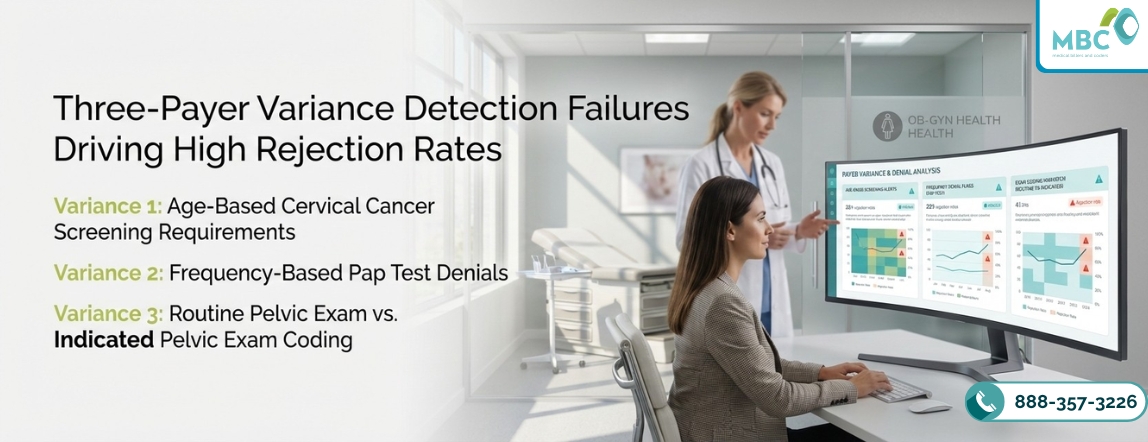
Variance 1: Age-Based Cervical Cancer Screening Requirements
According to the USPSTF, cervical cancer screening (Pap smears) should not be performed on women under age 21, regardless of sexual activity.
High Rejection Scenario:
Billed Service: Annual Pap test for 18-year-old patient (CPT 88142, diagnosis Z01.419)
Payer Denial: “Not medically necessary—patient does not meet age criteria.”
Revenue Impact:
According to CDC research, 1.6 million Pap tests performed annually on women aged 15-20 are medically unnecessary, costing $123 million in denied claims nationally.
For an OBGYN practice serving a younger patient population:
- 120 annual inappropriate Pap tests
- Average denial per test: $180–$280
- Annual revenue loss: $21,600–$33,600
Variance 2: Frequency-Based Pap Test Denials
USPSTF Guidelines:
- Ages 21-29: Pap test every 3 years
- Ages 30-65: Pap test every 3 years OR HPV test every 5 years OR co-testing every 5 years
High Rejection Pattern:
Practice bills annual Pap tests for all patients
Payer denial root-cause engineering:
- 67% of patients had a Pap test within the past 3 years
- Claims denied as “too frequent—not medically necessary.”
Financial Performance Metrics Impact:
For practice performing 2,400 annual Pap tests:
- 1,608 tests (67%) within 3-year window
- Denial rate: 85–95% on frequent tests
- Revenue denied: $246,000–$428,000 annually
Variance 3: Routine Pelvic Exam vs. Indicated Pelvic Exam Coding
Critical Distinction:
Screening Pelvic Exam (facing high rejection):
- Asymptomatic patient
- No clinical indication
- Billed as a preventive service
- Payer denial: “Insufficient evidence for benefit.”
Indicated Pelvic Exam (covered):
- Symptomatic patient (pain, bleeding, discharge)
- Clinical indication documented
- Billed as a diagnostic E/M service
- Payer approves with proper documentation
Technological Efficiency Gap:
Many practices use templated preventive visit documentation that doesn’t capture when a pelvic exam is actually indicated for symptoms vs. routine screening.
Result: All pelvic exams coded as preventive, creating systematic 32–48% denial rates
Risk Mitigation: Aligning Billing With Evidence-Based Guidelines
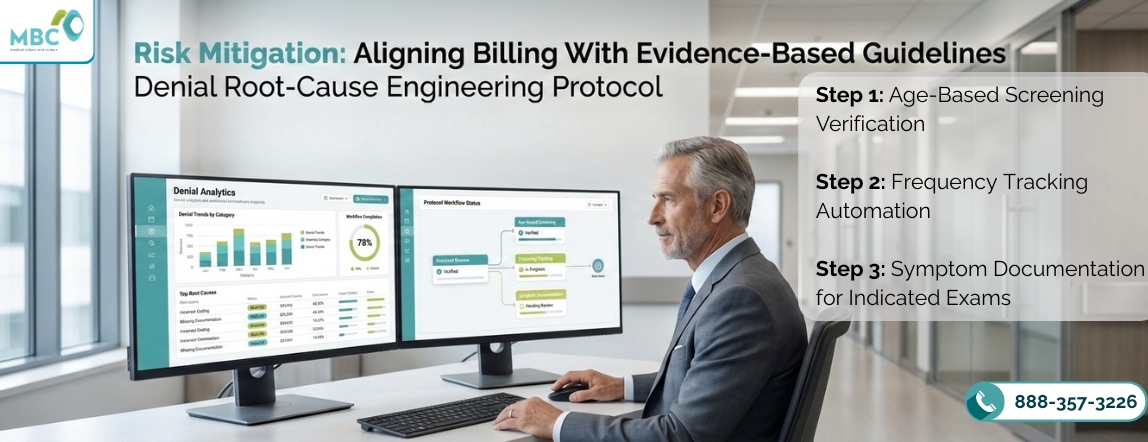
Denial Root-Cause Engineering Protocol:
Step 1: Age-Based Screening Verification
- EHR alert when Pap test is ordered for a patient <21 years
- Block preventive billing code, prompt for diagnostic indication if truly needed
- Prevent submission of claims destined for denial
Step 2: Frequency Tracking Automation
- System checks the date of the last Pap/HPV test before scheduling a preventive visit
- Alert: “Patient had Pap 18 months ago—next screening due in 18 months.”
- Prevents unnecessary service delivery and inevitable denial
Step 3: Symptom Documentation for Indicated Exams
- When a pelvic exam is performed, the requirement for an indication dropdown:
- Pelvic pain (specify location, duration)
- Abnormal bleeding (specify pattern)
- Vaginal discharge (specify characteristics)
- Routes to diagnostic E/M billing instead of preventive denial
Table 2: Net Realized Revenue Growth From Guideline Alignment
| Intervention | Inappropriate Services Prevented | Denials Avoided | Annual Revenue Protected |
|---|---|---|---|
| Age-based Pap screening blocks | 120 tests (under 21) | 102–114 denials | $18,360–$31,920 |
| Frequency tracking automation | 1,608 tests (too frequent) | 1,367–1,528 denials | $246,000–$428,000 |
| Symptom-based pelvic exam coding | 800 screenings → diagnostics | 256–384 preventive denials | $76,800–$153,600 |
| Total Annual Protection | — | — | $1.2M–$1.8M |
Patient Financial Counseling: Managing Expectations
The ACA Coverage Gap:
Patients expect annual GYN exams to be covered at $0 cost under ACA preventive services. When payers deny routine pelvic exams, practices face:
- Surprise patient bills ($180–$450 per visit)
- Collections challenges (28–42% bad debt rate on surprise bills)
- Patient dissatisfaction and retention risk
Payer Variance Detection Solution:
Pre-Visit Financial Counseling: “Your insurance covers cervical cancer screening every 3 years starting at age 21. Since your last Pap was 18 months ago, today’s pelvic exam will be subject to your deductible/copay of approximately $180–$280. Would you like to proceed or reschedule when the screening is due?”
This transparency prevents surprise bills while allowing informed patient choice.
The Self-Collection Alternative Reducing Exam Barriers
According to research by The Harris Poll, 72% of women delay GYN visits due to fear/discomfort, and 81% want less invasive options like self-collection swabs for HPV testing.
Self-Collection Impact on Financial Performance Metrics:
- Increases screening compliance (reduces future cancer treatment costs)
- Eliminates speculum exam rejection risk
- Maintains preventive billing eligibility with proper coding
Medical Billers and Coders’ 25+ years of OBGYN billing experience include coding protocols for self-collected HPV tests to ensure proper reimbursement.
Protect $1.2M–$3.8M Annual Revenue From Preventive GYN Exam Payer Rejections
If your OBGYN practice collects $1M–$5M+ monthly experiences preventive GYN exams, facing high rejection rates from payers with 32–48% denial rates on routine pelvic examinations and Pap tests, guideline misalignment between traditional practice patterns and current USPSTF recommendations creates $1.2M–$3.8M annual revenue leakage.
Medical Billers and Coders, the leading medical billing company in the USA with 25+ years of specialized OBGYN Billing Services experience, eliminates GYN exams facing high rejection through comprehensive OBGYN Billing Services, Medical Billing Services, Old AR Recovery, RCM Services, and Denial Management Services—all managed by a dedicated account manager using your existing EMR without system changes.
Our OBGYN Billing Services deliver payer variance detection protocols, distinguishing screening vs. indicated exams, age-based Pap test verification, preventing inappropriate orders, frequency tracking automation, eliminating too-frequent screening denials, denial root-cause engineering, converting preventive to diagnostic coding when symptoms are documented, and technological efficiency tools implementing symptom documentation dropdowns routing to proper billing codes.
With proven 30% A/R reduction, protecting $1.2M–$3.8M from preventive GYN exams facing high payer rejection rates, we deliver net realized revenue growth while protecting EBITDA.
Request your Preventive GYN Billing Assessment to quantify exact denial patterns across age-inappropriate, too-frequent, and screening vs. indicated pelvic exam coding.
Contact Medical Billers and Coders today to implement specialized OBGYN Billing Services and eliminate systematic rejections that are destroying your preventive care revenue.
Frequently Asked Questions
Yes—OBGYN practices experience 32–48% denial rates on preventive GYN exams because USPSTF classified routine pelvic exams in asymptomatic women as having insufficient evidence for benefit, prompting payers to deny claims as “not medically necessary” under ACA preventive service requirements, creating $1.2M–$3.8M annual revenue loss for practices collecting $1M–$5M+ monthly.
Cervical cancer screening should start at age 21 according to USPSTF guidelines—Pap tests on women under 21 face 85–95% denial rates regardless of sexual activity, with CDC research showing 1.6 million unnecessary Pap tests annually costing $123 million in denied claims when practices bill preventive codes for age-inappropriate screening.
Pap tests can be billed as preventive services every 3 years for ages 21-65 according to USPSTF guidelines—annual Pap tests face 85–95% denial rates when performed more frequently than 3-year intervals, with 67% of patients having tests within the appropriate screening window creating $246,000–$428,000 annual denied revenue for practices performing 2,400 annual screenings.
Screening pelvic exams (asymptomatic patients, no clinical indication) face 32–48% denial rates when billed as preventive services due to insufficient USPSTF evidence, while indicated pelvic exams (symptomatic patients with documented pain, bleeding, or discharge) are covered as diagnostic E/M services—proper symptom documentation and diagnostic coding prevents $76,800–$153,600 annual revenue loss from inappropriate preventive billing.
Practices reduce rejection rates through age-based Pap screening verification (EHR alerts preventing orders for patients <21), frequency tracking automation (system checks last screening date before scheduling), symptom documentation requirements (dropdown menus routing to diagnostic vs. preventive codes), payer variance detection (commercial insurer policy differences), and denial root-cause engineering—protecting $1.2M–$1.8M annually through guideline-aligned billing.
References
U.S. Preventive Services Task Force. (2024). Clinical preventive services recommendations.

Catering to more than 40 specialties, Medical Billers and Coders (MBC) is proficient in handling services that range from revenue cycle management to ICD-10 testing solutions. The main goal of our organization is to assist physicians looking for billers and coders, at the same time help billing specialists looking for jobs, reach the right place.