Specialities
 Services
 Resource Center
 Pricing
 About
About
 Contact
The best gastroenterology billing companies don’t just submit claims — they protect colonoscopy reimbursements, recover polyp removal revenue lost to bundling errors, and prevent the payer-specific denials that quietly erode GI practice margins by six figures annually.
If your Days in AR are climbing while procedure volume holds steady, the problem isn’t patient mix — it’s billing infrastructure not built for gastroenterology’s complexity.
Why GI Billing Demands Specialty Expertise
Gastroenterology is one of the highest-denial-risk specialties in outpatient medicine. Colonoscopy-to-polypectomy conversion coding (CPT 45378 vs. 45380), screening-to-diagnostic modifer adjustments (Modifier PT, KX), and ERCP complexity bundling (CPT 43260–43278 series) are not edge cases — they are daily billing decisions that generic medical billing services consistently get wrong.
The cost of this misalignment is measurable. Multi-physician GI practices report an average of $140,000–$220,000 in annual revenue leakage from incorrect procedure-to-diagnosis mapping, missed add-on code capture, and inadequately appealed endoscopy denials. The right gastroenterology billing partner eliminates this gap systematically, not case by case.
What Separates the Best Gastroenterology Billing Companies from Generic Vendors
GI-Specific Coding Depth
Top-tier Gastroenterology Billing Services maintain coders credentialed specifically in endoscopy and hepatology coding — not general outpatient coders rotated across specialties. This matters because APC (Ambulatory Payment Classification) rules for GI procedures create bundling traps that non-specialist coders miss on roughly 12–18% of complex cases.
Payer Contract Intelligence
Medicare’s colonoscopy coverage rules differ from commercial payer policies on screening vs. diagnostic designation. The best billing companies maintain payer-specific rule libraries that automatically flag when a claim’s diagnosis code will trigger a coverage denial before submission — not after.
Real-Time Denial Analytics
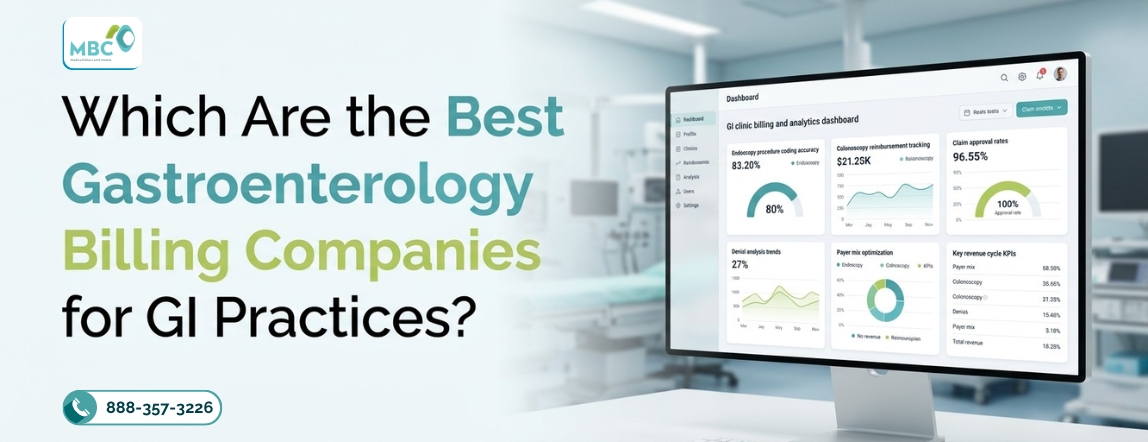
GI practices need denial root-cause visibility by payer, procedure code, and provider — not monthly summary reports. Best-in-class vendors deliver dashboards that identify whether your denial spike is a coding issue (ICD-10 specificity) or a payer policy shift (prior auth requirement changes), so your team stops treating symptoms and fixes causes.
Endoscopy Unit vs. Office Billing
GI practices billing for both in-office services and hospital-based or freestanding endoscopy units face dual revenue streams with separate compliance requirements. The best gastroenterology billing companies manage both under one infrastructure — preventing the coordination gaps that create duplicate denials and delayed remittances.
Medical Billers and Coders (MBC): Built for GI Revenue Performance
MBC’s Gastroenterology Center of Excellence delivers specialty-specific revenue performance management — not transactional billing. Over 25 years serving high-volume GI practices, MBC has engineered the operational infrastructure that recovers revenue where generic vendors routinely fail.
What MBC delivers for GI practices:
- Colonoscopy Revenue Protection: Real-time coding audits prevent CPT downcoding on polypectomy and biopsy add-ons, maintaining a 97.8% clean claim rate on endoscopy procedures
- Modifier PT & KX Compliance: Automated screening-to-diagnostic conversion workflows eliminate the $85–$220 per-claim revenue loss from incorrect modifier application
- Denial Recovery Infrastructure: Average 24% reduction in Days in AR for multi-physician GI groups within 90 days of engagement
- Hepatology & IBD Complexity Coding: Infusion therapy, biologic administration (CPT 96413, J0178 series), and chronic disease management codes captured and billed at full contracted value
- CFO-Grade Reporting: Executive dashboards showing Net Collection Ratio by procedure category, payer variance analysis, and month-over-month AR trend — the visibility your financial leadership demands
GI practices partnering with MBC average a 15% improvement in Net Collection Ratio, translating to $310,000 in additional annual revenue for a practice billing $2M+ annually.
To evaluate your current revenue performance gap, explore MBC’s pricing and engagement models designed for GI practices at every volume level.
Understanding Medical Billing Services Cost for GI Practices
Medical Billing Services Cost in gastroenterology typically ranges from 4%–8% of net collections, depending on practice size, procedure complexity, and denial volume. However, evaluating cost without evaluating recovery performance is the wrong framework.
A vendor charging 5% that recovers 94% of collectible revenue outperforms a vendor charging 3.5% that recovers 87% — by $130,000+ annually on a $2M practice. The question isn’t what billing costs. It’s what under-billing costs.
The best gastroenterology billing companies are priced as an investment in margin protection — and they prove it with metrics, not promises.
Ready to improve your gastroenterology practice’s financial performance?
Partner with Medical Billers and Coders for accurate coding, faster reimbursements, and proactive denial management. Get your revenue cycle analysis now.
FAQs
GI billing involves procedure-specific bundling rules, colonoscopy screening-to-diagnostic modifier conversions, and ERCP complexity coding that require specialty-trained coders. Generic Medical Billing Services routinely miss add-on codes and misapply modifiers, resulting in significant annual revenue loss for GI practices.
Top gastroenterology billing companies use GI-certified coders who correctly differentiate CPT 45378 (diagnostic colonoscopy) from 45380–45392 (with intervention), apply Modifier PT for screening-converted-to-diagnostic claims, and capture all billable add-on procedures — preventing the bundling denials that cost practices $150–$300 per case.
Evaluate clean claim rates on endoscopy procedures (benchmark: 97%+), denial rate by procedure category, Days in AR (GI benchmark: under 30 days), and whether the vendor has GI-specific coders — not generalists. Also confirm they manage both office-based and endoscopy unit billing if applicable to your practice.
Medical Billing Services Cost for GI practices typically falls between 4%–8% of net collections. High-complexity or high-volume practices may negotiate performance-based models. The more relevant metric is Net Collection Ratio improvement — a quality GI billing partner should demonstrate 14%–18% NCR uplift within the first 90 days.
Most GI practices see measurable improvement within 60–90 days of transitioning to a specialty-focused billing partner. Early wins typically come from denial recovery on previously written-off claims, modifier correction on existing case backlog, and improved clean claim rates that accelerate payer remittance cycles — compressing Days in AR by 20%+ in the first quarter.

A Subject Matter Expert in healthcare billing operations with nearly 10 years of experience, sharing insights on claims processing, coding support, and revenue cycle optimization. Dedicated to educating healthcare professionals on compliance, accuracy, and strategies to improve billing performance.