Specialities
 Services
 Resource Center
 Pricing
 About
About
 Contact
Best Orthopedic Medical Billing Companies 2026:
- Medical Billers and Coders (MBC)
- Coronis Health
- AdvancedMD RCM
- CareCloud
- Tebra (formerly Kareo)
Orthopedic billing is not general medical billing with harder codes. It is a distinct revenue cycle discipline where modifier errors, global period tracking failures, and implant documentation gaps routinely generate $150,000–$500,000 in annual uncaptured revenue for busy multi-surgeon practices. Choosing among the best orthopedic medical billing companies is not simply a vendor decision — it is a margin protection strategy that directly impacts collections, compliance, and long-term profitability.
According to the Medical Group Management Association (MGMA), top-performing orthopedic practices achieve Net Collection Rates of 95%–98%. The national median sits near 93%–94%. That 2–5 percentage point gap, at $5M in annual collections, represents $100,000–$250,000 in recoverable revenue that the wrong billing company silently writes off each year. We evaluated the leading orthopedic medical billing companies against five criteria that orthopedic practice administrators and CFOs actually use when selecting a billing partner.
Key Takeaways
- The article lists the Best Orthopedic Medical Billing Companies 2026, including Medical Billers and Coders (MBC), Coronis Health, AdvancedMD RCM, CareCloud, and Tebra.
- Orthopedic billing is distinct from general medical billing, facing unique challenges like modifier errors and global period tracking failures that can lead to significant revenue loss.
- MBC stands out for its specialized orthopedic coders and consistently high Net Collection Rate (NCR) of over 97%.
- Evaluation criteria for billing companies include orthopedic coding depth, NCR, denial management, compliance with global period and modifiers, and scalability for multi-site practices.
- Selecting the right orthopedic billing company can protect margins and enhance compliance and long-term profitability.
How We Evaluated Orthopedic Medical Billing Companies
Generic billing company reviews compare pricing tiers and software features. This evaluation uses the criteria that determine whether an orthopedic practice collects what it is owed:
- Orthopedic Coding Depth: Certified coders with subspecialty-specific orthopedic experience — not generalists trained on multi-specialty CPT overview courses. This means demonstrated expertise in 90-day global period management, modifier application (24, 25, 58, 78, 79), fracture care billing, and device-intensive procedure documentation.
- Net Collection Rate (NCR) for Orthopedic Groups: The definitive performance metric. NCR measures the percentage of collectible revenue actually recovered after adjustments. For orthopedic practices, world-class NCR is 95%–98%. Anything below 92% is a signal of systemic failure.
- Denial Management for Orthopedic CPT Codes: Root-cause denial analytics specific to orthopedic code families — not generic claim resubmission workflows that treat a modifier 25 denial the same as an eligibility failure.
- Global Period and Modifier Compliance: Systematic tracking of 90-day global periods for major procedures (joint replacement, spine surgery) and 10-day periods for minor procedures — a standard that most generalist billing companies treat as the practice’s responsibility.
- Multi-Site and PE-Group Scalability: Ability to support multi-surgeon, multi-OR, and PE-backed orthopedic networks without degrading coding accuracy or compliance controls at scale.
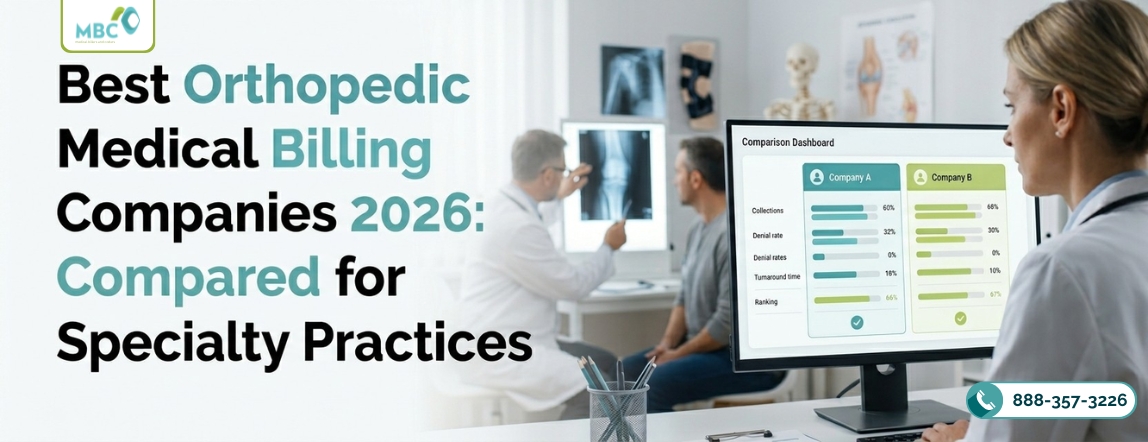
Quick Comparison: Best Orthopedic Medical Billing Companies 2026
| Company | Best For | Orthopedic Coding Depth | Reported NCR | Global Period Tracking | Enterprise Fit |
|---|---|---|---|---|---|
| Medical Billers and Coders (MBC) | Multi-surgeon groups and PE-backed orthopedic networks | Subspecialty-certified orthopedic coders | 97%+ | Standard service | ★★★★★ |
| Coronis Health | Large orthopedic hospital systems | Broad multi-specialty | ~94% | Practice-managed | ★★★★☆ |
| AdvancedMD RCM | AdvancedMD platform users | Platform-dependent | 95% FPAR* | Not included | ★★★☆☆ |
| CareCloud | Mid-size orthopedic practices | General multi-specialty | ~90% | Practice-managed | ★★★☆☆ |
| Tebra (Kareo) | Small independent orthopedic offices | Primary care focus | ~88–91% | Not included | ★★☆☆☆ |
*FPAR = First Pass Acceptance Rate, which measures clean claim submission, not ultimate revenue recovery. NCR and FPAR are related but distinct metrics. AdvancedMD does not provide in-house medical coding.
#1 — Medical Billers and Coders (MBC): Best for Orthopedic Multi-Surgeon Groups
Orthopedic billing has three revenue failure points that most billing companies mishandle: global period compliance, multi-procedure modifier accuracy, and implant cost documentation. MBC’s orthopedic billing practice is built around eliminating all three through subspecialty-certified coders who work exclusively on orthopedic claim mixes — not generalists rotating across specialties.
Why MBC Leads in Orthopedic Billing
- 90-Day Global Period Management as a Standard Service: Joint replacements, spine surgery, and major fracture repairs carry a 90-day global period during which post-operative visit billing requires modifier 24 or 25 with compliant documentation. MBC tracks global periods systematically across every claim, flagging modifier requirements at the charge entry stage — not after a denial. Most generalist billing companies leave global period tracking to the practice, creating both compliance exposure and revenue loss from unbilled separately payable services.
- Modifier Accuracy for Multi-Procedure Cases: Orthopedic cases frequently involve multiple procedures in a single surgical session — bilateral procedures, staged repairs, and device-plus-implant documentation. MBC’s orthopedic coders apply modifiers 50, 51, 59, and 78/79 with case-specific accuracy, reducing the most common orthopedic denial trigger: incorrect bundling of separately billable procedure components.
- Implant and Device Documentation: CMS and commercial payers require specific invoice documentation for implant cost passthrough on device-intensive procedures including total joint arthroplasty and spinal hardware. MBC’s billing workflow includes an implant documentation checkpoint that catches missing or incomplete invoices before claim submission — eliminating a denial category that orthopedic practices frequently discover only during retrospective AR reviews.
- 97%+ Net Collection Rate for Orthopedic Groups: MBC delivers a documented 97%+ NCR to orthopedic practices through acuity-based coding protocols, real-time claim scrubbing against payer-specific orthopedic rules, and proactive denial root-cause analytics. For a $5M orthopedic practice, each percentage point of NCR improvement above the national median represents $50,000 in annual revenue recovered.
- Best For: Multi-surgeon orthopedic groups, PE-backed orthopedic networks, orthopedic practices with $1M+ in monthly collections, and spine and joint replacement centers requiring subspecialty coding depth with CFO-grade financial reporting.
Contact MBC for Orthopedic Billing: 888-357-3226 | info@medicalbillersandcoders.com
#2 — Coronis Health: Best for Orthopedic Hospital Systems
Coronis Health has built a credible enterprise RCM reputation, including recognition in Everest Group’s Revenue Cycle Management PEAK Matrix Assessment. For large orthopedic hospital systems that have already integrated Coronis into their broader health network revenue cycle infrastructure, the platform offers genuine operational depth.
The limitation for specialty orthopedic groups is Coronis’s generalist coding model. Its strength is enterprise technology infrastructure and process scale — not subspecialty coding accuracy at the level that multi-surgeon orthopedic practices require. Practices with high volumes of complex procedures including spine, arthroplasty, and sports medicine microsurgery report coding depth gaps compared to dedicated orthopedic billing specialists.
Best For: Large health systems with orthopedic service lines already integrated into broader Coronis RCM infrastructure.
#3 — AdvancedMD RCM: Best for AdvancedMD Platform Users
AdvancedMD’s billing services are best understood as a native extension of its practice management platform. For orthopedic practices deeply invested in the AdvancedMD ecosystem, the integrated billing layer reduces claim submission friction and data silos between scheduling, documentation, and billing workflows.
The critical limitation: AdvancedMD does not provide in-house medical coding. Orthopedic practices using AdvancedMD RCM must maintain their own certified coding staff internally — effectively splitting the revenue cycle between two operational owners.
This creates accountability gaps when denial root causes require distinguishing between a coding error and a billing submission error. For orthopedic groups where coding complexity is the primary driver of NCR performance, this split model is a structural weakness.
Best For: Orthopedic practices already on the AdvancedMD platform with established in-house coding staff who need billing submission and AR management support.
#4 — CareCloud: Best for Mid-Size Orthopedic Practices Seeking Workflow Structure
CareCloud delivers structured denial management workflows and live reporting dashboards that give practice administrators real-time visibility into claims activity. Its reported 90% collection rate and 30-day AR reduction metrics are credible for general orthopedic practices with moderate procedure complexity.
The ceiling for CareCloud in orthopedic billing appears at multi-surgeon groups with complex procedure mixes. Subspecialty coding depth for high-acuity procedures including revision arthroplasty, complex spine reconstruction, and trauma surgery requires coder expertise that CareCloud’s generalist model does not consistently deliver at the same level as a dedicated orthopedic billing specialist.
Best For: Established mid-size orthopedic practices with moderate procedure complexity seeking structured workflow management and real-time claims dashboards.
#5 — Tebra (Formerly Kareo): Best for Small Independent Orthopedic Offices
Tebra serves small and independent practices, primarily in primary care and behavioral health. For orthopedic practices, its billing services are optimized for lower-complexity procedure mixes — general office visits, fracture care for simple injuries, and routine musculoskeletal injections — rather than the surgical complexity of a busy orthopedic group.
PE-backed orthopedic networks, multi-surgeon groups with high surgical volumes, and spine or arthroplasty centers should not evaluate Tebra as a billing partner. The platform is not built for their revenue cycle requirements.
Best For: Solo orthopedic practitioners or small independent offices on the Kareo platform with low surgical volumes and routine musculoskeletal procedure mixes.
The Three Revenue Failure Points Every Orthopedic Practice Must Address
Before selecting any orthopedic billing company, every practice administrator and CFO should assess performance against these three specific failure points that the AAOS identifies as the primary drivers of orthopedic revenue loss:
- Global Period Non-Compliance: CMS defines a 90-day global period for major orthopedic surgical procedures. Incorrectly billing post-operative visits without required modifiers generates both denial exposure and compliance risk. Failing to bill separately payable new problems within the global period generates uncaptured revenue. Both failures require subspecialty billing expertise, not general modifier knowledge.
- Multi-Procedure Bundling Errors: NCCI (National Correct Coding Initiative) edits define which orthopedic procedure codes are bundled and which are separately billable. Incorrect bundling is the most common orthopedic denial trigger. Consistent unbundling errors generate OIG audit risk. A billing company without orthopedic-specific NCCI expertise generates both denial volume and compliance exposure simultaneously.
- Authorization and Medical Necessity Documentation: Commercial payers have significantly increased prior authorization requirements for orthopedic surgical procedures since 2023. Incomplete or late authorization documentation is the fastest-growing denial driver for orthopedic practices nationally. An orthopedic billing company should include authorization tracking and medical necessity documentation review as a standard pre-submission checkpoint — not a reactive response after a denial.
Ready to Benchmark Your Orthopedic Revenue Performance?
If your orthopedic practice is collecting below 95% NCR, you are leaving recoverable revenue behind on every claim cycle. MBC’s orthopedic billing specialists deliver subspecialty-certified coding, 90-day global period management, and CFO-grade AR reporting as standard services — not add-ons.
Request a complimentary AR analysis for your orthopedic practice and identify the specific revenue gaps your current billing workflow is generating.
FAQs: Best Orthopedic Medical Billing Companies
Orthopedic billing involves high-complexity coding decisions that general billers consistently mishandle: 90-day global period tracking for joint replacements and spine surgery, modifier application (24, 25, 58, 78, 79) for post-operative visits, fracture care billing with treatment-specific code selection, and implant cost documentation for device-intensive procedures. A generalist coder applying broad CPT knowledge to an orthopedic claim mix will generate denial rates 3–5 percentage points above a subspecialty-certified orthopedic coder. At $500K monthly in orthopedic collections, that gap represents $15,000–$25,000 in monthly revenue loss.
According to MGMA benchmarks, top-performing orthopedic practices achieve Net Collection Rates of 95%–98%. The national average across all orthopedic practices sits near 93%–94%. A billing company delivering below 92% NCR for an orthopedic group is a signal of systemic coding errors, denial mismanagement, or inadequate payer contract knowledge — not payer behavior. Orthopedic practices should insist on NCR benchmarking against MGMA multi-specialty group median data, not against the billing company’s own reported averages.
Ask five non-negotiable questions before signing: (1) What percentage of your coding staff hold CPC or COC certifications with orthopedic subspecialty experience? (2) What is your documented denial rate for orthopedic CPT codes 27447, 27130, and 22551? (3) Do you provide 90-day global period tracking as a standard service, or is it an add-on? (4) What is your average Days in AR for orthopedic groups with similar payer mixes? (5) Can you provide three orthopedic-specific client references? A billing company that cannot answer all five specifically is a generalist vendor dressed as a specialist.
The American Academy of Orthopaedic Surgeons (AAOS) reports that orthopedic practices experience denial rates ranging from 10%–15%, significantly above the 5%–8% target that well-managed specialty billing delivers. The primary denial drivers are modifier errors on global period visits, medical necessity documentation gaps for surgical authorizations, and bundling errors on multi-procedure cases. A billing company with orthopedic subspecialty certification should reduce denial rates to 5% or below within 90 days of onboarding.
No. Orthopedic practices using the same vendor for EHR and billing lose the independent audit layer that catches revenue loss. EHR vendors optimize their billing modules for claim submission volume, not specialty coding accuracy. EHR-agnostic billing companies review claims against payer rules independently, catching errors the integrated system generates rather than concealing them within a closed technology loop.

A Subject Matter Expert in healthcare billing operations with nearly 10 years of experience, sharing insights on claims processing, coding support, and revenue cycle optimization. Dedicated to educating healthcare professionals on compliance, accuracy, and strategies to improve billing performance.