Specialities
 Services
 Resource Center
 Pricing
 About
About
 Contact

Chronic condition claims face payment delays because their complexity—involving multiple diagnoses, care coordination codes, and time-based documentation requirements—creates systematic documentation gaps, coding errors, and medical necessity justification failures that cause 35–45% initial denial rates, compared to 8–12% for acute care claims, resulting in $240,000 to $680,000 in annual revenue cycle friction for multi-provider practices managing diabetic, cardiovascular, COPD, and chronic pain populations.
The clinical challenge of managing chronic conditions—diabetes, heart failure, COPD, chronic kidney disease—extends directly into revenue cycle operations. These patients generate the highest reimbursement per encounter when properly coded, yet they also have the highest denial rates, the longest Days in AR, and the highest write-off percentages across all patient categories.
The Chronic Condition Payment Paradox
Why High-Value Care Creates High-Friction Billing
Chronic condition management represents the revenue cycle’s most valuable yet most vulnerable segment:
Revenue Potential:
- Average reimbursement per chronic care visit: $185–$340
- Chronic Care Management (CCM) codes: $85–$155 monthly per patient
- Transitional Care Management (TCM): $235–$320 per transition
- Remote Patient Monitoring (RPM): $115–$185 monthly per patient
Revenue Reality:
- Initial denial rate: 35–45%
- Average Days in AR: 52–68 days (vs. 28–35 for acute care)
- Write-off percentage: 12–18% of gross charges
- Appeal success rate when pursued: 65–72%
The Gap: Practices generate high charges but collect low percentages due to systematic operational failures in documentation, coding, and payer compliance.
Five Documentation Failures Driving Chronic Condition Payment Delays
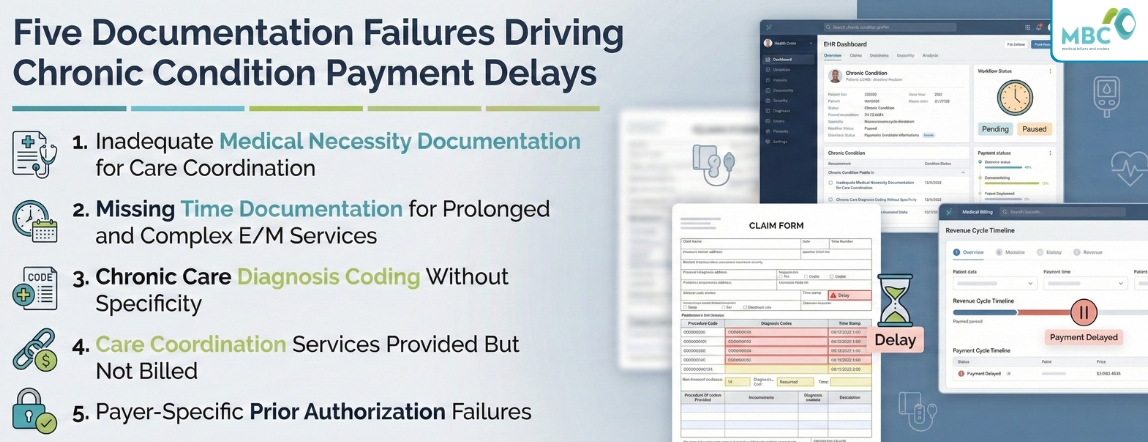
1. Inadequate Medical Necessity Documentation for Care Coordination
The Core Problem:
Chronic Care Management (99490, 99439, 99487, 99489) requires at least 20 minutes of non-face-to-face time per month, documented with specific elements that most practices fail to capture.
CMS Requirements for CCM:
- Comprehensive care plan documented
- 24/7 access to the care team
- Electronic care plan shared with patient
- Medication reconciliation performed
- Coordination with other providers documented
What Triggers Denials:
Practices document “managed patient’s diabetes this month” without the granular detail CMS requires. Payers deny 100% of CCM revenue when documentation lacks any required element.
Revenue Impact:
| Item | Amount |
| CCM-eligible chronic patients | 240 patients |
| Monthly CCM revenue at 60% enrollment | $12,240 (144 patients × $85) |
| Denial rate without proper documentation | 45–60% |
| Monthly revenue lost | $5,508–$7,344 |
| Annual impact | $66,096–$88,128 |
The Documentation Fix:
Medical Billers and Coders implement CCM documentation protocols that capture all required elements:
Instead of: “Managed diabetes care this month.”
Document: “CCM services provided 25 minutes: Reviewed home glucose logs showing AM readings 180–220 mg/dL, coordinated with endocrinologist Dr. Smith regarding insulin adjustment, updated comprehensive care plan to reflect new Lantus dosing (30 units), medication reconciliation completed identifying potential Metformin-lisinopril interaction, care plan electronically transmitted to patient portal, patient education provided on hypoglycemia recognition, 24/7 access confirmed via answering service.”
This documentation supports CCM billing and survives audit review.
2. Missing Time Documentation for Prolonged and Complex E/M Services
The Problem:
Chronic condition visits routinely exceed standard E/M time thresholds because multiple diagnoses require assessment, yet practices fail to document the total time or bill prolonged service codes.
The 2021 E/M Update Impact:
Time-based coding now includes:
- Face-to-face time with the patient
- Same-day time reviewing records, labs, and imaging
- Care coordination time with other providers
- Counseling and education time
Common Scenario:
A diabetic patient with poorly controlled A1C, hypertension, and diabetic neuropathy requires:
- 35 minutes face-to-face assessment
- 15 minutes reviewing recent endocrinologist notes and lab results
- 10 minutes coordinating with the nephrologist regarding creatinine elevation
- Total time: 60 minutes
Revenue Leakage Without Time Documentation:
| Service Level | Time Threshold | Reimbursement |
| 99214 (typical billing) | 30–39 minutes | $150–$185 |
| 99215 (appropriate) | 40–54 minutes | $215–$265 |
| 99215 + 99417 (actual) | 55+ minutes | $270–$340 |
Loss per encounter: $85–$155
For a practice averaging 3 such encounters daily across 4 providers:
- Daily loss: $1,020–$1,860
- Annual loss: $255,000–$465,000
The Fix:
Implement EHR time-tracking and documenting:
- Start and stop times for a face-to-face encounter
- Time spent reviewing records (with specifics)
- Time coordinating care (with provider names)
- Total time calculation
Medical Billers and Coders configure automated time summation fields that populate billing recommendations based on documented time.
3. Chronic Care Diagnosis Coding Without Specificity
The Problem:
Chronic conditions require ICD-10 code specificity that many practices fail to provide, triggering denials even when services are medically necessary.
Example: Type 2 Diabetes Coding
Generic coding (triggers denials):
- E11.9 (Type 2 diabetes without complications)
Specific coding (supports reimbursement):
- E11.65 (Type 2 diabetes with hyperglycemia)
- E11.40 (Type 2 diabetes with diabetic neuropathy, unspecified)
- E11.21 (Type 2 diabetes with diabetic nephropathy)
- E11.36 (Type 2 diabetes with proliferative diabetic retinopathy)
Why This Matters:
CMS and commercial payers use ICD-10 code specificity to:
- Determine medical necessity for testing and treatments
- Calculate risk adjustment scores (affects capitated payments)
- Identify conditions qualifying for care management programs
- Trigger prior authorization requirements
Revenue Impact:
A practice coding 200 diabetic patients with E11.9 instead of specific complication codes:
- Loses CCM eligibility for patients who don’t “appear” complex enough
- Receives lower risk adjustment payments in value-based contracts
- Faces higher denial rates for specialty testing (A1C, microalbumin, retinal exams)
The Fix:
Medical Billers and Coders maintain ICD-10 coding matrices for chronic conditions:
Table 1: ICD-10 Specificity for Common Chronic Conditions
| Condition | Generic Code (Inadequate) | Specific Codes (Required) | Documentation Trigger |
| Type 2 Diabetes | E11.9 | E11.65 (hyperglycemia), E11.40 (neuropathy), E11.21 (nephropathy) | A1C >7%, creatinine elevation, neuropathy symptoms |
| Heart Failure | I50.9 | I50.23 (acute on chronic systolic), I50.43 (acute on chronic diastolic) | EF%, symptoms, acute exacerbation |
| COPD | J44.9 | J44.1 (with exacerbation), J44.0 (with infection) | FEV1%, exacerbation within 12 months |
| CKD | N18.9 | N18.3 (Stage 3), N18.4 (Stage 4), N18.5 (Stage 5) | GFR calculation, creatinine level |
| Hypertension | I10 | I11.0 (with heart disease), I12.9 (with CKD), I13.0 (with both) | Comorbid conditions documented |
4. Care Coordination Services Provided But Not Billed
The Problem:
Practices provide extensive care coordination for patients with chronic conditions but fail to bill separately billable services because staff don’t recognize coding opportunities.
Commonly Missed Billable Services:
Transitional Care Management (TCM): 99495-99496
- Patient discharged from the hospital
- Face-to-face visit within 7 or 14 days
- Non-face-to-face services (medication reconciliation, discharge follow-up)
- Reimbursement: $235–$320 per transition
Principal Care Management (PCM): 99424-99427
- Single high-risk chronic condition
- 30+ minutes monthly management
- Reimbursement: $75–$145 monthly
Remote Patient Monitoring (RPM): 99453, 99454, 99457, 99458
- Device setup and patient education
- Daily monitoring data transmission
- Monthly data review and patient interaction
- Reimbursement: $115–$185 monthly per patient
Revenue Leakage:
A practice managing 300 chronic condition patients:
- 25 hospital discharges monthly (no TCM billing): Lost $5,875–$8,000 monthly
- 100 eligible for RPM (no billing): Lost $11,500–$18,500 monthly
- 80 eligible for PCM (no billing): Lost $6,000–$11,600 monthly
- Total monthly loss: $23,375–$38,100
- Annual loss: $280,500–$457,200
The Fix:
Medical Billers and Coders implement chronic care service tracking:
- Hospital discharge alerts triggering TCM workflow
- Monthly CCM/PCM eligibility screening
- RPM enrollment protocols with automated billing triggers
- Staff training on care coordination coding opportunities
5. Payer-Specific Prior Authorization Failures
The Problem:
Chronic condition treatments and testing often require prior authorization, but practices submit claims without obtaining authorization—resulting in 100% denials.
High-Denial Services Without Prior Auth:
Diabetes:
- Continuous glucose monitors (CGM)
- Insulin pumps
- Diabetic shoes (>$75)
- Advanced imaging for complications
Cardiovascular:
- Cardiac MRI
- Advanced lipid panels
- Genetic testing
- Implantable loop recorders
COPD:
- Pulmonary function tests (frequency limits)
- Home oxygen
- Nebulizer medications (specific brands)
CKD:
- EPO injections
- Advanced CKD panels
- Renal imaging beyond standard ultrasound
Revenue Impact:
For a practice ordering 50 prior-auth-required services monthly:
- Average service cost: $800–$2,400
- Denial rate without prior auth: 85–95%
- Monthly denied revenue: $34,000–$114,000
- Annual impact: $408,000–$1,368,000
Even when prior authorization is eventually obtained, and claims resubmitted, the delay extends Days in AR by 45–90 days and consumes 3–5 hours of staff time per case.
The Fix:
Medical Billers and Coders maintain payer-specific prior authorization matrices:
- Which services require authorization by the payer
- Payer-specific clinical criteria for approval
- Required documentation elements
- Submission timelines and portals
Automated EHR alerts flag orders requiring prior authorization before services are rendered.
How Chronic Condition Complexity Creates Systematic Revenue Cycle Failure
The Compounding Documentation Burden
Chronic condition management requires documentation supporting:
Multiple Diagnoses:
- Average chronic care patient: 4.7 active diagnoses
- Each diagnosis requiring specific ICD-10 code
- Interaction between diagnoses documented
- Severity/complexity justified
Multiple Providers:
- Primary care physician
- Specialists (endocrinology, cardiology, nephrology)
- Care coordination between providers is documented
- Medication reconciliation across providers
Multiple Services:
- Office visits (E/M codes)
- Care management (CCM, PCM, TCM)
- Remote monitoring (RPM)
- Preventive services
- Each service requires separate documentation standards
Multiple Payer Requirements:
- Medicare’s specific CCM documentation
- Commercial payers’ varying care management criteria
- Prior authorization requirements by the payer
- Medical necessity standards by payer and service
The Result:
When any single documentation element fails, the entire claim fails—even when clinical care is exceptional and services are medically necessary.
Payer-Specific Variation in Chronic Condition Coverage
Why the Same Service Gets Different Outcomes
Commercial payers maintain varying coverage policies for chronic condition management services.
Example: Chronic Care Management for a Diabetic Patient
Medicare:
- Covers CCM (99490) for patients with 2+ chronic conditions
- Requires documented consent
- Requires 20+ minutes non-face-to-face time
- Reimbursement: $85/month
UnitedHealthcare:
- Covers CCM but requires additional documentation
- Prior notification recommended
- May bundle with other services
- Reimbursement: $72–$88/month
Aetna:
- Covers CCM under specific contracts
- Requires a care plan documented in a certified EHR
- Denies overlap with other care management
- Reimbursement: $65–$82/month
BCBS (varies by state):
- Some plans cover CCM, others don’t
- May require participation in value-based programs
- Documentation requirements exceed Medicare standards
- Reimbursement: $58–$95/month (when covered)
Without Payer-Specific Protocols:
The same CCM service receives:
- Medicare: Approved and paid
- UnitedHealthcare: Approved with additional documentation
- Aetna: Denied due to “insufficient care plan documentation.”
- BCBS: Denied as “not a covered benefit.”
Medical Billers and Coders maintains updated coverage policies for the top 15 commercial payers, ensuring documentation meets payer-specific criteria before claim submission.
The Regulatory Context: CMS Focus on Chronic Condition Management
Why Federal Policy Emphasizes Chronic Care Revenue
CMS has systematically expanded chronic condition management codes because chronic disease accounts for:
- 90% of healthcare spending
- 7 in 10 deaths annually
- 86% of healthcare costs for Medicare beneficiaries
CMS Payment Policy Evolution:
2015: Chronic Care Management codes introduced 2017: Complex CCM codes added (99487, 99489) 2018: Remote Patient Monitoring codes introduced 2019: Principal Care Management codes added 2022: Additional RPM codes for data transmission 2023: Expanded time-based E/M coding
The Federal Intent:
Incentivize comprehensive chronic disease management through proper reimbursement for coordination activities previously unbillable.
The Practice Reality:
Most practices fail to capture this revenue due to documentation complexity and lack of specialized billing infrastructure.
OIG Scrutiny of Chronic Condition Billing
The Office of Inspector General audits chronic care management billing to identify:
- Services billed without required documentation
- Time claimed but not actually spent
- Services provided by unqualified staff
- Patients were enrolled without proper consent
Audit Triggers:
- High percentage of patients with CCM billing (>60% raises flags)
- Consistent billing of maximum time codes
- Lack of variation in monthly time documentation
- Missing care plan documentation when audited
Consequences:
- Recoupment of improperly billed services
- Fines and penalties for systematic violations
- Exclusion from federal programs in severe cases
The Balance:
Practices must capture appropriate revenue while maintaining audit-defensible documentation, a requirement that most internal billing departments lack the specialized expertise to meet.
Identifying Chronic Condition Revenue Leakage: The 90-Day AR Diagnostic
Week 1–2: Chronic Care Patient Population Analysis
Extract Patient Data:
- All patients with 2+ chronic conditions (CCM-eligible)
- Patients with a single high-risk chronic condition (PCM-eligible)
- Recent hospital discharges (TCM-eligible)
- Patients with remote monitoring devices (RPM-eligible)
Calculate Eligibility vs. Billing:
| Service | Eligible Patients | Currently Billing | Billing Rate | Monthly Revenue Gap |
| CCM (99490) | 240 | 45 | 18.8% | $16,575 |
| Complex CCM (99487) | 80 | 8 | 10.0% | $11,160 |
| TCM (99495) | 25/month | 3/month | 12.0% | $5,170 |
| RPM (99457) | 120 | 0 | 0% | $13,800 |
| Total Monthly Gap | — | — | — | $46,705 |
| Annual Revenue Leakage | — | — | — | $560,460 |
Week 3–4: Denial Pattern Analysis by Chronic Condition Service
Extract Denial Data:
- CCM/PCM/TCM claims denied in the past 12 months
- Denial reason codes (CARC/RARC)
- Payer-specific denial rates
- Appeal outcomes when pursued
Categorize Denial Root Causes:
Table 2: Chronic Condition Denial Analysis
| Denial Reason | Percentage of Denials | Primary Cause | Prevention Strategy |
| CO-16 (Missing information) | 32% | Incomplete CCM documentation | Implement the CCM documentation checklist |
| CO-197 (No prior authorization) | 28% | Prior authorization not obtained for DME, testing | Automated prior auth alerts in EHR |
| CO-50 (Non-covered service) | 18% | Payer doesn’t cover the specific CCM code | Verify coverage before service delivery |
| CO-18 (Duplicate claim) | 12% | Same-day E/M + CCM billing error | Modifier training, claim scrubbing |
| CO-96 (Non-covered charge) | 10% | Time threshold not met/documented | Time tracking automation |
Week 5–6: Payer Performance Benchmarking for Chronic Services
Calculate Payer-Specific Metrics:
Table 3: Payer Performance on Chronic Condition Claims
| Payer | CCM Approval Rate | Avg. Days to Payment | Denial Rate | Appeal Success | Net Yield |
| Medicare | 88% | 18 days | 12% | 78% | 94.2% |
| UnitedHealthcare | 76% | 34 days | 24% | 68% | 87.3% |
| Aetna | 82% | 28 days | 18% | 72% | 89.6% |
| BCBS Local | 64% | 42 days | 36% | 61% | 78.4% |
| Humana | 71% | 38 days | 29% | 65% | 83.9% |
Strategic Insights:
- BCBS has the lowest approval rate (64%) and the longest payment cycle (42 days)
- Medicare offers the highest net yield (94.2%) but requires strict documentation
- UnitedHealthcare denials are primarily due to insufficient care plan documentation
- Humana requires specific consent language not needed for other payers
Operational Response:
- Develop payer-specific CCM documentation templates
- Escalate systematic BCBS denials to provider relations
- Implement automated consent tracking by payer requirement
- Focus CCM enrollment on Medicare patients first (highest yield)
Infrastructure Solutions: From Reactive to Proactive Chronic Care Revenue Management
Real-Time Service Eligibility Tracking
The Problem:
Most practices discover CCM/TCM/RPM billing opportunities weeks or months after services are provided—when documentation is incomplete or time windows have closed.
The Solution:
Configure EHR to flag eligible services at the point of care:
CCM Eligibility Alerts:
- Patient has 2+ active chronic conditions
- No CCM billing in the current month
- Last care plan update >12 months
- Alert: “Patient eligible for CCM—document qualifying activities.”
TCM Workflow Triggers:
- Hospital discharge data received
- Alert within 24 hours: “TCM eligible—schedule appointment within 7 days.”
- Post-discharge contact documented
- Face-to-face visit completed
- Automatic billing code population (99495 or 99496 based on timing)
RPM Enrollment Prompts:
- Patient with diabetes, hypertension, or heart failure
- Home monitoring device provided or recommended
- Alert: “Patient eligible for RPM—complete setup and consent.”
Medical Billers and Coders implement automated eligibility tracking that increases service capture from 15–25% to 65–80% of eligible patients.
Chronic Care Documentation Templates
The Gap:
Generic EHR templates don’t capture chronic care-specific documentation requirements, forcing providers to free-text critical elements—which they often forget or are incomplete.
The Solution:
Deploy condition-specific and service-specific templates:
CCM Documentation Template:
- Required time tracking (auto-calculated)
- Care plan review checkboxes
- Medication reconciliation fields
- Provider coordination documentation
- Patient communication log
- 24/7 access confirmation
- Consent verification
Diabetes Visit Template:
- A1C value and trend
- Home glucose monitoring review
- Complication screening (neuropathy, nephropathy, retinopathy)
- Medication adherence assessment
- Diabetic education provided
- ICD-10 code auto-population based on documented complications
These templates ensure documentation completeness while reducing provider documentation time by 35–40%.
Payer-Specific Prior Authorization Automation
The Manual Process Problem:
Staff manually checks whether services require prior authorization, then manually submits authorization requests through payer portals—consuming 20–30 minutes per case and frequently missing authorization requirements entirely.
The Automated Solution:
Integrate payer authorization databases with EHR:
Order Entry Alert: Provider orders a continuous glucose monitor for a diabetic patient → System checks payer (UnitedHealthcare) → Alert: “Prior authorization required—clinical criteria: A1C >7% on maximum oral therapy” → Documentation prompt: “Document current A1C and medication regimen” → One-click authorization submission to payer portal
Result:
- Prior authorization obtained before service delivery
- Claim submission with authorization number
- 98% approval rate vs. 15% without authorization
- Days in AR reduced by 45 days on average
Medical Billers and Coders maintains integrated authorization workflows for the top 15 commercial payers.
The Hybrid Revenue Model for Chronic Condition Management
Covered vs. Self-Pay Chronic Care Services
Medicare/Commercial Coverage (Billable):
- Office visits (E/M codes)
- Chronic Care Management (99490, 99439, 99487, 99489)
- Transitional Care Management (99495, 99496)
- Principal Care Management (99424-99427)
- Remote Patient Monitoring (99453, 99454, 99457, 99458)
- Preventive services (annual wellness visits, screenings)
Often Not Covered (Patient Pay or Supplemental):
- Extended nutrition counseling beyond covered limits
- Health coaching programs
- Group diabetes education (some payers)
- Advanced laboratory testing beyond coverage limits
- Home health aide services
Revenue Architecture for Chronic Care Practice
Monthly Revenue per Well-Managed Chronic Patient:
| Service | Frequency | Reimbursement |
| Office visits (99214) | 1–2/quarter | $150–$185 each |
| CCM (99490) | Monthly | $85 |
| RPM (99457) | Monthly | $65 |
| Preventive visit (G0438/G0439) | Annual | $185–$225 |
| Specialty testing | As needed | Variable |
Average Monthly Revenue per Patient: $180–$250
For practice managing 500 chronic patients with 70% service capture:
- Monthly revenue: $63,000–$87,500
- Annual revenue: $756,000–$1,050,000
Medical Billers and Coders help practices maximize billable service capture while identifying appropriate self-pay service opportunities.
Recover $280K–$680K in Lost Chronic Condition Revenue
If your practice manages diabetic, cardiovascular, COPD, or CKD patients and experiences systematic claim denials, payment delays, or low care management service billing, you’re likely losing $280,000 to $680,000 annually to preventable revenue cycle failures. Most practices excel at clinical chronic disease management but lack the specialized billing infrastructure required to translate care coordination, time-based documentation, and multi-diagnosis complexity into claims that payers approve on first submission.
Medical Billers and Coders’ Chronic Care Revenue Management program identifies your precise revenue leakage across five failure points: CCM/PCM/TCM services provided but not billed due to staff unfamiliarity with coding opportunities, documentation gaps causing 35–45% denial rates on chronic care claims, missing time documentation forfeiting $85–$155 per complex visit through lost prolonged service billing, ICD-10 coding without specificity triggering medical necessity denials and reducing risk adjustment revenue, and prior authorization failures creating 100% denials on high-value testing and treatments.
Our specialized infrastructure delivers chronic care-trained coders achieving 92–96% clean claim rates on CCM, TCM, and RPM services, automated eligibility tracking increasing service capture from 15–25% to 65–80% of qualifying patients, condition-specific EHR templates ensuring documentation completeness while reducing provider time by 35–40%, payer-specific prior authorization workflows preventing denials before claims are submitted, and real-time revenue opportunity alerts flagging billable services at point of care.
Request your Chronic Care Revenue Diagnostic to discover exactly how much collectible revenue you’re leaving on the table across CCM, TCM, RPM, and complex E/M services, receive payer-specific denial analysis showing which documentation gaps drive your highest denial rates, and learn which operational fixes deliver the fastest revenue recovery. Contact Medical Billers and Coders today to implement the Chronic Care Billing infrastructure that protects your margins while supporting the comprehensive, coordinated care your complex patients require.
Frequently Asked Questions
Chronic care management claims have higher denial rates because they require detailed, multi-layered documentation that many practices do not complete correctly. CCM codes demand proof of care coordination, comprehensive care plans, time tracking, and payer-specific compliance. Missing any required element results in claim denial, even when care is medically necessary. Time-based requirements and ICD-10 specificity further increase the risk of denial. Medical Billers and Coders reduce CCM denials by standardizing documentation, automating time capture, and applying payer-specific billing protocols.
CCM applies to patients with two or more chronic conditions and involves ongoing monthly care coordination. PCM is used for patients with a single high-risk chronic condition requiring intensive monitoring. TCM is a one-time service billed after hospital discharge and includes post-discharge follow-up and medication reconciliation. These services have strict billing and timing rules and cannot always be billed together. Medical Billers and Coders ensure compliant code selection while maximizing reimbursement.
Inadequate ICD-10 specificity reduces revenue by affecting medical necessity determinations, risk adjustment payments, care management eligibility, and quality performance metrics. Generic diagnosis codes fail to reflect disease severity, resulting in lower reimbursement, missed CCM qualification, reduced value-based payments, and weaker quality scores. Accurate ICD-10 coding allows practices to capture the full financial value of chronic care services.
Prior authorization failures result in automatic claim denials regardless of medical necessity, extend AR days, increase staff workload, and negatively affect patient satisfaction. Retroactive authorizations are time-consuming and often unsuccessful, reducing collection rates and creating an administrative burden. Repeated failures can also trigger stricter payer scrutiny. Medical Billers and Coders prevent these losses through automated authorization workflows and payer-specific compliance controls.
Practices should calculate chronic care NRY separately by comparing actual collections to total collectible revenue for patients with multiple chronic conditions. This approach highlights revenue leakage from missed CCM billing, documentation gaps, undercoded services, and ICD-10 specificity. Medical Billers and Coders perform chronic-care-focused NRY analysis to identify recoverable revenue and improve RCM performance within 90 days.
References
- Centers for Medicare & Medicaid Services. (2024). Chronic care management services: MLN fact sheet. U.S. Department of Health and Human Services.
- Centers for Medicare & Medicaid Services. (2023). Evaluation and management services guide. Medicare Learning Network.
- Centers for Disease Control and Prevention. (2023). Chronic diseases in America. U.S. Department of Health and Human Services.
- U.S. Department of Health and Human Services, Office of Inspector General. (2023).

Catering to more than 40 specialties, Medical Billers and Coders (MBC) is proficient in handling services that range from revenue cycle management to ICD-10 testing solutions. The main goal of our organization is to assist physicians looking for billers and coders, at the same time help billing specialists looking for jobs, reach the right place.