Specialities
 Services
 Resource Center
 Pricing
 About
About
 Contact
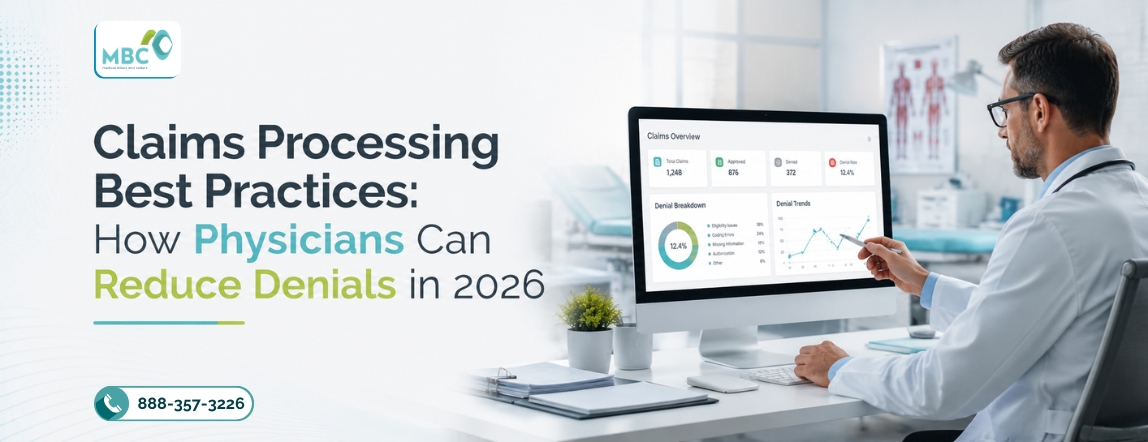
The single most effective Claims Processing Best Practices strategy in 2026 is catching errors before a claim ever leaves your system. Practices that shift from reactive denial management to pre-submission validation are cutting rejection rates by up to 35% and collecting faster — without adding billing staff.
Here’s what’s actually working on the ground.
Why Denials Are Getting Worse, Not Better
Most physicians assume denials are an unavoidable cost of doing business. They aren’t. They’re a symptom of a fixable process problem.
According to the Centers for Medicare and Medicaid Services (CMS), administrative errors account for a significant share of the estimated $1.1 trillion in annual healthcare administrative waste in the U.S. (CMS Electronic Billing Standards). At the practice level, that translates to over $180,000 in lost revenue and overhead per year for a mid-size group — not from complex cases, but from preventable mistakes in claim creation.
Manual data entry errors alone drive 42% of all rejections. Eligibility issues that could have been caught at check-in account for another major share. These aren’t coding mysteries. They’re workflow gaps.
The 4 Claims Processing Best Practices That Actually Move the Needle
1. Verify Before You Schedule, Not After You Bill
Real-time eligibility verification is the foundation of clean claim submission. Automated systems now confirm active coverage, copay structures, and prior authorization requirements before the patient walks through the door.
Practices running automated verification at the point of scheduling have seen eligibility-related denials drop by 45%. More importantly, they’ve eliminated the awkward post-service billing conversations that erode patient trust and delay collections.
The HIPAA Security Rule, enforced by the Department of Health and Human Services (HHS), also requires proper data management across the claims lifecycle — with audit penalties increasing for non-compliant handling of patient information. (HHS HIPAA Security Guidance)
2. Connect Your EHR Directly to Billing
One of the highest-impact Claims Processing Best Practices is eliminating the gap between clinical documentation and the billing office. When procedure codes and patient demographics transfer automatically from your EHR into claim creation, you remove the single largest source of manual error.
Native EHR integration reduces claim creation time by up to 70% and ensures the clinical record directly supports every billing code submitted. That alignment is what payers are looking for — and what auditors check when a claim gets flagged.
3. Use AI Scrubbing as Your Last Line of Defense
With over 70,000 ICD-10 codes in active use, manual coding review is a high-risk activity. AI-assisted coding tools now suggest optimal codes with confidence scores, reducing coding-related denials by nearly 45%.
Claims scrubbing software goes one step further — validating every claim against payer-specific rules before submission. Practices using scrubbing tools consistently achieve first-pass acceptance rates of 92–95%, compared to the 78–82% industry average for those still relying on manual review.
This is where partnering with professional medical billing and coding services pays for itself. The right team brings both the technology and the specialty-specific expertise to apply it correctly.
4. Build a Denial Pattern Dashboard, Not Just a Denial Log
Most practices track denials. High-performing practices analyze them. There’s a significant difference.
A denial log tells you what got rejected. A denial pattern dashboard tells you why, which payers are responsible, which procedure codes are triggering rejections, and — critically — which claims are at high risk before they’re submitted.
| Metric | Manual/Legacy Process | Automated Best Practice |
| First-Pass Acceptance Rate | 78–82% | 92–95% |
| Days in AR | 35–45 days | 18–22 days |
| Eligibility Denial Rate | High | Reduced by up to 45% |
| Coding Error Rate | High (manual) | Reduced by ~45% with AI |
| Compliance Check | Periodic manual review | Real-time embedded validation |
| Annual Revenue Lost to Errors | $180,000+ (mid-size practice) | Significantly reduced |
When you can see denial patterns in real time, you can fix the root cause — not just resubmit the claim.
The No Surprises Act: A Compliance Layer You Can’t Ignore
Effective January 2022 and still actively enforced in 2026, the No Surprises Act requires that automated eligibility checks include accurate out-of-network cost estimates for patients. Physicians who haven’t updated their intake workflows to include this compliance step are exposed to federal penalties and payer audits.
Embedding No Surprises Act checks into your verification workflow isn’t just a legal requirement — it’s a Claims Processing Best Practices standard that protects both your revenue and your patient relationships.
What “Revenue Cycle Management” Actually Means in 2026
The phrase gets used loosely. In practice, modern revenue cycle management in 2026 means having visibility into every stage of the claim — from eligibility at intake, through coding and scrubbing, to payment posting and denial resolution — in a single dashboard.
The practices outperforming their peers aren’t working harder on billing. They’re working with a revenue integrity partner who brings specialty-specific infrastructure, payer contract knowledge, and predictive analytics to the process. That combination is what drives Days in AR below 20 and pushes Net Collection Ratio above 96%.
If you’re managing this internally with spreadsheets and a general billing team, you’re likely leaving 8–12% of collectible revenue on the table every month.
When to Outsource vs. When to Optimize Internally
Not every practice needs to outsource everything. But every practice needs to honestly assess where their current process is leaking revenue.
If your first-pass acceptance rate is below 90%, your Days in AR are above 30, or you’re spending more than 15 minutes per denied claim on manual resubmission — those are signals that your current workflow isn’t built for 2026 volume and payer complexity.
Professional medical billing services that specialize in your specific specialty can close that gap faster than internal retooling, with lower risk and measurable ROI within the first 90 days.
Review our medical billing and coding pricing options to find a structure that fits your practice’s volume and specialty mix.
Ready to Stop Leaving Revenue on the Table?
If denials are consuming your staff’s time and your practice’s cash flow, the fix starts with the right Claims Processing Best Practices framework — not more billing staff doing the same manual work faster.
MBC’s certified billing specialists work across 40+ specialties, combining AI-assisted scrubbing, real-time eligibility verification, and specialty-specific coding expertise to drive first-pass acceptance rates above 92% for our physician clients.
Call us: 888-357-3226
Email us: info@medicalbillersandcoders.com
FAQs
1. What are Claims Processing Best Practices in 2026?
Real-time eligibility verification, EHR integration, AI-powered claims scrubbing, and predictive denial analytics — used together before a claim is submitted.
2. What causes the most claim denials for physicians?
Manual data entry errors account for 42% of rejections. Eligibility issues caught too late are the second-largest driver.
3. How much revenue do billing errors cost a typical practice?
Mid-size practices lose over $180,000 annually in revenue and overhead from manual processing inefficiencies and denial rework.
4. Is AI replacing medical billing staff?
No. In 2026, AI handles administrative validation; billing specialists handle complex appeals, payer negotiations, and exception management that requires clinical and contractual judgment.
5. How quickly can outsourced billing improve my denial rate?
Most practices partnering with a specialized billing service see measurable improvement in first-pass acceptance rates and Days in AR within 60–90 days of implementation.
Healthcare providers looking for the Fastest Claim Processing often choose medical billing services that combine AI-powered automation, real-time eligibility verification, proactive denial management, and specialty-specific billing expertise.
The most effective Claims Processing Best Practices include real-time eligibility verification, EHR-to-billing integration, AI-powered claims scrubbing, and denial pattern analysis dashboards. These strategies help providers catch errors before submission and significantly improve first-pass claim acceptance rates.
Claims Processing Best Practices help achieve Fastest Claim Processing by eliminating manual workflow gaps, reducing coding errors, and automating claim validation before submission. Practices that implement AI-assisted billing workflows often experience faster reimbursements, lower Days in AR, and improved revenue cycle efficiency.

With almost 12 years of experience in healthcare revenue cycle management, this Revenue Cycle Specialist brings deep expertise in medical billing, claims optimization, and practice profitability. Shares industry-backed insights focused on improving collections, reducing denials, and driving operational excellence.