Specialities
 Services
 Resource Center
 Pricing
 About
About
 Contact
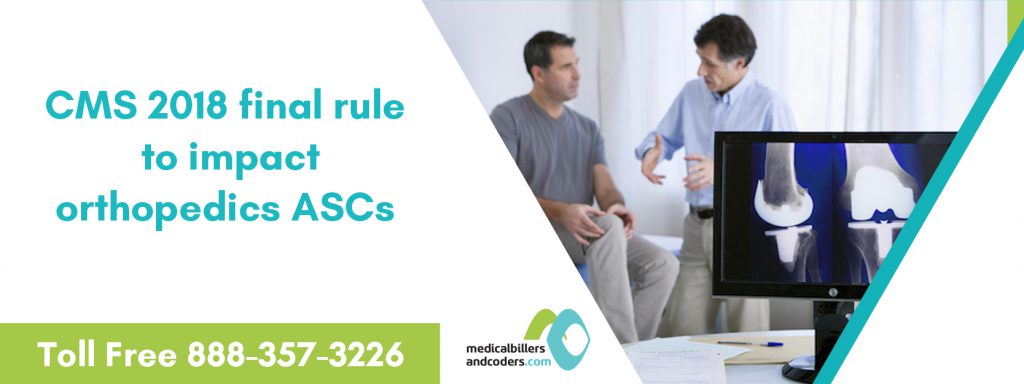
The Center for Medicare and Medicaid Services (CMS) has issued the final rules on Ambulatory Surgical Center (ASC) reimbursement and changes that could have important implication on the orthopedics billing in ASC. The rule includes update to payment policies, payment rates and also the quality provisions for the services provided under the Physician Fee Schedule (PFS).
The rule will be applicable on and after January 1, 2018. The final for the Payment rule provides 1.2 percent increase in ASC reimbursement and having effect on reimbursement of orthopedics billing at ASC.
Total Knee Replacement Removed From Inpatient Only List
CMS has finally implemented the long awaited rule of billing for removing the total knee replacement from the inpatient-only list. Though CMS hasn’t added the procedure to an ASC payable list, though many ASC providers who work on Total Knee replacement do feel that this means the arthroplasty can be added to the ASC payable list. The total knee replacement involves removing the damaged knee and replacing it with artificial knee implant.
Recent Advancement in the knee replacement surgery reduces the risk and creates the path on outpatient basis. Improved perioperative anesthesia, resulting into minimum invasive technique of rehabilitation procedure makes the procedure safe and with same day discharge.
The rule change has created confusion among the physician regarding how to interpret the new rule. Hospitals, surgeons and payers are all interpreting the rule according to their understanding. Further their seem to be no single consistency in the rule leading to the uncertainty about what needs to be concluded. An additional concern is that reporting of the Medicare Advantage plan which will be directing the network towards the TKA for an outpatient status.
Addition To Create ASC Payable List
CPT 22856
Used For:
Total disc arthroplasty (artificial disc), anterior approach, including discectomy with endplate preparation (includes osteophytectomy for nerve root or spinal cord decompression and micro dissection), single interspace, cervical.
CPT 22858 – Second Level
Used For:
Cervical disc arthroplasty with discectomy Artificial Total Disc Replacement involves the replacement of a degenerating intervertebral disc with an artificial disc in adults with degenerative disc disease (DDD) in either the lumbar or cervical region of the spine.
The artificial disc is intended to preserve range of motion (ROM) and reduce pain, and prevent adjacent disc degeneration. Like knee arthroplasty, cervical disc arthroplasty can also be performed using minimally-invasive techniques and patients can go home in less than 24 hours.
Quality Reporting:
CMS has finalized the new ASC payment system and quality reporting (ASCQR) measure to impact the orthopedic surgery center. This would be targeted towards
ASC-17:
Hospital Visits after Orthopedic Ambulatory Surgical Center procedure, which leads to assesses all-cause, unplanned hospital visit within seven days of orthopedic procedure.
Payment Rates:
Overall, ASC reimbursement rate will increase 1.2 percent in 2018. Hospital Outpatient department will lead to increase in 1.35 percent increase.
Orthopedics deals with major procedures and many of the rules would vary according to the payer’s contract. ASC reimbursement is complex and it makes more difficult with ever changing compliance regulations. For more info how your ASC facility can bill for orthopedics billing visit us.
FAQs
1. What changes has CMS introduced in ASC reimbursement for orthopedics starting January 1, 2018?
- CMS has implemented a 1.2% increase in ASC reimbursement rates and introduced new payment policies and quality measures. These updates are part of the Physician Fee Schedule (PFS) and directly impact orthopedics billing for procedures performed in ASCs.
2. How does the new CMS rule affect billing for Total Knee Replacement (TKR) in ASCs?
- CMS has removed Total Knee Replacement from the inpatient-only list, although it hasn’t yet added it to the ASC payable list. This change suggests a potential shift toward performing TKR on an outpatient basis, creating opportunities for ASCs to consider future billing for TKR.
3. What is the significance of adding CPT codes 22856 and 22858 to the ASC payable list?
- CPT 22856 and CPT 22858 are now on the ASC payable list for procedures involving cervical disc arthroplasty. These codes cover single and second-level disc replacements, which can be done with minimally invasive techniques, allowing patients to be discharged within 24 hours.
4. What quality reporting requirements are included in the new CMS rules for ASC orthopedic procedures?
- The new CMS rule includes ASC-17, a quality measure targeting unplanned hospital visits within seven days following an orthopedic procedure. This measure is part of the ASC Quality Reporting (ASCQR) initiative and aims to enhance the quality of care in orthopedic ASCs.
5. How does CMS’s final rule impact payment rates for ASC and hospital outpatient departments?
- Starting in 2018, ASC reimbursement rates will see a 1.2% increase, while hospital outpatient departments will experience a 1.35% rise. These adjustments are designed to support the financial viability of ASCs and outpatient departments while accommodating new compliance requirements in orthopedics billing.
Catering to more than 40 specialties, Medical Billers and Coders (MBC) is proficient in handling services that range from revenue cycle management to ICD-10 testing solutions. The main goal of our organization is to assist physicians looking for billers and coders, at the same time help billing specialists looking for jobs, reach the right place.