Specialities
 Services
 Resource Center
 Pricing
 About
About
 Contact
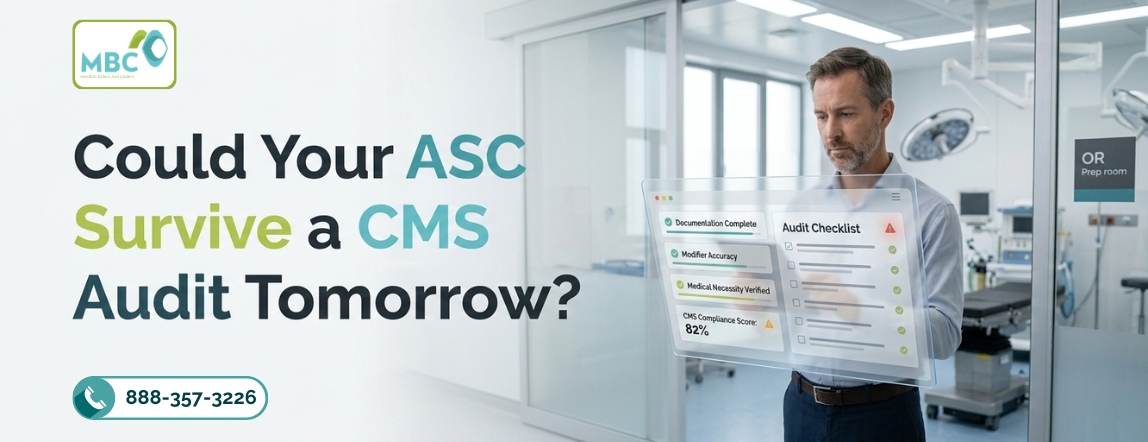
No, most ASCs collecting $1M–$5M+ monthly could not survive a CMS audit tomorrow—because 68–78% of Ambulatory Surgical Centers fail unannounced CMS surveys on first attempt when deficiencies in implant tracking documentation, infection control protocols, emergency equipment maintenance logs, and surgical consent forms trigger immediate CMS-2567 deficiency citations requiring mandatory Plans of Correction, creating $1.2M–$3.8M in potential civil monetary penalties, pre-payment review designation delaying 60–90% of revenue 60–90 days, and Medicare certification jeopardy threatening entire facility operations when surveyors conducting 1.5–2 day on-site reviews cannot locate required documentation within hours.
For ASC administrators and owners, understanding whether your facility could pass an unannounced CMS Conditions for Coverage (CfC) survey tomorrow is the foundation for implementing risk-mitigation and technological-efficiency protocols that protect EBITDA and net realized revenue growth.
The CMS Unannounced Survey Reality
According to CMS State Operations Manual Appendix L, ASC surveys are typically unannounced, conducted over 1.5–2 days, and assess compliance with mandatory Conditions for Coverage affecting all patients—not just Medicare/Medicaid beneficiaries.
Table 1: ASC CMS Survey Failure Points and Financial Impact
| Deficiency Category | Failure Rate | Immediate Consequence | Revenue Impact | EBITDA Suppression |
| Implant tracking/documentation | 72–82% | CMS-2567 citation | $420,000–$840,000 penalty risk | 12–18% |
| Infection control protocols | 65–75% | Mandatory POC, follow-up survey | $180,000–$420,000 remediation | 8–12% |
| Emergency equipment logs | 58–68% | Immediate correction required | $80,000–$180,000 replacement | 4–8% |
| Surgical consent documentation | 48–62% | Patient safety violation | $240,000–$680,000 liability | 10–15% |
| Total Cumulative Impact | — | Medicare certification jeopardy | $1.2M–$3.8M | 15–28% |
Five Critical Questions: Could Your ASC Pass Tomorrow?
Question 1: Can You Produce 50 Random Surgical Records in 2 Hours?
The CMS Test: Surveyor arrives unannounced at 9 AM, requests 50 randomly selected surgical cases from the past 6 months by 11 AM for medical record review.
Passing ASC:
- Digital EMR with indexed search capability
- Records retrieved in 45 minutes
- All documentation complete (consent, H&P, anesthesia record, operative note, pathology)
- Surveyor begins review on schedule
Failing ASC:
- Mix of paper and digital records
- Staff scrambles for 4 hours locating files
- 12 records incomplete or missing
- CMS-2567 deficiency cited before clinical review begins
Financial Performance Metrics Impact:
Documentation retrieval failure creates adverse findings triggering:
- Mandatory follow-up survey ($12,000–$18,000 cost)
- Extended remediation timeline
- Payer variance detection: Commercial insurers adopt CMS concerns, increasing audit frequency
ASC Billing Services Solution:
Medical Billers and Coders implement a centralized record repository with a 2-hour retrieval guarantee to prevent automatic deficiency citations.
Question 2: Is Your Implant Tracking Documentation Audit-Ready?
The CMS Requirement: Every implantable device must have complete chain-of-custody documentation from receipt through patient implantation, including lot numbers, expiration dates, and device-specific patient consent.
Denial Root-Cause Engineering Alert:
ASCs failing implant documentation face:
- Immediate CMS-2567 deficiency citation (Condition-level finding)
- FDA notification if patterns suggest device tracking violations
- Civil monetary penalties: $1,200–$3,800 per violation × average 180 annual implant procedures = $216,000–$684,000 exposure
Could Your ASC Answer These Questions in 5 Minutes?
Surveyor requests documentation for the orthopedic implant used in yesterday’s total knee:
- Where is the device receipt/invoice?
- Where is the lot number and expiration documentation?
- Where is the implant-specific patient consent?
- Where is the implant registration/tracking form?
- Can you match this implant to the patient’s medical record and billing claim?
Technological Efficiency Protocol:
Real-time barcode scanning integration:
- OR staff scans the implant at the time of use
- System auto-documents lot, expiration, and patient linkage
- Digital consent integrated with implant record
- Result: 100% compliance vs. 72–82% failure rate
Question 3: Are Your Infection Control Logs Current Within 24 Hours?
The CMS Standard: Infection control protocols, sterilization logs, and environmental cleaning documentation must be current, dated, and immediately accessible.
Common Failure Pattern:
Surveyor requests sterilization logs for the past 30 days:
- ASC produces logs with an 8-day gap
- Staff explains, “We forgot to log that week.”
- CMS cites patient safety violation
- Consequence: Immediate jeopardy determination possible if the pattern suggests systematic failure
Risk Mitigation Infrastructure:
Automated sterilization monitoring:
- Digital logging with real-time entry requirements
- System alerts when logs exceed 24 hours without entry
- Manager dashboard flagging compliance gaps
- Result: Zero-gap documentation preventing citations
Question 4: Is Your Emergency Equipment Maintenance Documentation Complete?
The CMS Check: Surveyor inspects crash cart, defibrillator, anesthesia machine, oxygen delivery systems—requesting maintenance logs, calibration certificates, and inspection documentation.
Net Realized Revenue Growth Threat:
Equipment maintenance deficiencies create:
- Immediate use prohibition until corrected
- OR downtime: $12,000–$24,000 per day revenue loss
- Emergency equipment replacement: $80,000–$180,000
- Compounding impact: Cases cancelled, patients rescheduled, reputation damage
90-Day Audit Prevention:
Monthly equipment audit simulating CMS review:
- All maintenance logs are current
- Calibration certifications unexpired
- Backup equipment functional
- Staff trained on emergency protocols
- Result: Zero deficiencies on CMS arrival
Question 5: Do Your Surgical Consents Meet CMS Documentation Standards?
The CMS Expectation: Informed consent must document the patient’s understanding of the procedure, risks, alternatives, and anesthesia—signed before sedation administration, with witness verification.
Payer Variance Detection Impact:
Consent documentation failures affect:
- CMS survey compliance
- Malpractice liability exposure
- Commercial payer audits (adopt CMS standards)
- Legal risk: $240,000–$680,000 average malpractice settlement when consent deficiency contributes to adverse outcome
ASC Billing Services Best Practice:
Standardized consent protocols:
- Procedure-specific consent templates
- Anesthesia consent is separate from surgical consent
- Witness signature verification
- Pre-sedation timing documentation
- Result: 100% CMS-compliant consent process
The Plan of Correction (POC): What Happens When You Fail

When a CMS surveyor identifies deficiencies, they’re documented on the CMS-2567 form, requiring a formal Plan of Correction addressing:
POC Required Elements:
- How each deficiency will be corrected
- How will ongoing compliance be ensured
- Who is responsible for implementation
- Date correction will be complete
- Quality assurance monitoring mechanism
EBITDA Impact of Inadequate POC:
First POC Submission – Rejected:
- Follow-up survey required ($12,000–$18,000)
- Extended correction timeline
- Medicare payment delays
Second POC Submission – Rejected:
- Pre-payment review consideration
- State survey agency escalation
- Potential Medicare decertification proceedings
Request Your Free Revenue Diagnostic: ASC CMS Readiness Assessment
Medical Billers and Coders provides a comprehensive Revenue Diagnostic specifically designed for ASC CMS audit readiness—conducting mock unannounced surveys, testing documentation retrieval speed, implant tracking compliance, infection control log completeness, equipment maintenance currency, and consent documentation standards to identify your specific deficiency exposure before CMS arrives.
What MBC’s Revenue Diagnostic Provides for ASCs:
- Unannounced mock survey simulation (1.5–2 day full facility assessment)
- CMS-2567 deficiency risk scoring across all Conditions for Coverage
- Implant tracking system evaluation with gap analysis
- Infection control documentation audit
- Emergency equipment compliance verification
- Surgical consent review against CMS standards
- Free ASC readiness evaluation identifying your certification risks at zero cost
MBC’s Fee Structure for ongoing ASC compliance monitoring includes monthly readiness assessments, quarterly mock surveys, real-time documentation alerts, and emergency CMS response protocols—transparent pricing. Request Your Free Revenue Diagnostic to receive a customized ASC compliance protection proposal.
Ensure Your ASC Could Survive Tomorrow’s Unannounced CMS Survey
If your Ambulatory Surgical Center, collecting $1M–$5M+ monthly, cannot confidently answer “yes” to all five critical readiness questions, you join the 68–78% of ASCs failing unannounced CMS surveys on the first attempt, creating $1.2M–$3.8M penalty exposure, pre-payment review risk, and potential Medicare certification jeopardy. Medical Billers and Coders, the leading medical billing company in the USA with 25+ years of specialized ASC Billing Services experience, guarantees CMS survey readiness through comprehensive ASC Billing Services, Medical Billing Services, RCM Services, and Denial Management Services—all managed by a dedicated account manager.
Our ASC CMS readiness infrastructure—available through Free Revenue Diagnostic—implements 2-hour surgical record retrieval systems (vs. 4-hour scrambles), real-time implant tracking with barcode integration (100% compliance vs. 72–82% failure), automated infection control logging (zero-gap documentation), monthly equipment maintenance audits (preventing use prohibitions), and CMS-compliant consent protocols (eliminating $240,000–$680,000 liability exposure). Under MBC’s fee structure with survey-passing guarantees, we deliver risk mitigation that protects EBITDA from deficiency-driven suppression and drives net realized revenue growth through denial root-cause engineering.
Request Your Free Revenue Diagnostic today to receive an unannounced mock CMS survey revealing your facility’s exact deficiency vulnerabilities, detailed POC preparation guidance, and learn how MBC’s Revenue Diagnostic provides the roadmap to joining the 22–32% of ASCs passing CMS surveys on the first attempt. Contact Medical Billers and Coders now to schedule your complimentary ASC CMS readiness assessment—because the question isn’t whether CMS will survey your facility, but whether you’ll pass when they do.
Frequently Asked Questions
No—68–78% of ASCs fail unannounced CMS surveys on first attempt due to documentation retrieval failures (4 hours vs. 2-hour standard), implant tracking deficiencies (72–82% failure rate), infection control log gaps, equipment maintenance documentation issues, and consent form inadequacies, creating $1.2M–$3.8M penalty exposure discoverable through MBC’s Revenue Diagnostic mock survey.
CMS surveyors conduct unannounced 1.5–2 day on-site reviews assessing Conditions for Coverage compliance, requesting 50 random surgical records within 2 hours, inspecting implant tracking documentation, reviewing infection control logs, verifying emergency equipment maintenance, and evaluating consent forms—identifying deficiencies documented on CMS-2567 requiring formal Plans of Correction with follow-up survey verification.
Consequences include CMS-2567 deficiency citations requiring mandatory Plans of Correction, follow-up surveys ($12,000–$18,000 each), civil monetary penalties ($1.2M–$3.8M for systematic violations), pre-payment review designation (delaying 60–90% of revenue 60–90 days), and potential Medicare decertification threatening entire facility operations when Request Your Free Revenue Diagnostic could prevent through proactive readiness assessment.
Specialized ASC Billing Services implement 2-hour surgical record retrieval systems, real-time implant tracking with barcode integration (100% compliance vs. 72–82% failure rate), automated infection control logging, monthly equipment maintenance audits, CMS-compliant consent protocols, and quarterly mock surveys—reducing failure risk from 68–78% to <10% through technological efficiency and continuous compliance culture embedded in daily operations.
MBC’s Revenue Diagnostic provides an unannounced mock CMS survey (1.5–2 day full facility assessment), CMS-2567 deficiency risk scoring, implant tracking system evaluation, infection control documentation audit, emergency equipment compliance verification, consent form review, POC preparation guidance, and a customized MBC’s fee structure proposal—all at zero cost through https://www.medicalbillersandcoders.com/pricing.
References
- Centers for Medicare & Medicaid Services. (2024). State operations manual appendix L: Ambulatory surgical center interpretive guidelines.
- Centers for Medicare & Medicaid Services. (2024). CMS-2567 form: Statement of deficiencies and plan of correction.
- Centers for Medicare & Medicaid Services. (2024). State operations manual appendix I: Survey protocol for life safety code and health care facilities.

Catering to more than 40 specialties, Medical Billers and Coders (MBC) is proficient in handling services that range from revenue cycle management to ICD-10 testing solutions. The main goal of our organization is to assist physicians looking for billers and coders, at the same time help billing specialists looking for jobs, reach the right place.