Specialities
 Services
 Resource Center
 Pricing
 About
 Contact
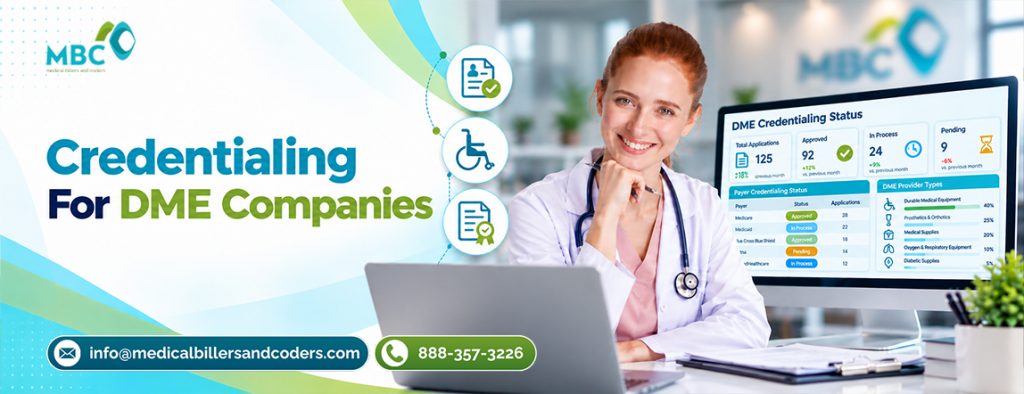
Durable Medical Equipment (DME) is equipment that includes oxygen supplies, wheelchairs, iron lungs, catheters, etc. As you are starting a Durable Medical Equipment (DME) company, be prepared with time on hand, money, endurance, and determination; as it ultimately boils down to being paid for the products sold by your company.
This means receiving DME bills from clients (patients/healthcare providers) and accepting the insurance, billing the insurance, and finally receiving payments for the DME billing from the insurance provider- is called Credentialing For DME Companies.
DME business also referred to as Home Medical Equipment business is replete with potholes along the way which need to be cleared. One of them is ‘Provider Credentialing.’ Credentialing simply denotes verification. It’s also known as DME credentialing, DME medical credentialing, DME provider enrollment, insurance credentialing, or getting on insurance panels.
These terms imply that the patient is going to pay through insurance and your company is “In-Network” with the insurance companies. And, as you go on to be accepted as a provider (post credentialing), receiving payments of DME billing through this process is known as an “In-Network” provider. It also implies acknowledging more clients along with on-time and accurate payments.
There are a number of companies through which a DME company can/should be credentialed; government organizations like Medicare, Medicaid, or Tricare, and other big players (commercial insurance) in the market such as Aetna, BCBS, UHC, Cigna, etc. Smaller companies could be targeted too as they have immense potential with respect to a greater number of clients and comprise lesser competition.
Key Takeaways
- DME credentialing puts your company in-network with Medicare, Medicaid, Tricare, and commercial payers so your claims get paid. Claims submitted before approval are denied.
- Medicare DMEPOS enrollment is filed on the CMS-855S and requires accreditation from a CMS-approved organization, a $50,000 surety bond, and a site visit.
- Accreditation (for example ACHC, The Joint Commission, HQAA, or The Compliance Team) must be completed before you can enroll with Medicare.
- Commercial DME insurance credentialing typically takes 90–120 business days for 8–12 carriers, plus 30–60 days for contracting.
- Medicare DMEPOS suppliers must revalidate every 3 years and meet all 42 CFR §424.57(c) supplier standards to keep billing privileges.
- Outsourcing DME provider enrollment reduces application errors, the most common cause of credentialing delays and lost revenue.
DME Credentialing Process:
1. Obtain an office space.
2. Acquire a business bank account.
3. Obtain a business organization and a set location.
4. Organize all documents: Information on a license, background, insurance, and resume. Also, double-check that the application has been signed, dated, and holds a legal document- Unique Federal Tax ID#.
A DME provider credentialing usually takes around 90 to 120 business days for 8-12 carriers. This is the stage for approval and denial. Post credentialing, you move towards ‘Contracting’ which states your eligibility to be in the network of insurance providers. Here, the insurance company sends a contract to be read and signed by you and the doorway to the network occurs in the next 30-60 days.
Note: Centers for Medicare and Medicaid Services (CMS) approved 10 national accreditation organizations that will accredit suppliers of durable medical equipment, prosthetics, orthotics, and supplies (DMEPOS) as meeting new quality standards under Medicare Part B. In order to enroll or maintain Medicare billing privileges, all DMEPOS suppliers (except for exempted professionals and other persons as specified by the Medicare Improvement for Patients and Providers Act of 2008) must comply with the Medicare program’s supplier standards (found at 42 CFR §424.57 (c)) and quality standards to become accredited (www.cms.gov).
Understand that no insurance company acknowledges preceding claims before acceptance in the network. Hence, it is always better to start the credentialing process early to avail of benefits and reimbursements.
How Much Does DME Credentialing Cost?
The total DME credentialing cost combines fixed government and accreditation fees with the cost of preparing and following up on payer applications. Here is what DME suppliers typically budget for:
| Cost Component | Typical Range | Notes |
|---|---|---|
| CMS application fee (CMS-855S) | Set annually by CMS | Paid per enrollment and revalidation; check the current year’s fee on CMS.gov |
| DMEPOS accreditation | $3,000 – $10,000+ per 3-year cycle | Varies by accrediting body, locations, and product categories |
| $50,000 Medicare surety bond | About 1% – 3% of bond value per year | Required per NPI; premium depends on credit and business history |
| State DME / pharmacy licensure | Varies by state | Some states require a separate DME supplier license |
| Outsourced credentialing service | Per-payer or monthly bundle | Depends on number of payers, locations, and ongoing maintenance needs |
How MBC prices DME credentialing: Every DME supplier has a different payer mix, location count, and product line, so we custom-quote each engagement. Your quote is based on:
- Number of payers (Medicare, state Medicaid, Tricare, commercial carriers)
- Number of locations and NPIs to enroll
- Scope: new enrollment, revalidation, CAQH maintenance, or full managed credentialing
- Add-ons: payer contracting support and DME billing services
Request a custom DME credentialing quote →
You can choose our outsourced DME billing and coding services and we would take care of the complete range of billing and coding responsibilities for you, including preparing claims using appropriate DME codes and modifiers and other medical details, submitting them, and following up with insurance authorities for their timely reimbursement.
Call us today to talk about what you need to know about DME credentialing, and We can discuss your options. For all questions and further information, reach out to us at 888-357-3226 or at info@medicalbillersandcoders.com.
Frequently Asked Questions About DME Credentialing
Medicare DMEPOS enrollment usually takes 60–90 days after accreditation is complete. Commercial DME insurance credentialing typically takes 90–120 business days for 8–12 carriers, plus 30–60 days for contracting. Incomplete applications are the main cause of delays.
Yes. Most DMEPOS suppliers must be accredited by a CMS-approved accreditation organization before enrolling in Medicare. Certain licensed professionals, such as physicians and physical therapists, are exempt under MIPPA 2008.
Medicare requires DMEPOS suppliers to hold a $50,000 surety bond for each enrolled NPI. The bond protects Medicare against overpayments the supplier fails to repay. Suppliers pay an annual premium, usually a small percentage of the bond amount.
DME provider enrollment requires a completed CMS-855S, NPI, Federal Tax ID (EIN), state licenses, accreditation certificate, surety bond, proof of a physical business location, liability insurance, a business bank account, and ownership and managing-employee details.
DMEPOS suppliers must revalidate their Medicare enrollment every 3 years, more often than most other provider types. Missing a revalidation deadline can deactivate billing privileges and stop payments.
Yes. Medicare treats each DMEPOS location as a separate supplier, so every site goes through its own enrollment, bonding, accreditation coverage, and site visit. A new site can’t bill under the parent location’s PTAN. Medicaid and commercial plans often ask for location-level enrollment too.
Since January 1, 2026, a change in majority ownership of a DMEPOS supplier within 36 months of its initial Medicare enrollment, or of its last majority ownership change, requires a brand-new enrollment application. That means new screening and possible delays. Buyers and PE groups should review this rule before closing any DME acquisition.
No. The moratorium that began February 27, 2026 expired on August 27, 2026, and NPE contractors are taking initial applications again. CMS can impose new six-month pauses, so keep accreditation, licensure, and bond files current.
No. Medicare enrollment only allows you to bill traditional Medicare. Each state Medicaid program, Medicare Advantage plan, and commercial insurer runs its own credentialing and contracting. Many require Medicare enrollment and accreditation first, so suppliers should start these applications in parallel to avoid months of unbilled revenue.
Finish state licensure and accreditation first, then secure the surety bond and file a complete CMS-855S in PECOS. Keep your location open, staffed, and signed for the unannounced site visit. Matching details across NPPES, PECOS, and accreditation records avoids most development requests that slow approval.

A Subject Matter Expert in healthcare billing operations with nearly 10 years of experience, sharing insights on claims processing, coding support, and revenue cycle optimization. Dedicated to educating healthcare professionals on compliance, accuracy, and strategies to improve billing performance.