Specialities
 Services
 Resource Center
 Pricing
 About
About
 Contact
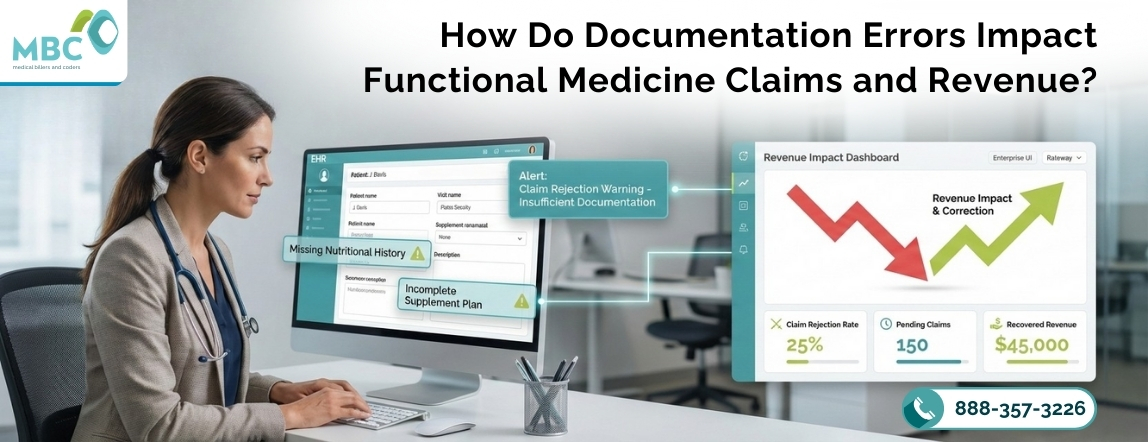
Documentation errors cost functional medicine practices $180,000 to $420,000 annually through functional medicine claims denials, E/M code downgrades, and missed billing opportunities—not because services lack value, but because 60–90 minute consultations aren’t documented in the payer-compliant format required for reimbursement.
The clinical care is exceptional. The treatments work. But without proper documentation, payers deny functional medicine claims—and revenue disappears.
Why Functional Medicine Documentation Fails
Traditional vs. Functional Medicine Documentation
Traditional Medical Visits:
- 15–30 minute visits
- Single-problem focus
- Brief documentation
Functional Medicine Visits:
- 90-minute consultations
- Multi-system assessment
- Extensive lifestyle interventions
- Specialty laboratory testing
The Three Costly Errors
1. Undercoding
- Billing 99213 for 90 minutes
- Loss: $65–$95 per visit
2. Overcoding Without Support
- Billing 99215 without proper documentation
- Result: Audits and recoupment
3. Missing Medical Necessity
- Specialty testing denied
- Loss: $2,000–$8,000 per patient
Five Documentation Failures Costing Six Figures
1. Inadequate Medical Necessity for Extended Visits
The Problem: Billing 99215 without documenting medical decision-making complexity on functional medicine claims.
Revenue Impact:
| Code | Reimbursement | Loss |
| 99215 (billed) | $215–$285 | — |
| 99213 (paid) | $130–$165 | $85–$120 |
Annual Loss: $15,300–$21,600 (15 new patients/month)
What’s Missing:
- Number and complexity of problems
- Amount of data reviewed
- Risk without treatment
The Fix:
Medical Billers and Coders train documentation using 2021+ E/M guidelines:
Time-Based:
- Face-to-face: 65 minutes
- Administrative: 25 minutes
- Total: 90 minutes → Qualifies for 99215 + prolonged codes
MDM Documentation: “Patient with hypothyroidism, IBS, and chronic fatigue requires extensive data review, including 15 years of records, a comprehensive hormone panel, and GI mapping. High risk without treatment: uncontrolled inflammation increases cardiovascular disease risk.”
2. Specialty Lab Testing Without Medical Necessity
The Problem: Ordering comprehensive testing without linking symptoms to each test—a leading cause of functional medicine claims denials.
Revenue Impact:
| Item | Amount |
| Specialty panel cost | $2,000–$4,500 |
| Denial rate | 40–60% |
| Monthly volume | 8–12 patients |
| Annual loss | $76,800–$129,600 |
What Triggers Denials:
CMS requires services to be “reasonable and necessary.” Generic “wellness screening” language triggers automatic denials.
The Fix:
Wrong: “Ordered comprehensive hormone panel.”
Right:
“Patient presents with persistent fatigue (6+ months), 15-pound weight gain, cold intolerance, irregular menses. Comprehensive thyroid panel (TSH, Free T3, Free T4, Reverse T3, antibodies) ordered to differentiate primary hypothyroidism vs. conversion issues vs. autoimmune thyroiditis—standard TSH insufficient given symptom complexity. Testing is medically necessary to establish a diagnosis and prevent progression.”
Result: Lab approval rates increase from 45–60% to 88–94%.
3. Missing Time Documentation for Prolonged Services
The Problem: Not billing prolonged service codes when visits exceed 54 minutes.
The Opportunity:
- 99215 covers up to 54 minutes
- 99417 adds $55–$75 per 15-minute increment
Revenue Leakage:
| Item | Amount |
| Uncaptured per visit | $55–$75 |
| New patients monthly | 15 |
| Annual loss | $9,900–$13,500 |
The Fix:
Document total time, including:
- Face-to-face time
- Record review time
- Care coordination time
Medical Billers and Coders configure EHR templates with automatic time tracking and billing recommendations.
4. Lifestyle Interventions as “Patient Education.”
The Problem: Documenting nutrition counseling as “education” instead of a therapeutic intervention.
Missed Revenue:
| Service | Code | Monthly Revenue |
| Nutrition therapy | 97802-97804 | $55–$75 per 15 min |
| Behavioral health | 99484 | $65/month |
| Chronic care mgmt | 99490 | $85–$155/month |
Total: $120–$280 monthly per patient
The Fix:
Wrong: “Discussed anti-inflammatory diet.”
Right:
“Medical nutrition therapy: 30 minutes developing an individualized anti-inflammatory protocol for elevated CRP (8.2 mg/L) and autoimmune markers. Macronutrient targets (40% carb, 30% protein, 30% fat), elimination protocol for inflammatory triggers (gluten, dairy, refined sugars). Written meal plan provided. Follow up in 14 days. Billed 97802.”
5. Missing ICD-10 Translation
The Problem: Using functional medicine terms that don’t exist in ICD-10—causing immediate functional medicine claims rejections.
Common Denials:
- “Adrenal fatigue” → Not a code
- “Leaky gut” → Not recognized
- “Detoxification” → Not a medical diagnosis
The Solution:
Table 1: ICD-10 Translation
| Functional Term | ICD-10 Code | Documentation |
| Adrenal fatigue | E27.40 + R53.82 | Cortisol results, orthostatic hypotension |
| Leaky gut | K63.9 + K59.9 | GI symptoms, food intolerances |
| Brain fog | R41.840 | Cognitive testing, daily function impact |
| Hormone imbalance | E28.9 + N94.6 | Menstrual irregularities, hormone levels |
Revenue Impact Summary
Table 2: Documentation Error Costs
| Error | Revenue Loss |
| No MDM complexity | $85–$120 per visit |
| Missing time tracking | $55–$75 per visit |
| Lab without medical necessity | $2,000–$4,500 per patient |
| Missing ICD-10 translation | 100% claim denial |
| Lifestyle as “education.” | $120–$280/month per patient |
Payer-Specific Requirements
Why Same Service Gets Different Coverage
Example: PCOS Hormone Testing
UnitedHealthcare:
- Basic panel only
- Prior authorization for extensive testing
Aetna:
- Expanded testing if coded E28.2 (PCOS)
- Denies if coded E28.9 (unspecified)
BCBS:
- Requires failed first-line treatments documented
- Needs specific symptom scoring
Medical Billers and Coders maintain payer matrices, ensuring functional medicine claims documentation meets specific criteria before submission.
Regulatory Context
CMS requires services to be “reasonable and necessary” under the Social Security Act.
If it is not documented, carriers consider the service was not performed.
Consequences:
- Increased audit risk
- Higher denial rates
- Potential fraud allegations
Six-Week Documentation Audit
Week 1–2: Baseline Review
Extract 30–50 encounters and analyze:
- Does MDM match the billed code?
- Is time documented?
- Are labs linked to findings?
- Do ICD-10 codes support interventions?
Week 3–4: Gap Identification
Common Findings:
- 68% of 99215 claims lack MDM documentation
- 92% of extended visits are missing time
- 45% of labs lack medical necessity
- 71% of nutrition is documented as “education.”
Week 5–6: Template Implementation
Deploy EHR templates with:
- Auto time tracking
- MDM complexity checkboxes
- Lab medical necessity fields
- ICD-10 dropdown menus
Table 3: Audit Findings
| Element | Current | Required | Revenue at Risk |
| MDM for 99215 | 32% | 100% | $11,900/year |
| Time tracking | 8% | 100% | $9,900/year |
| Lab necessity | 55% | 95%+ | $115,200/year |
| Nutrition coding | 5% | 80%+ | $13,200/year |
Infrastructure Solutions
Real-Time Quality Monitoring
Configure EHR alerts:
- Visit 60+ minutes without time → Alert
- 99215 without MDM → Prompt
- Lab without diagnosis link → Require necessity
- Nutrition without code → Suggest 97802-97804
Specialty Coding Support
Medical Billers and Coders’ Functional Medicine Center of Excellence provides:
- Integrative medicine-trained coders
- Nutrition therapy certification
- Chronic care management expertise
- Specialty lab protocols
Result: Clean claim rates increase from 82–87% to 94–97%, ensuring the functional medicine claims process is successful on the first submission.
Hybrid Revenue Model
Covered vs. Non-Covered
Typically Covered:
- Office visits (proper coding)
- Medical nutrition therapy
- Chronic care management
- Standard laboratory testing
Typically Not Covered:
- Supplement dispensing
- Advanced specialty testing (varies)
- Group visits
- Extended coaching
Revenue Architecture
Billable (Insurance):
| Service | Reimbursement |
| Initial consult | $280–$365 |
| Follow-up | $180–$285 |
| Nutrition therapy | $55–$75 per 15 min |
| Care management | $85–$142/month |
Patient Pay:
- Supplements: $80–$200/month
- Group programs: $500–$1,500
- Coaching: $75–$150/session
Protect Your Functional Medicine Practice From $180K–$420K in Annual Revenue Loss
If your functional medicine practice is experiencing systematic claim denials despite delivering exceptional, medically necessary care, documentation gaps are silently draining six figures from your annual revenue. You’re not alone—most functional medicine practitioners excel at clinical care but lack the specialized billing infrastructure required to translate 90-minute consultations, comprehensive laboratory testing, and integrative treatment protocols into payer-compliant documentation that survives audit review and secures appropriate reimbursement.
Medical Billers and Coders‘ Functional Medicine Center of Excellence specializes in identifying the precise documentation failures driving your denials, whether it’s E/M code downgrades from inadequate medical decision-making documentation, specialty laboratory claim denials from insufficient medical necessity justification, missed prolonged service revenue from absent time tracking, or uncaptured nutrition therapy and chronic care management revenue that’s being documented as non-billable “patient education.”
Our functional medicine-trained coders, who are credentialed in integrative medicine billing protocols, nutrition therapy certification, and chronic care management expertise, achieve 94–97% clean claim rates on functional medicine claims while reducing denial rates from the industry average of 12–18% down to just 3–6%. We deploy EHR templates with embedded documentation quality checks, maintain payer-specific medical necessity protocols for specialty testing, provide ICD-10 translation frameworks that convert functional medicine diagnoses into codes payers recognize, and implement real-time documentation monitoring that prevents denials before claims are ever submitted.
Don’t wait until your next quarterly financial review reveals the revenue erosion that’s been occurring for months—request your practice documentation audit today to discover your specific revenue leakage from documentation gaps, receive a detailed analysis quantifying exactly where documentation fails to support the services you provide, and learn how much collectible revenue you’re currently leaving on the table.
Schedule a CFO briefing to see how functional medicine practices nationwide are recovering $180,000 to $420,000 annually through systematic documentation improvement and specialty coding expertise, and contact Medical Billers and Coders today to protect your margins while maintaining the integrative, patient-centered care model that differentiates your practice and delivers superior clinical outcomes for your patients.
References
-
Centers for Medicare & Medicaid Services. (2024). Medicare Benefit Policy Manual (Chapter 15).
-
American Medical Association. (2023). CPT® 2023 evaluation and management (E/M) guidelines.
-
Social Security Administration. (1965). Social Security Act, Section 1862(a)(1)(A).
FAQs
Functional medicine billing differs because visits are longer, documentation must support time or medical decision-making, specialty testing requires clear medical necessity, and lifestyle-based treatments must be documented correctly to be billable. Diagnoses often need careful ICD-10 translation, and hybrid self-pay and insurance services must be clearly separated. Without specialized billing expertise, practices commonly lose $85–$120 per visit or face audit risk.
Link every test to clinical findings. Don’t write “ordered hormone panel.” Write: “Patient with fatigue (6+ months), weight gain (15 lbs), cold intolerance, irregular menses. Thyroid panel ordered to differentiate hypothyroidism vs. conversion issues—TSH alone insufficient.” Medical Billers and Coders increase approval from 45–60% to 88–94%.
Yes, using 97802-97804 when documented as a therapeutic intervention. Requirements: qualified provider, time documentation, medical diagnosis, individualized plan, and follow-up scheduled. CPT 97802: 30 minutes ($55–$75). Many practices forfeit $120–$280 per patient per month by documenting as “discussed diet.”
99215 claims are downgraded when documentation fails to demonstrate high complexity. Simply listing diagnoses is not enough. The record must clearly show multiple chronic conditions, extensive data review, and high clinical risk without treatment. Strong documentation explains what data was reviewed, how decisions were made, and why the patient’s condition required advanced care coordination and intervention.
If the claim is never processed because they perceive errors that could be corrected, it is a rejection. Rejections: technical errors, can resubmit. Denials: processed but deemed not covered/necessary, require appeal. Medical Billers and Coders prevent 8–12% rejections through scrubbing, reducing denials from 12–18% to 3–6%.

Catering to more than 40 specialties, Medical Billers and Coders (MBC) is proficient in handling services that range from revenue cycle management to ICD-10 testing solutions. The main goal of our organization is to assist physicians looking for billers and coders, at the same time help billing specialists looking for jobs, reach the right place.