Specialities
 Services
 Resource Center
 Pricing
 About
About
 Contact
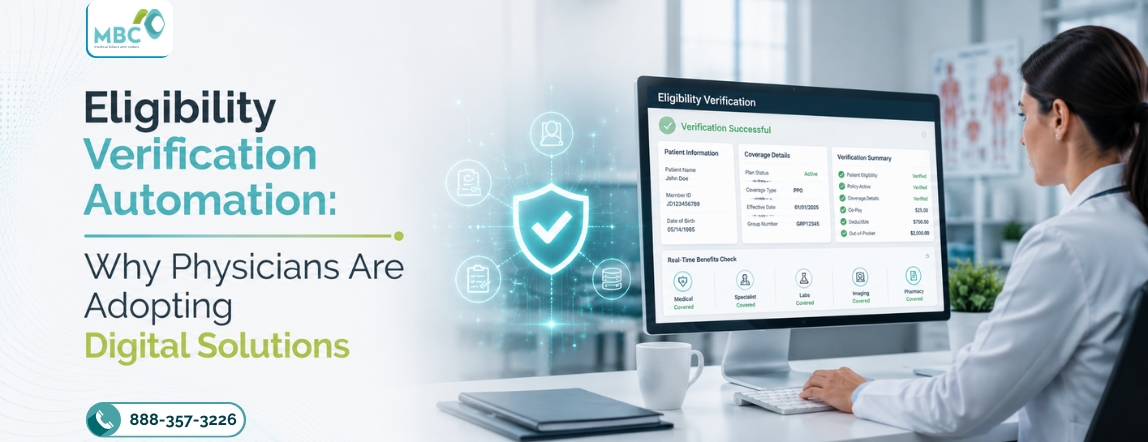
Eligibility Verification Automation is how modern practices eliminate the #1 front-end revenue leak: unverified insurance. In plain terms, it replaces the 12-minute manual phone call to a payer with a real-time electronic check that takes under 60 seconds — and in doing so, it prevents up to 75% of eligibility-related denials before a single claim is ever submitted.
If your front desk is still calling payer lines to confirm coverage, your practice is silently bleeding revenue every single day.
The Real Cost of Manual Verification in 2025–2026
Let’s put numbers to this problem.
The Centers for Medicare & Medicaid Services (CMS) consistently reports that eligibility and coverage issues account for nearly 50% of all claim denials in the U.S. healthcare system. Meanwhile, the HHS Office of Inspector General has flagged eligibility verification failures as a recurring compliance risk in Medicare and Medicaid billing audits.
For a practice seeing 30 patients a day, manual verification eats over six hours of staff time daily. That’s not an administrative inconvenience. That’s a structural revenue problem.
And it gets worse. A manual eligibility check costs roughly $3.70 per transaction. An automated one? $0.74. That’s an 80% cost reduction per verification — and that saving compounds across thousands of patient encounters per year.
What Eligibility Verification Automation Actually Does
Eligibility Verification Automation uses HIPAA-standardized EDI 270/271 transactions to query payer systems in real time. The 270 is the inquiry; the 271 is the response. Together, they pull current coverage data — deductibles, co-pays, in-network status, prior auth requirements — directly into your EHR or billing platform before the patient ever steps into the exam room.
Here’s what that prevents:
- Claims submitted under inactive or lapsed plans
- Billing errors from secondary/tertiary payer misidentification
- Missed prior authorization triggers on carved-out services
- Front-desk check-in delays caused by coverage uncertainty
The American Medical Association (AMA) reported in its 2024 Prior Authorization Survey that 94% of physicians say administrative burdens from manual verification and prior auth workflows have a significant negative impact on patient outcomes. That number reflects a systemic failure in how front-end revenue cycle steps are being handled.
Manual vs. Automated Eligibility Verification: By the Numbers
| Factor | Manual Process | Automated (EDI 270/271) |
| Time per patient | ~12.64 minutes | Under 60 seconds |
| Cost per verification | $3.70 | $0.74 |
| Denial risk | High — 50% of denials are eligibility-related (CMS) | Low — 70–75% reduction in eligibility denials |
| Error source | Human transcription, outdated payer portals | Direct payer data feed |
| Coverage complexity | Often misses secondary/tertiary payers | Flags multi-payer situations automatically |
| Patient experience | Delays at check-in, billing surprises | Real-time out-of-pocket estimate at arrival |
The business case is not subtle. Practices that implement automation as part of a structured revenue cycle management program recover the cost of implementation within weeks, not quarters.
Why This Matters More Right Now
Hospital operating margins across the U.S. are hovering between -1% and 3% as of 2026, according to data tracked by the American Hospital Association (AHA). That’s a razor-thin buffer. Any revenue lost to front-end verification errors is revenue that cannot be recovered from the back end — and most denial management workflows aren’t designed to catch eligibility failures efficiently after the fact.
At the same time, 62% of patients report being confused about their insurance benefits, according to Experian Health’s 2024 Patient Access Survey. Confusion at the patient level translates directly into delayed collections and write-offs at the practice level. Practices that give patients a real-time out-of-pocket cost estimate at check-in — enabled by Eligibility Verification Automation — consistently report higher point-of-service collection rates.
The Hybrid Model: Automation Plus Human Oversight
Automation handles 80% of routine verifications with speed and accuracy. But it doesn’t handle everything perfectly. Complex cases — patients with Medicare Advantage + secondary commercial coverage, COBRA transitions, or out-of-network surgical scenarios — require a trained human eye on the flag.
The most effective approach pairs automated real-time checks with expert human review on low-confidence results. This is exactly the model a specialized revenue integrity partner runs — not just pushing claims through, but owning the verification outcome.
Practices that rely on a full-service medical billing and coding services partner with embedded eligibility automation typically achieve 98%+ pre-visit verification rates across their patient volume. Generic billing vendors typically don’t build this capability into their workflows — which is why eligibility-related denial rates at those practices remain stubbornly high.
HIPAA Compliance Requirements for Automated Systems (2026 Standards)
Implementing Eligibility Verification Automation means handling Electronic Protected Health Information (ePHI) at scale. Per the HHS HIPAA Security Rule, every system touching ePHI must meet:
- Encryption standards: AES-256 for data at rest; TLS 1.2 or higher for data in transit
- Audit logging: Access logs maintained for a minimum of 6 years
- Business Associate Agreements (BAA): Mandatory for any third-party vendor processing patient data on your behalf
Any automation vendor that cannot produce a signed BAA and demonstrate encryption compliance should not be handling your verification workflow.
What the Revenue Impact Looks Like in Practice
A multi-physician internal medicine group running 200 patient encounters per week — with zero Eligibility Verification Automation in place — is typically looking at:
- 24+ eligibility-related denials per week
- $8,000–$15,000 in monthly rework and resubmission costs
- 6+ hours of daily staff time consumed by phone-based verification
After implementing automated real-time verification through a structured medical billing services partner, the same group routinely sees a 40–70% reduction in front-end denials within the first 90 days. That’s recovered revenue — not projected revenue.
If you want to understand exactly where your practice stands on this, view our service plans and pricing here and request a front-end revenue cycle diagnostic.
Ready to Stop Losing Revenue at the Front Door?
Your claims don’t fail at the back end. They fail before they’re submitted — when eligibility isn’t confirmed, coverage gaps aren’t caught, and staff spend six hours a day on hold with payers instead of supporting patients.
MBC’s Eligibility Verification Automation infrastructure integrates directly with your EHR, runs real-time EDI 270/271 checks across all major payers, and flags complex cases for expert human review before they become denial write-offs.
Talk to an MBC revenue cycle specialist today.
Phone: 888-357-3226 | Email: info@medicalbillersandcoders.com
FAQs
It’s the real-time electronic process of confirming a patient’s insurance coverage using HIPAA EDI 270/271 transactions — replacing manual phone calls with automated payer queries completed in under 60 seconds.
Per CMS data, eligibility and coverage issues contribute to approximately 50% of all claim denials in the U.S. healthcare system.
Automation flags multi-payer and low-confidence cases. A hybrid model — automation plus expert human review — is the most reliable approach for complex scenarios.
Yes, provided the system uses AES-256 encryption, maintains 6-year audit logs, and operates under a signed Business Associate Agreement (BAA) with your billing partner.
Most practices working with a structured RCM partner report measurable reductions in eligibility-related denials within 60 to 90 days of implementation.

A Subject Matter Expert in healthcare billing operations with nearly 10 years of experience, sharing insights on claims processing, coding support, and revenue cycle optimization. Dedicated to educating healthcare professionals on compliance, accuracy, and strategies to improve billing performance.