Specialities
 Services
 Resource Center
 Pricing
 About
About
 Contact

Run this 60-second test on your last 10 patient notes: Can you find documented evidence of medical decision-making complexity for every 99214/99215 you billed? If not, you’re billing ahead of your documentation—and Texas payers are auditing family practices aggressively for exactly this gap. This is precisely what the Family Practice Revenue Diagnostic in Texas reveals: documentation-to-billing gaps that create $1.2M–$3.8M in annual revenue exposure when 35–52% of submitted claims lack the note elements supporting billed E/M levels, CCM time requirements, and Modifier 25 justification.
The Real Question: What Can an Auditor Prove From Your Notes?
Family Practice Revenue Diagnostic in Texas starts with one brutal reality: If an auditor can’t find the MDM elements in your note, the payer will downcode your claim and demand repayment. It doesn’t matter what you actually did—only what you documented.
Table 1: Documentation Audit Test—Can You Find These in Your Last 10 Notes?
| If You Billed… | Your Note Must Contain… | Can You Find It? | If Missing, You Lose… |
| 99215 | “Considered hospitalization” OR “High-risk medication requiring monitoring.” | Yes / No | $180–$280 per encounter |
| 99214 | 2+ problems + data reviewed + medication management documented | Yes / No | $85–$140 per encounter |
| 99490 (CCM) | “Total time: 23 minutes” with dated activities | Yes / No | $62–$88 per claim |
| Modifier 25 | Separate the chief complaint from the procedure | Yes / No | $140–$220 per encounter |
If you answered “No” to any of these, keep reading.
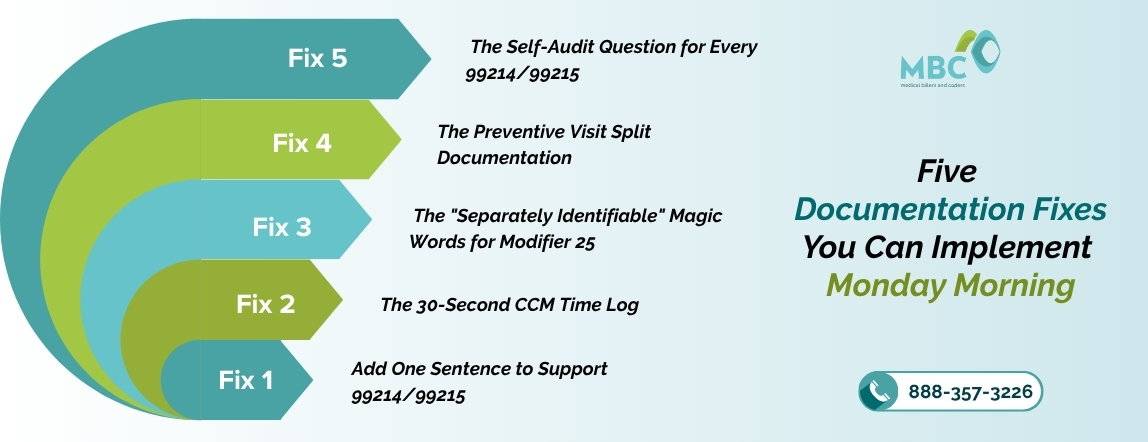
Five Documentation Fixes You Can Implement Monday Morning
Fix 1: Add One Sentence to Support 99214/99215
The Missing Piece: Most notes describe what you did, but not why it was complex.
What Downcodes Your 99215: “Patient with diabetes and hypertension. Refilled medications. Follow up in 3 months.”
What Protects Your 99215 (Add This ONE Sentence): “Patient with diabetes and hypertension. Considered hospitalization vs. outpatient management given A1c 9.2 and BP 168/98, elected aggressive outpatient treatment with close monitoring for metabolic decompensation. Refilled medications with dosage adjustments. Follow up in 3 months.”
That one sentence documents:
- High-risk decision-making (hospitalization consideration)
- Drug therapy requires intensive monitoring
- Complexity justifying 99215
Copy-Paste Template for 99215: “Decision point: [Hospitalization / ER referral / Specialty consultation] vs. outpatient management. Elected [choice] given [clinical rationale]. [Treatment plan] with monitoring for [complication risk].“
Fix 2: The 30-Second CCM Time Log
Why 65–78% of Texas CCM Claims Get Denied: Notes say “CCM provided” but don’t show 20+ minutes documented.
What Gets Denied: “Patient enrolled in CCM. Staff called the patient.”
What Gets Paid (Exact Format to Use):
CCM Activities - [Patient Name] - [Month/Year]
3/15: RN phone call - medication reconciliation (8 min)
3/18: Reviewed cardiology records (6 min)
3/22: RN follow-up - discussed labs, scheduled appointment (9 min)
TOTAL: 23 minutes → Bill 99490
Copy-Paste Template for Your EHR: Keep a running monthly log per CCM patient. Staff adds one line per activity over time. Bill 99490 when total hits 20 minutes.
Why Family Practice Billing Services in Texas Focus on Documentation First
Specialized Family Practice Billing Services in Texas recognize that the highest ROI activity isn’t chasing denials—it’s preventing them through front-end documentation protocols. Medical Billing Services in Texas with family practice expertise implement real-time documentation alerts within EHR systems, flagging when providers select 99215 but haven’t documented hospitalization consideration or high-risk medication monitoring in the note.
Unlike generalist billing companies that code what providers enter, experienced Family Practice Billing Services conduct pre-submission chart reviews identifying when notes don’t support billed codes. This Texas-specific approach prevents the systematic downcoding pattern where providers believe they’re billing correctly (services were rendered) but documentation gaps create 35–52% revenue leakage through payer audits and recoupment demands that could have been prevented with proper note templates.
Fix 3: The “Separately Identifiable” Magic Words for Modifier 25
Why Modifier 25 Gets Denied 35–48% in Texas: Notes don’t prove the E/M was separate from the procedure.
What Gets Denied: “Patient for joint injection. Examined the knee. Performed injection.”
What Gets Paid (Use These Exact Words):
“Patient presented for scheduled knee injection. Additionally [or Separately], patient reports [UNRELATED ISSUE]. Performed [distinct history/exam/MDM for unrelated issue]. Separately, completed scheduled knee injection as planned.”
The Key Words Payers Look For:
- “Additionally”
- “Separately”
- “Unrelated to”
- Different diagnosis codes for E/M vs. procedure
Real Example: “Patient for scheduled knee injection (M17.11). Additionally, the patient reports new chest pain × 3 days (unrelated to the knee). Detailed cardiac history, exam, and EKG performed. Likely costochondritis (R07.89). Started NSAID, ordered troponin. Separately, completed right knee injection for OA management (M17.11, 20610).”
Bill: 99214-25 (chest pain, R07.89) + 20610 (knee OA, M17.11)
Fix 4: The Preventive Visit Split Documentation
The Problem: Patient comes for an annual physical but mentions back pain. You address both. Payer bundles everything into a preventive visit—you lose the problem-focused payment.
The Solution: Two separate note sections.
Section 1: Preventive Visit (G0439) “Annual Wellness Visit performed. Health risk assessment completed. Reviewed screening labs (all normal). Vaccines current. Discussed Mediterranean diet and exercise goals. Updated personalized prevention plan.”
Section 2: Problem-Focused Visit (99213-25) “Separately from wellness visit above, patient presented with acute low back pain × 5 days. [Detailed MSK history and exam]. Likely acute lumbar strain. Prescribed NSAID, home exercise program. RTC if worsening.”
Bill: G0439 + 99213-25 (different diagnosis codes)
The Key: Physically separating documentation makes it obvious to auditors that these are distinct services.
How Medical Billing Services in Texas Address Documentation Gaps Proactively
Medical Billing Services in Texas specializing in family practice understand that documentation education isn’t a one-time training—it requires ongoing provider-specific coaching based on individual denial patterns. Family Practice Billing Services analyze each provider’s documentation habits identifying systematic gaps: Provider A consistently underdocuments MDM complexity for 99214, Provider B never documents CCM time stamps, Provider C overuses Modifier 25 without “separately identifiable” language.
This granular approach through Family Practice Revenue Diagnostic in Texas allows targeted intervention rather than generic coding reminders. When Family Practice Billing Services in Texas identify that 42% of Provider A’s 99214 claims lack data review documentation, they provide that specific physician with the copy-paste template: “Reviewed [test results/outside records/patient glucose log] showing [findings]. Discussed implications with patient.” This Texas-focused, provider-level coaching prevents the recurring denials that generic billing services miss by treating all documentation failures identically.
Fix 5: The Self-Audit Question for Every 99214/99215
Before you sign the note, ask yourself:
For 99214: “Did I document reviewing data (test results, outside records, patient logs) AND managing medication?”
For 99215: “Did I write the words ‘considered hospitalization’ OR ‘requires intensive monitoring’ somewhere in this note?”
If the answer is no, either:
- Add that documentation NOW, or
- Bill 99213 instead (and avoid the audit recoupment later)
The Texas Payer Audit Pattern Family Practices Miss
What triggers audits in Texas:
- High Modifier 25 usage (>30% of encounters)
- CCM billing without time documentation (automated system flags these)
- 99215 billing >15% of encounters (national average is 8-12%)
- Same diagnosis code for preventive visit + problem-focused visit on the same day
The Smart Defense: Run your own monthly audit using the Table 1 checklist above. If you can’t find the documentation elements, downcode yourself before the payer does it and demands repayment.
How MBC’s Family Practice Revenue Diagnostic Works
MBC’s Revenue Diagnostic evaluates your billing by pulling 90 days of notes and running the exact same audit checklist payers use. We tell you:
- Which providers consistently bill 99214 but document 99213-level complexity
- Where CCM time logs are missing (before denials hit)
- Which Modifier 25 claims lack “separately identifiable” language
- Your audit risk score by payer
Request Your Free Revenue Diagnostic to receive provider-specific documentation gap analysis, copy-paste EHR templates supporting 99214/99215, CCM time-tracking workflows, Modifier 25 “separately identifiable” language examples, and payer-specific audit risk scoring identifying which documentation failures create highest revenue exposure in your practice.
MBC helps yield your EBITDA by maximizing reimbursement through fixing documentation BEFORE billing, not appealing denials AFTER. As your Revenue Integrity Partner, we provide the above templates customized to your EHR, train your providers on the “magic words” payers need, and prevent the $1.2M–$3.8M in downcodes that Texas family practices face annually.
MBC’s fee structure: https://www.medicalbillersandcoders.com/pricing
Contact Medical Billers and Coders for the complete documentation template library that supports what you bill—because if your notes don’t prove complexity, payers won’t pay for it.
References
- Centers for Medicare & Medicaid Services. (2024). Evaluation and management services documentation guidelines. https://www.cms.gov/outreach-and-education/medicare-learning-network-mln/mlnproducts/downloads/eval-mgmt-serv-guide-icn006764.pdf
- American Academy of Family Physicians. (2024). Documentation and coding for family medicine. https://www.aafp.org/family-physician/practice-and-career/getting-paid/coding.html
- U.S. Department of Health & Human Services, Office of Inspector General. (2024). Compliance guidance for physician practices. https://oig.hhs.gov/compliance/physician-education/
Frequently Asked Questions
Pull your last 10 charts where you billed 99214/99215—can you find documented MDM elements (problems addressed, data reviewed, risk level)? If not in 35–52% of charts, your notes don’t support billing, creating $1.2M–$3.8M in audit exposure that the Family Practice Revenue Diagnostic in Texas can help identify.
Payers look for “considered hospitalization,” “intensive monitoring required,” “decision not to hospitalize given,” or “parenteral controlled substances”—without these exact phrases documenting high-risk decision-making, Texas payers downcode 99215 to 99214, recouping $180–$280 per encounter through Medical Billing Services in Texas chart audits.
Create a monthly time log per CCM patient showing: “3/15: RN call (8 min), 3/18: record review (6 min), 3/22: follow-up (9 min), TOTAL: 23 min”—without this dated time documentation proving 20+ minutes, Texas payers deny CCM claims, which MBC’s Revenue Diagnostic evaluates your billing patterns to prevent.
Use exact words “Additionally” or “Separately” with different chief complaints unrelated to procedure, distinct diagnosis codes, and separate note sections—without this language, Texas payers deny 35–48% of Modifier 25 claims as bundled services requiring Family Practice Billing Services expertise addressing documentation gaps.
Create two physically separate note sections: Section 1 for preventive visit (G0439), Section 2 starting “Separately from wellness visit above” for problem-focused evaluation (99213-25) with different diagnosis codes—preventing bundling denials through Family Practice Revenue Diagnostic in Texas at https://www.medicalbillersandcoders.com/pricing.

Catering to more than 40 specialties, Medical Billers and Coders (MBC) is proficient in handling services that range from revenue cycle management to ICD-10 testing solutions. The main goal of our organization is to assist physicians looking for billers and coders, at the same time help billing specialists looking for jobs, reach the right place.