Specialities
 Services
 Resource Center
 Pricing
 About
About
 Contact
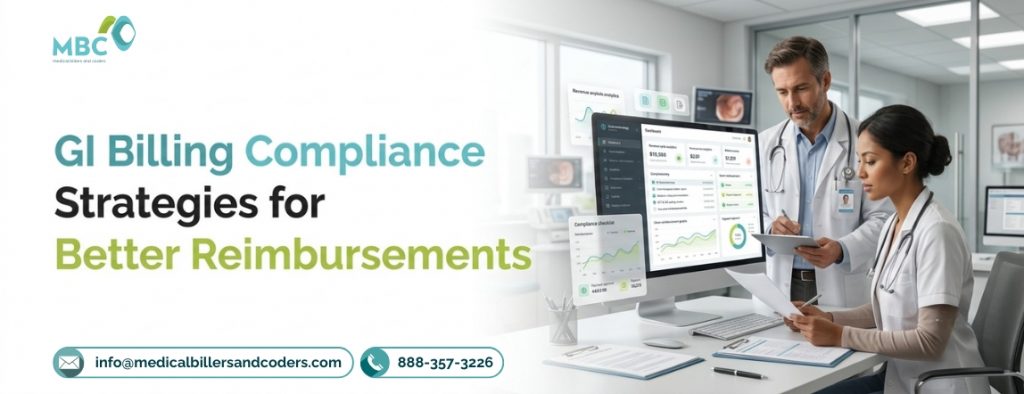
Compliance is no longer just a regulatory requirement—it is a financial strategy. For gastroenterology practices, every coding decision, documentation detail, and claim submission directly impacts reimbursement, especially when it comes to GI Billing. As payer requirements become more stringent and audits become more frequent, maintaining compliancte throughout the revenue cycle has become essential for protecting revenue.
Whether your practice performs screening colonoscopies, diagnostic endoscopies, ERCPs, capsule endoscopies, or other complex GI procedures, billing inaccuracies can quickly lead to denied claims, underpayments, delayed reimbursements, and increased administrative costs.
An effective GI Billing strategy combines specialty-specific coding expertise, strong documentation, regular compliance reviews, and proactive denial prevention. This article explores practical compliance strategies that help gastroenterology practices improve reimbursements while reducing financial risk.
Why Compliance Matters in GI Billing
Gastroenterology is one of the most coding-intensive medical specialties. Every patient encounter may involve multiple procedures, pathology reports, anesthesia coordination, modifiers, and payer-specific reimbursement rules.
Without proper compliance measures, practices commonly experience:
- Increased claim denials
- Delayed insurance payments
- Coding-related payment reductions
- Revenue leakage
- Higher audit exposure
- Increased administrative workload
A compliant GI Billing process ensures every claim accurately represents the services performed while meeting payer guidelines and regulatory standards. More importantly, it helps practices receive appropriate reimbursement the first time a claim is submitted.
1. Ensure Complete Clinical Documentation
Accurate billing begins with complete physician documentation.
Every gastroenterology procedure should clearly document:
- Patient history
- Medical necessity
- Symptoms or diagnosis
- Procedure performed
- Findings
- Interventions completed
- Specimens collected
- Final diagnosis
- Follow-up recommendations
Incomplete documentation creates coding uncertainty and often results in payer denials or requests for additional information.
Strong documentation also provides critical support if a claim is audited.
2. Code Every Procedure Accurately
Accurate CPT, ICD-10-CM, and HCPCS coding remains one of the most important compliance requirements in GI Billing.
Gastroenterology frequently involves:
- Colonoscopy
- Upper GI Endoscopy (EGD)
- Flexible Sigmoidoscopy
- ERCP
- Endoscopic Ultrasound (EUS)
- Capsule Endoscopy
- Biopsies
- Polypectomies
- Hemostasis procedures
Each service must be coded correctly according to physician documentation.
Coding errors can result in:
- Downcoded claims
- Claim denials
- Payment delays
- Lost reimbursement opportunities
Certified gastroenterology coders should stay updated on annual coding revisions and payer-specific billing policies.
3. Apply Modifiers Correctly
Modifier errors remain one of the leading causes of payment delays in gastroenterology.
Modifiers communicate additional procedural information to payers.
Examples include:
- Multiple procedures during the same session
- Repeat procedures
- Screening converted to diagnostic procedures
- Distinct procedural services
Incorrect modifier usage may trigger:
- Duplicate claim edits
- Reduced reimbursement
- Manual claim review
- Audit concerns
Billing teams should never assume all payers interpret modifiers the same way.
4. Verify Medical Necessity Before Claim Submission
Medical necessity is one of the first areas reviewed by insurance companies.
Before submitting claims, billing teams should verify:
- Diagnosis supports the procedure
- Documentation justifies treatment
- Frequency limitations have not been exceeded
- Coverage guidelines are satisfied
Verifying medical necessity before claim submission significantly reduces avoidable denials.
5. Strengthen Prior Authorization Workflows
Many gastroenterology procedures require prior authorization depending on payer requirements.
Missing authorization frequently results in payment denial regardless of clinical necessity.
An effective authorization process should include:
- Insurance verification
- Authorization submission
- Approval tracking
- Expiration monitoring
- Documentation storage
Integrating authorization management into the billing workflow improves reimbursement consistency.
6. Monitor Payer Policy Updates
Insurance companies regularly update:
- Coverage policies
- Documentation requirements
- Coding guidelines
- Medical necessity criteria
- Reimbursement methodologies
Practices that fail to monitor these updates often experience an increase in denials.
Scheduling regular payer policy reviews helps maintain long-term billing compliance.
7. Conduct Regular Internal Billing Audits
Compliance should never be evaluated only after problems occur.
Quarterly billing audits help identify:
- Coding inconsistencies
- Documentation deficiencies
- Modifier misuse
- Recurring denial trends
- Compliance gaps
Routine internal audits reduce audit exposure while improving reimbursement accuracy.
8. Track and Analyze Denial Trends
Every denial contains valuable information.
Rather than simply resubmitting claims, practices should identify the root cause.
Common GI Billing denials include:
- Coding errors
- Missing documentation
- Incorrect modifiers
- Prior authorization failures
- Eligibility issues
- Medical necessity denials
Monitoring denial patterns allows billing teams to implement permanent corrective actions instead of temporary fixes.
9. Invest in Ongoing Staff Education
Healthcare regulations change every year.
Continuous education ensures billing professionals remain current with:
- CPT updates
- ICD-10 revisions
- CMS guidelines
- Commercial payer requirements
- Gastroenterology coding changes
Well-trained billing teams consistently produce cleaner claims and fewer denials.
10. Use Technology to Improve Billing Compliance
Modern revenue cycle platforms help automate compliance checks before claims are submitted.
Technology can assist with:
- Eligibility verification
- Claim scrubbing
- Coding validation
- Missing documentation alerts
- Denial analytics
- Revenue reporting
Automation reduces manual errors while allowing billing professionals to focus on higher-value revenue cycle activities.
Common Compliance Mistakes That Reduce Reimbursements
Even experienced practices can lose revenue because of preventable billing mistakes.
The most common issues include:
- Incomplete physician documentation
- Incorrect CPT or ICD-10 coding
- Improper modifier usage
- Missed filing deadlines
- Failure to obtain prior authorization
- Poor denial follow-up
- Lack of routine billing audits
- Failure to update payer guidelines
Addressing these issues proactively improves both compliance and financial performance.
Benefits of a Compliance-Focused GI Billing Strategy
Practices that prioritize compliance often experience measurable improvements across the revenue cycle.
These include:
- Higher first-pass claim acceptance
- Faster insurance payments
- Reduced denial rates
- Improved coding accuracy
- Better audit preparedness
- Stronger cash flow
- Higher net collections
- Increased operational efficiency
Instead of reacting to denied claims, compliant practices prevent revenue leakage before it happens.
Why Many Gastroenterology Practices Outsource GI Billing
Managing compliance internally requires dedicated staff, continuous education, coding expertise, and ongoing payer monitoring.
Many gastroenterology practices choose to outsource GI Billing Company because specialized billing companies provide:
- Certified gastroenterology coders
- Dedicated denial management teams
- Compliance monitoring
- Prior authorization support
- Revenue cycle reporting
- Coding audits
- Faster claim submission
- Continuous payer policy updates
This allows physicians and administrators to focus more on patient care while improving overall financial performance.
Understanding GI Billing Services Cost
GI Billing services typically cost 4%–8% of monthly net collections, depending on factors such as practice size, provider count, claim volume, procedure complexity, payer mix, and the overall health of the revenue cycle. While pricing is an important consideration, selecting a billing partner based solely on the lowest percentage often leads to higher denial rates, slower reimbursements, and greater revenue leakage.
A billing company charging 5% but consistently achieving a 97% first-pass claim acceptance rate, reducing denials, and recovering aging accounts can deliver significantly higher net revenue than a provider charging 3.5% with inconsistent collections. For a gastroenterology practice generating $2 million in annual collections, even a 3% improvement in reimbursement performance can result in $60,000 or more in additional annual revenue.
The most reliable GI Billing partners should be evaluated based on measurable performance indicators such as clean claim rates, denial reduction, days in A/R, collection ratios, and reporting transparency—not simply on pricing. The true investment is in protecting every dollar your practice earns.
To evaluate your current revenue performance gap, explore MBC’s pricing and engagement models designed for GI practices at every volume level.
Ready to improve your gastroenterology practice’s financial performance?
Partner with Medical Billers and Coders for compliant GI Billing, specialty-focused coding expertise, proactive denial management, and faster reimbursements. Request a free revenue cycle assessment and discover opportunities to increase collections while reducing billing inefficiencies.
Frequently Asked Questions
GI Billing is the process of coding, submitting, and managing insurance claims for gastroenterology services and procedures. It ensures providers receive accurate reimbursements while remaining compliant with payer and regulatory requirements.
Compliance helps prevent claim denials, payment delays, and audit risks by ensuring documentation, coding, and billing follow current payer and regulatory guidelines. A compliant billing process also improves reimbursement accuracy.
Common issues include incorrect CPT or ICD-10 coding, improper modifier usage, missing documentation, lack of medical necessity, and failure to obtain prior authorization. These mistakes often lead to denied or underpaid claims.
Accurate coding, complete documentation, timely claim submission, and proactive denial management help reduce revenue leakage. A well-managed GI Billing process increases first-pass claim acceptance and accelerates cash flow.
Most practices should conduct internal billing and coding audits at least quarterly. Regular audits identify compliance gaps early and help improve claim accuracy before payer audits or denials occur.
Reference – CMS Medicare Claims Processing Manual (Endoscopy & GI Billing)

A Subject Matter Expert in healthcare billing operations with nearly 10 years of experience, sharing insights on claims processing, coding support, and revenue cycle optimization. Dedicated to educating healthcare professionals on compliance, accuracy, and strategies to improve billing performance.