Specialities
 Services
 Resource Center
 Pricing
 About
About
 Contact
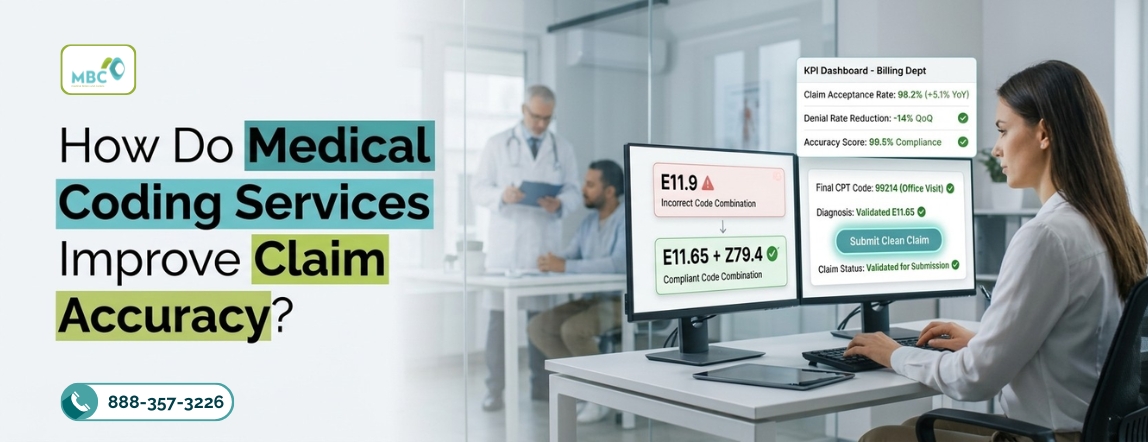
Medical coding services improve claim accuracy by converting clinical documentation into standardized codes that eliminate billing errors, prevent denials, and protect every dollar of reimbursement your practice has earned.
That one-line answer matters because claim accuracy is no longer just an administrative metric — it is the financial pulse of your practice. According to the American Medical Association (AMA) 2024 Prior Authorization Survey (ama-assn org), physicians reported that prior authorization and coding-related delays directly affected patient outcomes in 93% of cases.
Meanwhile, the Centers for Medicare & Medicaid Services (CMS) estimates that improper payments — many rooted in coding errors — totaled $51.6 billion in FY 2023 alone (CMS Improper Payments Report). If your claims are not coded correctly, you are not just leaving money on the table. You are actively handing it back.
Why Coding Accuracy Is a Revenue Protection Issue
Most practices measure coding quality by their clean claim rate. But that number only tells part of the story.
A claim can be “clean” and still be systematically undercoded. A claim can pass initial scrubbing and still trigger a post-payment audit. The real question isn’t are your claims going through — it’s are they going through at the right value, with the right documentation, and with zero audit exposure?
This is where professional medical coding services shift the conversation from process efficiency to revenue integrity.
According to the Office of Inspector General (OIG) Work Plan 2025–2026, high-priority audit targets include evaluation and management (E/M) upcoding, diagnosis specificity in HCC (Hierarchical Condition Category) risk adjustment, and modifier misuse — all areas where a specialized revenue integrity partner delivers measurable protection.
Three Operational Ways Medical Coding Services Improve Accuracy
1. Certified Human Expertise That Scales With Complexity
Coding errors cluster around complexity. Routine office visits are low-risk. Multi-diagnosis encounters, surgical procedures with modifiers, and specialty-specific documentation are where unmanaged in-house teams fall short.
Professional medical coding services deploy AAPC-certified (CPC) and AHIMA-certified (CCS) coders who specialize by clinical domain. They don’t just know the code — they know the documentation requirements that make the code defensible. According to the AAPC 2024 Salary and Industry Report, certified coders reduce denial rates by an average of 23% compared to non-credentialed staff.
2. AI-Assisted Claim Scrubbing Before the Claim Leaves the Practice
The most damaging billing mistakes happen before a claim ever reaches the payer. Missing modifiers, diagnosis-procedure mismatches, and duplicate submissions are entirely preventable — but only if you catch them at the source.
Leading medical billing and coding services now use NLP-driven pre-submission scrubbing tools that review every claim in real time. This is not fully autonomous AI — it’s a human-verified workflow where technology flags anomalies and certified coders make the final call. The result: clean claim rates consistently above 98%, versus the 75–85% industry average for unmanaged practices.
The Healthcare Financial Management Association (HFMA) confirms that practices using hybrid AI-human coding models see a 15–20% improvement in first-pass resolution rates (hfma.org).
3. Denial Root Cause Analysis — Not Just Resubmission
Most billing teams treat denials as paperwork. They resubmit, move on, and repeat the same mistake next month. Specialized rcm services treat denials as diagnostic data.
Every denial code — CO-11 (diagnosis inconsistent with procedure), CO-16 (missing information), CO-4 (modifier issue) — points to a systemic failure upstream. A structured denial management program maps those codes back to their root causes: documentation gaps, coder training deficiencies, or payer-specific contract misalignments. The fix isn’t one claim. It’s a process correction that prevents the next 200 denials of the same type.
Coding Model Comparison: What Your Practice Is Actually Choosing Between
| Factor | In-House Manual Coding | Fully Automated AI | Specialized Coding Services |
| Accuracy Rate | 75–88% | 60–85% (complex cases) | 97–99%+ |
| Denial Rate | 12–18% | 10–20% | 2–5% |
| HCC/Risk Adjustment | Inconsistent | Limited | Systematic & Auditable |
| Regulatory Updates | Reactive | Tool-Dependent | Proactive (ICD, LCD, CMS) |
| OIG Audit Exposure | High | Moderate | Minimized |
| Cost Structure | Fixed overhead | Tech investment | Scalable, performance-based |
| Best For | Small, low-complexity practices | High-volume routine encounters | Multi-specialty, high-acuity, enterprise |
The data is clear: in-house manual coding is the highest-risk model for any practice billing above a moderate complexity threshold.
What Accurate Coding Actually Protects
Revenue Integrity Across Every Encounter
Professional medical billing services ensure that every billable service in the clinical record has a corresponding code — and that code has the documentation to support it. This closes the gap between what a physician delivers and what the practice actually collects.
The Government Accountability Office (GAO) reported in 2024 that Medicare Advantage plans returned $50 billion in risk-adjusted payments tied to unsupported HCC diagnoses. Practices relying on accurate coding with a qualified revenue integrity solutions partner avoid becoming part of that recoupment pool.
Compliance Without the Administrative Burden
ICD-10-CM updates annually. CPT codes change every January. MAC Local Coverage Determinations (LCDs) shift quarterly. No in-house team can reasonably stay current across all of these while managing daily claim volume.
A qualified revenue cycle management partner makes this their full-time operation — so your clinicians can make patient care theirs.
Ready to Stop Losing Revenue to Coding Errors?
Every month your coding operation runs below 97% accuracy, you are funding denials, rework, and audit exposure with revenue you already earned. MBC’s certified coders and denial management infrastructure are built to close that gap — fast.
Request a Revenue Accuracy Audit — No Commitment Required
Call us: 888-357-3226 | Email: info@medicalbillersandcoders.com
Our specialists will analyze your current clean claim rate, denial patterns, and coding accuracy — and show you exactly where revenue is leaking before you make any decision.
FAQs
Top-tier services consistently maintain 97–99%+ accuracy. Anything below 95% signals systemic coding or documentation issues that are likely costing your practice significant reimbursement.
Every denied or undercoded claim delays or reduces payment. A 5% improvement in clean claim rate for a $2M practice typically translates to $80,000–$120,000 in recovered annual revenue and a measurable reduction in Days in AR.
The opposite. Certified outsourced coders follow AHIMA Standards of Ethical Coding and stay current on OIG Work Plan targets, CMS updates, and payer-specific LCDs — reducing your audit exposure, not increasing it.
The costliest are HCC undercoding (reduces risk-adjusted revenue), modifier misuse (triggers bundling denials), and E/M level misassignment (either leaves money uncollected or flags for OIG review).
Most practices see measurable denial rate improvement within 30–60 days of transitioning to a specialized service, with full baseline stabilization by the 90-day mark as root cause corrections take effect.

A Medical Coding Subject Matter Expert with over 16 years of experience in ICD-10 and CPT coding, clinical documentation, and revenue cycle management. Shares actionable insights to improve billing accuracy and support compliance-driven healthcare practices.