Specialities
 Services
 Resource Center
 Pricing
 About
About
 Contact

Yes, your dermatology practice is losing revenue due to coding lag—with high-volume dermatology practices collecting $1M–$5M+ monthly experiencing $1.2M–$3.6M annual revenue leakage when the time gap between patient encounters and claim submission extends from the 24–48 hour benchmark to 7–14 days, creating systematic denial patterns (40% higher than specialty benchmark), timely filing violations ($180,000–$420,000 annually), and EBITDA suppression from cash flow delays that force working capital borrowing while properly coded services remain unbilled in documentation backlogs.
For multi-provider dermatology practices, understanding how coding lag creates compounding failures in financial performance metrics is the foundation for implementing risk mitigation protocols that protect net realized revenue growth.
What Is Coding Lag and Why Does It Destroy Dermatology Revenue?
Coding lag is the time delay between service delivery and clean claim submission, typically caused by incomplete clinical documentation forcing coders to wait for physician clarification on lesion sizes, anatomical locations, or biopsy techniques.
Table 1: Coding Lag Impact on Dermatology Practice Revenue
| Coding Lag Duration | Monthly Procedures (300-500) | Claims in Backlog | Days in A/R | Monthly Revenue Delayed | Annual Revenue Impact |
| 24-48 hours (benchmark) | 300-500 | 25-42 | 28-32 days | Minimal | Baseline |
| 5-7 days (moderate lag) | 300-500 | 125-292 | 42-55 days | $420,000-$840,000 | $1.2M-$1.8M delayed |
| 10-14 days (severe lag) | 300-500 | 250-583 | 68-85 days | $680,000-$1,260,000 | $2.4M-$3.6M delayed |
EBITDA Compression:
Severe coding lag creates dual EBITDA impact:
- Working capital tied up in unbilled services requiring credit line borrowing (6-8% interest annually)
- Timely filing deadline violations are creating permanent revenue loss
Four Documentation Gaps Driving Dermatology Coding Lag
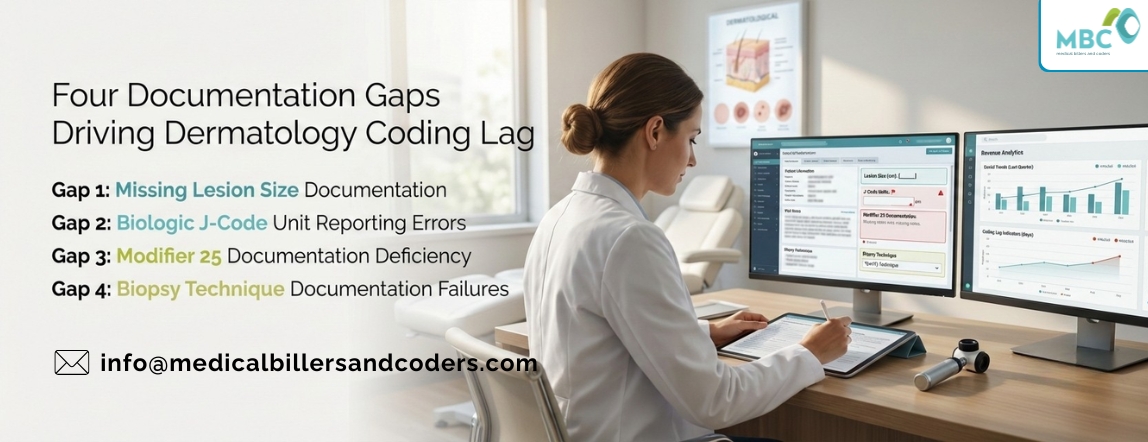
Gap 1: Missing Lesion Size Documentation
According to CMS, proper CPT code assignment for excisions requires precise lesion measurement and documentation of margins.
Coding Lag Scenario:
Provider documents: “Removed melanoma from back.”
What Coder Needs:
- Exact lesion size in centimeters
- Margin width excised
- Specific anatomical location (upper vs. lower back, left vs. right)
Without this information:
- Coder must query the physician (2-5 day delay)
- Cannot determine the correct CPT code (11600-11606 based on size)
- Claim submission delayed 5-7 days
Revenue Impact:
For practice, performing 80 monthly excisions:
- 40% require physician queries due to incomplete documentation
- 32 procedures delayed 5-7 days
- Monthly coding lag revenue impact: $56,000-$84,000
- Annual loss: $672,000-$1,008,000
Gap 2: Biologic J-Code Unit Reporting Errors
Biologics represent the highest dermatology revenue per encounter ($3,500-$12,000) and the highest coding lag risk.
J-Code Complexity:
Dermatology biologics require:
- Specific J-code (not miscellaneous J3490)
- Exact NDC number
- Precise unit billing (milligrams administered, not vials dispensed)
- Waste documentation when applicable
Coding Lag Failure Pattern:
Provider documents: “Administered Dupixent injection.”
Missing Critical Information:
- Dose administered (300mg initial vs. 200mg maintenance)
- NDC cross-reference
- Waste units if a partial vial is used
Denial Root-Cause Engineering Alert:
Practices using miscellaneous codes (J3490) or incorrect unit reporting experience:
- 40% higher denial rate than specialty benchmark
- Average $200,000-$500,000 annual revenue loss from biologic coding errors
- Coding lag of 10-14 days while the billing team researches the correct units
Gap 3: Modifier 25 Documentation Deficiency
National Correct Coding Initiative edits require Modifier 25 when performing both E/M and procedures on the same day.
Payer Variance Detection Gap:
Medicare: Accepts Modifier 25 with clear documentation of a separately identifiable E/M service
- Approval rate with proper documentation: 92-96%
Commercial Payers: Varying requirements create systematic denials
- UnitedHealthcare: 35-42% denial rate without “significant, separately identifiable” language
- Aetna: Requires documentation exceeding routine pre-procedure assessment
- BCBS: Some plans auto-deny, others accept with appeals
Coding Lag Creation:
When provider documentation states: “Saw patient for annual skin check, performed biopsy.”
Coder cannot determine:
- Was a separate E/M performed beyond the biopsy pre-assessment?
- What specific additional evaluation justified E/M?
Result: 3-5 day delay querying provider for Modifier 25 justification
Revenue Impact:
- 120 monthly same-day E/M + procedure encounters
- 45% require clarification queries
- 54 encounters delayed 3-5 days
- Annual coding lag impact: $324,000-$486,000
Gap 4: Biopsy Technique Documentation Failures
The 2019 CPT code restructure (11102-11107) requires specific documentation of the biopsy technique.
Technological Efficiency Gap:
Provider documents: “Performed skin biopsy.”
Coder needsa specific technique:
- CPT 11102: Tangential biopsy (shave)
- CPT 11104: Punch biopsy
- CPT 11106: Incisional biopsy
Without technique specification:
- Coder queries physician (2-4 day delay)
- Or defaults to lower-paying code, creating underbilling
- Claim submission delayed or revenue lost
For practice performing 200 monthly biopsies:
- 30% require technique clarification
- 60 procedures delayed 2-4 days
- Annual coding lag revenue impact: $288,000-$432,000
Technological Efficiency Solutions: Eliminating Coding Lag
Real-Time Documentation Validation:
EHR alerts preventing coding lag:
- The lesion size field is required before encountering close
- Biopsy technique dropdown (tangential/punch/incisional) mandatory
- Biologic dose and NDC auto-populated from the drug dispensing system
- Modifier 25 documentation prompt when E/M + procedure is documented
Medical Billers and Coders’ system-agnostic approach implements real-time validation within existing EMR platforms without system replacement.
Financial Performance Metrics Dashboard:
Track coding lag impact:
- Average time from encounter to claim submission
- Percentage of claims requiring physician queries
- Revenue in the documentation backlog
- Days in A/R trend analysis
Table 2: Coding Lag Reduction Impact on Net Realized Revenue Growth
| Intervention | Coding Lag Reduction | Days in A/R Improvement | Annual Revenue Recovery ($3M Monthly) |
| Real-time documentation validation | 7-14 days → 24-48 hours | 68 days → 32 days | $1.2M-$2.4M |
| Automated J-code unit verification | Eliminates unit errors | Prevents 40% biologic denials | $200,000-$500,000 |
| Modifier 25 documentation templates | Reduces query volume 65% | Accelerates 54 monthly claims | $324,000-$486,000 |
| Biopsy technique dropdown menus | Eliminates technique queries | Accelerates 60 monthly claims | $288,000-$432,000 |
| Total Annual Recovery | — | — | $2.0M-$3.8M |
Eliminate $1.2M-$3.6M Annual Revenue Loss From Dermatology Coding Lag
If your dermatology practice is collecting $1M-$5M+ monthly and experiences coding lag extending claim submission from 24-48 hours to 7-14 days, documentation gaps in lesion sizes, biologic units, Modifier 25 justification, and biopsy techniques create $1.2M-$3.6M annual revenue leakage through delayed cash flow, timely filing violations, and systematic denial patterns.
Medical Billers and Coders, the leading medical billing company in the USA with 25+ years of specialized Dermatology Billing Services experience, eliminates coding lag through comprehensive Dermatology Billing Services, Medical Billing Services, Old AR Recovery, RCM Services, and Denial Management Services—all managed by a dedicated account manager using your existing EMR without system changes.
Our dermatology practice is losing revenue recovery infrastructure, implementing real-time documentation validation, eliminating physician queries, automated J-code unit verification, preventing biologic denials, payer variance detection protocols for Modifier 25 requirements, technological efficiency tools capturing biopsy techniques at the point of service, and denial root-cause engineering, reducing Days in A/R from 68 to 32 days.
With proven 30% A/R reduction freeing $1.2M-$3.6M in delayed revenue, our Dermatology Billing Services deliver net realized revenue growth while protecting EBITDA from coding lag cash flow suppression.
Request your Dermatology Coding Lag Assessment to quantify the exact revenue delayed in documentation backlogs and identify which Medical Billing Services interventions deliver the fastest revenue recovery.
Contact Medical Billers and Coders today to implement specialized Dermatology Billing Services, eliminate coding lag, and preserve your dermatology practice’s revenue margins.
Frequently Asked Questions
Yes—dermatology practices experience $1.2M-$3.6M annual revenue loss when coding lag extends from 24-48 hour benchmark to 7-14 days, creating claim backlogs, timely filing violations, and 68-85 day Days in A/R requiring working capital borrowing while properly performed services remain unbilled due to incomplete lesion size, biologic unit, Modifier 25, and biopsy technique documentation.
Coding lag results from four documentation gaps: missing lesion size/margin documentation requiring physician queries (2-5 day delay on 40% of excisions), biologic J-code unit reporting errors creating 10-14 day research delays, Modifier 25 justification deficiencies requiring clarification on 45% of same-day E/M + procedure encounters, and biopsy technique omissions forcing 2-4 day queries on 30% of biopsies.
Coding lag suppresses EBITDA through dual mechanisms: $680,000-$1,260,000 monthly revenue delayed in documentation backlogs requiring working capital borrowing at 6-8% interest annually, and timely filing deadline violations creating permanent revenue loss when claims exceed payer submission windows—compounding to $1.2M-$3.6M annual EBITDA impact for $1M-$5M monthly collection practices.
Biologic J-code coding lag creates $200,000-$500,000 annual revenue loss when practices use miscellaneous codes (J3490) instead of specific J-codes, report incorrect units (vials vs. milligrams), or experience 10-14 day delays researching proper NDC cross-references and unit calculations—while experiencing 40% higher denial rates than specialty benchmark on biologics averaging $3,500-$12,000 per encounter.
Specialized dermatology billing services eliminate coding lag through real-time documentation validation (lesion size fields required before encounter close), automated J-code unit verification from drug dispensing systems, payer-specific Modifier 25 documentation templates, biopsy technique dropdown menus, and financial performance metrics dashboards tracking time from encounter to claim submission—reducing Days in A/R from 68 to 32 days and recovering $1.2M-$3.6M annually.
References

Catering to more than 40 specialties, Medical Billers and Coders (MBC) is proficient in handling services that range from revenue cycle management to ICD-10 testing solutions. The main goal of our organization is to assist physicians looking for billers and coders, at the same time help billing specialists looking for jobs, reach the right place.