Specialities
 Services
 Resource Center
 Pricing
 About
About
 Contact
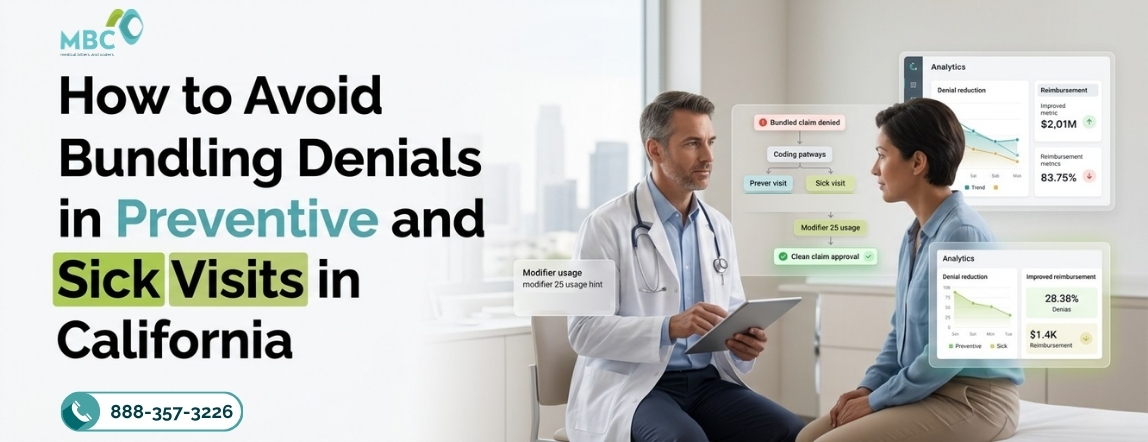
Bundling denials on same-day preventive and sick visits are the single most consistent source of preventable revenue loss in family practice billing services in California. Every day, California family practice physicians see patients for annual wellness exams who also present with an acute problem — a rash, a new complaint, an elevated blood pressure reading that requires separate evaluation and management. Every one of those encounters is legitimately billable as two separate services. And in practices where the billing workflow has not been built to handle it correctly, every one of those encounters is being bundled into the preventive visit code and the problem-focused E/M is lost — silently, repeatedly, on every affected claim cycle.
This is not a coding misunderstanding. It is a structural workflow failure in family practice billing services — and it generates $50,000 to $200,000 per month in preventable revenue loss for mid-size California family practices. The fix is not complicated. But it requires payer-specific protocols, correct Modifier 25 application, and documentation workflows that California’s commercial payers and Medi-Cal plans will actually accept.
Why Bundling Denials Happen in California Family Practice Billing
The AMA CPT guidelines are unambiguous: when a provider addresses a preexisting or new problem during a preventive visit, and that problem requires work beyond the routine preventive evaluation, both the preventive code and the problem-focused E/M code are billable — with Modifier 25 appended to the E/M. This is not aggressive billing. It is the correct application of CPT rules for a legitimate clinical encounter.
The problem is not the rule. It is the workflow. In most California family practice EHR systems, the preventive visit populates as the primary claim automatically. The separately documented sick visit — which the provider evaluated and managed as a distinct clinical concern — does not trigger a Modifier 25 flag unless the billing team is specifically trained to look for it on every same-day encounter. Without that flag, the E/M is either not submitted or submitted without the modifier and bundled by the payer’s automated adjudication system.
2026 new trigger — the G2211 conflict. CMS finalized a rule effective January 1, 2026: G2211 generally cannot be billed on the same day as an E/M that carries Modifier 25 for a minor procedure with a 0-day global period. California family practices that added G2211 to their standard visit workflow in 2024 or 2025 are now generating a new category of bundling denials on procedure-day encounters — on top of the existing same-day preventive and sick visit denial pattern.
Medical billing services in California for family practice must address both problems simultaneously: the structural same-day bundling pattern and the new 2026 G2211 conflict rule. A billing workflow that fixes only one generates denials from the other.
How California’s Major Payers Handle Same-Day Preventive and Sick Visit Billing
Every California payer applies different rules to same-day preventive and problem-focused E/M billing. Applying a single Modifier 25 rule across all payers is a systematic source of preventable denials. Family practice billing services in California require a payer-specific matrix — not a generic modifier protocol:
| Payer | Same-day policy | What family practices need to know |
| Blue Shield of California | Restrictive | Covers same-day preventive and problem-focused E/M with Modifier 25, but uses NLP-based claim review that scans clinical notes for shared language between the two services. If the preventive and problem documentation overlap — same phrasing, same exam elements — the E/M is bundled into the preventive code. The E/M section of the note must contain a completely separate chief complaint, HPI, and MDM from the preventive section. |
| Anthem Blue Cross (California) | Restrictive | Requires diagnosis codes that clearly distinguish the preventive visit (Z-codes) from the problem-focused E/M (condition-specific ICD-10 codes). Submitting only a Z-code on both claim lines, or using a Z-code as the primary diagnosis for the E/M, triggers automatic bundling. Anthem also applies documentation review for Modifier 25 high-frequency patterns — practices where Modifier 25 appears on nearly every preventive visit are flagged for prepayment review. |
| UnitedHealthcare (California) | Discounts E/M | Covers same-day billing with Modifier 25 but reimburses the problem-focused E/M at 50% of the standard rate. This is correct payer behavior under its contract — not a denial. The risk is when the modifier is missing: UnitedHealthcare bundles the E/M entirely with no payment. Fifty percent of legitimate E/M reimbursement is significantly better than zero, which is what practices get when Modifier 25 is not applied. |
| Kaiser Permanente (California) | Network-only | Kaiser’s integrated model means same-day visit billing applies only to Kaiser-affiliated family physicians. For Kaiser patients, separate preventive and problem-focused visits on the same day may be subject to Kaiser’s internal care coordination protocols rather than fee-for-service billing rules. Family practices receiving Kaiser referrals must confirm the applicable billing rules for each encounter type. |
| Medi-Cal — LA Care, Blue Shield Promise, Molina, Health Net | County-variable | Medi-Cal’s 20+ county managed care plans apply different same-day visit coverage rules. LA Care covers same-day preventive and sick visit billing when Modifier 25 is applied and diagnosis codes are correctly separated. Blue Shield Promise has stricter documentation requirements for the same encounter. Molina California’s prior authorization requirements for preventive services vary by plan year. Practices serving Medi-Cal patients across multiple California counties must maintain county-specific protocols. |
| Medicare / Medicare Advantage (California) | AWV-specific rules | Medicare does not cover routine annual physical CPT codes (99381–99397) for adults — it covers Annual Wellness Visits (AWV) under HCPCS G0438/G0439. When a separately identifiable medically necessary E/M is provided during an AWV, bill the AWV code plus the E/M code with Modifier 25. California Medicare Advantage plans — Humana, Anthem Blue Cross MA, Blue Shield MA — each apply their own coverage rules and may require separate documentation that the E/M was medically necessary and distinct from the AWV’s preventive scope. |
The Correct Way to Bill a Same-Day Preventive and Sick Visit in California
The AMA, CMS, and California’s commercial payers all confirm that same-day billing is appropriate when the following conditions are met. Medical billing services for California family practices must operationalize all four:
- Two distinct clinical concerns. The preventive visit addresses health maintenance — age-appropriate exam, immunization review, anticipatory guidance, preventive screenings. The problem-focused E/M addresses a separate, significant clinical concern — an acute illness, a newly identified chronic problem, or an existing condition that requires evaluation and management beyond what preventive care covers.
- Two separate documentation sections. The clinical note must contain separate documentation for each service. The preventive section documents preventive elements. The E/M section documents its own chief complaint, history, examination, and medical decision-making. Notes where these sections share language or are documented as a single combined encounter will not survive Blue Shield of California or Anthem’s NLP-based claim review.
- Correct diagnosis code assignment. The preventive visit claims with Z-codes (Z00.00, Z00.121, Z00.129 for well-child visits; Z00.00 for adult physicals). The problem-focused E/M claims with the condition-specific ICD-10 code for the problem addressed. Submitting a Z-code as the primary diagnosis for the E/M causes bundling at Anthem and documentation failure at Blue Shield.
- Modifier 25 on the E/M — correctly placed. Modifier 25 is appended to the problem-focused E/M CPT code (99213, 99214, 99215) — not to the preventive code. The preventive code is submitted without a modifier. Reversed modifier placement causes the payer’s system to misidentify the primary service and generate a processing error.
Line 2: CPT 99214-25 (problem-focused E/M) — Diagnosis: I10 (essential hypertension) — Modifier 25 on the E/M code
Documentation required:Preventive section covering health maintenance elements + separate E/M section with chief complaint (elevated BP reading), HPI (medication adherence, symptoms), exam (BP measurement, cardiovascular exam), and MDM (assessment and plan for hypertension management)
The Three Most Common Bundling Denial Patterns in California Family Practice
Pattern 1: EHR auto-population without Modifier 25 flag
The most common source of same-day bundling denials in California family practice is not a coder error — it is an EHR workflow design failure. When a provider addresses a sick visit problem during a scheduled preventive appointment, many EHR systems auto-populate the preventive code as the sole claim line. The billing team receives a claim that looks complete because the preventive visit is coded correctly. The separately documented problem visit never triggers a second claim line, and no one flags the missing Modifier 25. This pattern repeats across every same-day encounter in the practice — generating a structural denial pattern that compounds monthly until someone audits the claims specifically for this combination.
Pattern 2: Same diagnosis code on both claim lines
Anthem Blue Cross and Blue Shield of California both use diagnosis code analysis to identify same-day bundling candidates. When a practice submits both a preventive code and a problem-focused E/M on the same date with the same ICD-10 code on both lines, the payer’s system interprets them as the same service submitted twice and bundles or denies the E/M. The preventive visit must carry Z-codes. The E/M must carry the condition-specific code. If the provider addressed a new rash during an annual physical, the preventive visit claims Z00.00 and the E/M claims L30.9 (dermatitis, unspecified) or the most specific applicable L-code — not Z00.00 on both lines.
Pattern 3: G2211 conflict on procedure days
Since January 1, 2026, California family practices billing G2211 on the same day as a minor in-office procedure with a 0-day global period — vaccine administration, cryotherapy, wound care, cerumen removal — generate an automatic G2211 denial under the new CMS conflict rule. The fix is to remove G2211 from the claim on any encounter that also includes a Modifier 25 E/M for a minor procedure. G2211 can still be billed on standard E/M visits without procedure codes, and on preventive visits where the E/M Modifier 25 is not tied to a 0-day global procedure. Family practice billing services must build a pre-submission claim scrub that detects this conflict and flags it before the claim reaches the payer.
What MBC’s Family Practice Billing Services Fix in California
Effective family practice billing services in California address same-day bundling denials at the workflow level — before claims are submitted, not after they age in A/R. MBC’s approach to California family practice billing includes:
EHR claim-flag integration
Automated flag on every claim where a preventive CPT code and a problem-focused E/M code share the same date of service — triggering Modifier 25 verification before the claim is released.
California payer-specific modifier protocols
Separate billing rules for Blue Shield of California, Anthem Blue Cross, UnitedHealthcare, Medi-Cal county plans, and Medicare Advantage — applied at the claim level based on the patient’s actual enrolled plan.
Diagnosis code separation audit
Pre-submission verification that preventive claims carry Z-codes and problem-focused E/M claims carry condition-specific ICD-10 codes — eliminating the diagnosis-matching bundling trigger at Anthem and Blue Shield.
G2211 conflict detection
Automated scrub that identifies encounters where G2211 conflicts with the 2026 Modifier 25/minor procedure rule — removing G2211 from affected claims before submission rather than absorbing the denial.
Documentation template updates
Separate preventive and E/M documentation sections in your EHR that produce distinct note structures for each service — satisfying Blue Shield’s and Anthem’s NLP-based review criteria for the same-day billing combination.
A/R recovery on bundled denials
Systematic recovery of denied same-day E/M claims — correcting modifier placement, adding missing diagnosis codes, and resubmitting with the documentation required by each California payer’s appeal process.
A Revenue Diagnostic identifies exactly how much your California family practice is losing to same-day bundling denials — by payer, CPT combination, and denial root cause — using your actual claims data. It takes about 15 minutes and carries no cost or commitment.
Bundling denials on same-day preventive and sick visits repeat every billing cycle until the workflow is fixed. MBC’s medical billing services in California for family practice correct the problem at the claim level — before denials accumulate. Let’s find out what that is worth for your practice.
Frequently Asked Questions: Family Practice Billing Services in California
Yes — and failing to do so costs California family practices significant recoverable revenue on every affected encounter. AMA CPT guidelines are clear: when a provider addresses a preexisting or new problem during a preventive visit, and that problem requires evaluation and management beyond the preventive service’s scope, both the preventive CPT code and the problem-focused E/M code are billable. The problem-focused E/M must be appended with Modifier 25 to signal that it is a significant, separately identifiable service. The documentation must contain separate sections for each service — distinct chief complaint, examination, and medical decision-making for the E/M, separate from the preventive visit documentation. California’s commercial payers, including Blue Shield and Anthem, use NLP-based claim review that will bundle the E/M into the preventive code if the documentation sections share language.
Modifier 25 indicates that a significant, separately identifiable evaluation and management service was performed on the same day as another service. In family practice billing, it is most commonly used when a provider performs both a preventive visit and a problem-focused E/M on the same date — the modifier is appended to the E/M CPT code (99213, 99214, or 99215), not to the preventive code. It is also used when a same-day E/M accompanies a minor in-office procedure. In 2026, a new CMS rule limits Modifier 25 interaction with G2211: G2211 generally cannot be billed on the same day as an E/M that carries Modifier 25 for a minor procedure with a 0-day global period — a conflict that California family practice billing services must screen for before claim submission.
Blue Shield of California and Anthem Blue Cross both use AI-assisted claim review that scans clinical notes for documentation problems on same-day preventive and E/M claims. Blue Shield’s NLP review bundles the E/M into the preventive code when the two services’ documentation sections share language — even when Modifier 25 is present on the claim. Anthem triggers bundling when the same ICD-10 diagnosis code appears on both the preventive and E/M claim lines. Anthem also flags practices where Modifier 25 appears on nearly every preventive visit, treating it as a systematic misuse pattern subject to prepayment review. Family practice billing services in California must maintain payer-specific documentation and diagnosis code protocols — not a single same-day billing approach applied uniformly across all payers.
Medicare does not cover routine annual physical CPT codes (99381–99397) for adult patients — it covers Annual Wellness Visits under HCPCS G0438 (subsequent AWV) or G0439 (first AWV after initial enrollment). When a separately identifiable, medically necessary E/M service is provided during an AWV, it is billed with the AWV code plus the appropriate E/M CPT code (99202–99215) with Modifier 25 appended to the E/M. Medicare pays for the AWV in full and separately adjudicates the problem-focused E/M subject to the patient’s Part B cost-sharing. California Medicare Advantage plans — Humana, Anthem Blue Cross MA, Blue Shield MA — apply their own same-day billing policies that may require additional documentation that the E/M was medically necessary and performed as a distinct clinical service.
California Medi-Cal operates through more than 20 county managed care organizations, each with different same-day visit billing policies for family practice. LA Care covers same-day preventive and problem-focused E/M billing when Modifier 25 is applied and diagnosis codes are correctly separated — Z-codes on the preventive claim line, condition-specific codes on the E/M line. Blue Shield Promise applies stricter documentation review for the same encounter type. Molina California’s coverage of same-day services varies by plan year and county. Practices serving Medi-Cal patients across Los Angeles, San Diego, Fresno, and other California counties must maintain county-specific billing protocols rather than applying a uniform Medi-Cal same-day visit rule.
The clinical note must contain two clearly distinct documentation sections. The preventive section documents health maintenance elements: age-appropriate comprehensive history, physical examination, immunization review, anticipatory guidance, and preventive screenings. The E/M section documents its own chief complaint, history of present illness, focused examination, assessment, and medical decision-making for the specific problem addressed. The two sections must not share language — California payers including Blue Shield use NLP to identify shared phrasing and will bundle the E/M if the note reads as a single combined encounter rather than two distinct services. The diagnosis codes must also be separated: Z-codes for the preventive visit, condition-specific ICD-10 codes for the E/M. Both services must have distinct CPT codes on separate claim lines, with Modifier 25 on the E/M only.
For a California family practice billing $500,000 to $1M per month, the revenue loss from systematic same-day bundling denials typically falls between $30,000 and $150,000 annually — entirely from encounters that were legitimately billable as two services but submitted as one. The loss is invisible in most standard billing reports because the preventive visit codes as clean and paid. Only a claim-level audit that specifically identifies same-date preventive and E/M encounters and checks each for Modifier 25 application and diagnosis code separation surfaces the pattern. MBC’s Revenue Diagnostic performs this audit using your actual California claims data and quantifies the recoverable revenue before you commit to any changes.
Medical Billing Services in California: Reduce Claim Denials & Increase Revenue
Phone: 888-357-3226Fax: 888-316-4566
Email: sales@medicalbillersandcoders.com

Catering to more than 40 specialties, Medical Billers and Coders (MBC) is proficient in handling services that range from revenue cycle management to ICD-10 testing solutions. The main goal of our organization is to assist physicians looking for billers and coders, at the same time help billing specialists looking for jobs, reach the right place.