Specialities
 Services
 Resource Center
 Pricing
 About
About
 Contact
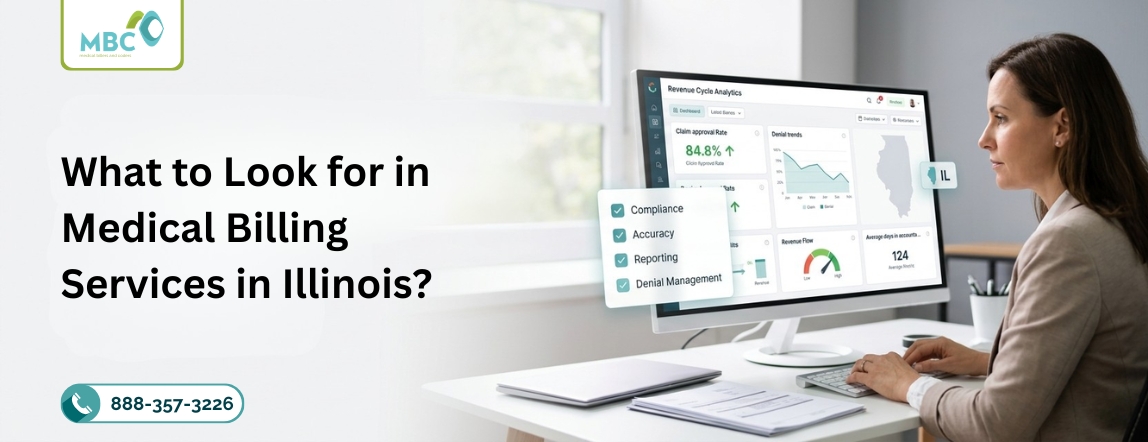
Medical Billing Services in Illinois operate in one of the most demanding regulatory environments in the country — governed by Illinois Department of Insurance mandates, Medicaid managed care contracting complexity, and evolving CMS reimbursement frameworks. Yet most healthcare providers in the state are evaluating billing vendors on surface-level criteria: pricing, turnaround time, and software compatibility.
That approach is leaving margin on the table.
The right Medical Billing Services in Illinois partner does not simply submit claims — they architect a revenue performance infrastructure that protects your facility from compliance risk, accelerates cash flow, and delivers CFO-grade visibility across every payer and procedure type.
This guide outlines exactly what separates high-performance Medical Billing Services in Illinois from vendors that process transactions without understanding your specialty, your payer mix, or your margin pressure.
Whether you operate a multi-physician group, an ambulatory surgery center, or a hospital-affiliated outpatient department, choosing among Medical Billing Services in Illinois requires a framework — not a feature checklist. Here is that framework.
1. Illinois-Specific Regulatory Mastery — Not Generic Compliance
Providers often assume that federal compliance — HIPAA, CMS guidelines, payer LCD policies — is sufficient. It is not. Medical Billing Services in Illinois must operate within a state-level regulatory layer that includes:
- Illinois Medicaid Managed Care Organization (MCO) billing protocols, which vary significantly by contracted plan and county
- Illinois Department of Insurance (IDOI) fair claims settlement rules governing prompt payment and coordination of benefits
- Illinois Hospital Licensing Act provisions affecting outpatient facility fee billing and cost-reporting obligations
- Illinois Workers’ Compensation Commission fee schedules — particularly critical for orthopedic, pain management, and physical therapy practices
MBC Insight: Ask any prospective billing partner: ‘How do you handle Illinois MCO prior authorization denials differently from commercial payer denials?’ If they cannot answer with specificity, they are operating as a generic vendor in a state-specific environment.
2. Specialty-Calibrated Coding Protocols
Generic billing vendors apply generic coding logic. In specialty medicine — wound care, orthopedics, behavioral health, oncology — that approach produces systemic undercoding, modifier errors, and LCD non-compliance that accumulate into six-figure annual revenue leakage.
High-performance Medical Billing Services in Illinois deploy specialty-specific coding protocols that address:
- Correct application of modifiers 59, XS, XU, and 25 in high-acuity, multi-procedure encounters
- LCD compliance for wound care (L35125), pain management, and other MAC-regulated procedures
- ICD-10-CM specificity requirements that prevent medical necessity denials on complex chronic condition claims
- ASC-specific HCPCS coding and facility fee optimization for ambulatory surgical centers
The operational difference: a specialty-calibrated coding team achieves 97–98% clean claim rates on complex cases. Generic vendors average 85–89%. That gap, across a $3M facility, represents $240K–$270K in additional annual collections.
3. Denial Management Infrastructure — Not a Denial Response Process
There is a critical difference between a billing company that responds to denials and one that has built denial prevention infrastructure. The former manages symptoms. The latter eliminates root causes.
What denial management infrastructure actually looks like:
- Real-time eligibility verification integrated with your scheduling system — not a manual check at time of service
- Automated claim scrubbing against payer-specific edits before first submission — preventing avoidable rejections
- Root-cause denial categorization: clinical documentation gaps vs. coding errors vs. authorization failures vs. COB issues
- Specialty-specific appeal templates with clinical rationale that address the exact denial reason code — not boilerplate letters
The Benchmark: Top-performing Medical Billing Services in Illinois maintain first-pass resolution rates above 95% and Days in AR below 28. Demand these numbers before signing any contract.
4. Transparent Performance Reporting — CFO-Grade, Not Billing-Clerk Grade
Monthly PDF statements are not revenue cycle reporting. A high-performance billing partner provides executive-level dashboards that give your CFO and practice administrator real-time visibility into:
- Net Collection Ratio (NCR) by payer, procedure type, and provider
- Days in AR trended over 90/180/365-day windows — flagging deterioration before it becomes a cash flow crisis
- Denial rate by reason code with resolution status and financial impact
- Payer contract variance analysis — identifying where contracted rates are being underpaid
- Write-off segmentation: contractual adjustments vs. bad debt vs. preventable revenue loss
If your current billing company cannot produce these metrics on demand, you do not have a billing partner — you have a claim submission vendor.
5. Payer Contract Intelligence
Illinois has a complex commercial payer landscape — BCBSIL, Aetna, Cigna, UnitedHealthcare, and a proliferating set of Medicaid MCOs each negotiate rates differently and apply reimbursement policies inconsistently.
Elite Medical Billing Services in Illinois maintain active payer contract intelligence, including:
- Contracted rate verification on every remittance — identifying systematic underpayments before they become write-offs
- Out-of-network reimbursement optimization for specialties where OON participation generates superior yield
- Credentialing support that accelerates payer enrollment and prevents revenue gaps during provider transitions
- MCO-specific authorization management — knowing which plans require prior auth for which CPT codes under Illinois Medicaid
6. Compliance Architecture That Protects You From OIG Scrutiny
The OIG 2025–2026 Work Plan identifies targeted audit areas including evaluation and management upcoding, modifier abuse, and facility fee billing irregularities. Illinois providers in high-audit specialties — orthopedics, wound care, behavioral health — face elevated scrutiny.
Your billing partner must function as a compliance firewall, not a compliance afterthought:
- Regular internal audits against OIG risk indicators — before external auditors identify them
- Documentation integrity protocols that align clinical notes with billed CPT codes
- Modifier usage audits — ensuring 59/XS/XU application is clinically defensible, not reflexive
- RADV audit readiness for practices with significant Medicare Advantage volume
Critical Question: Ask your prospective billing partner: ‘When did you last identify a compliance risk in a client’s billing pattern, and what did you do about it?’ Their answer will tell you whether they are a reactive vendor or a proactive partner.
The Illinois Provider’s Decision Framework
When evaluating Medical Billing Services in Illinois, structure your selection process around five non-negotiable criteria:
- State-specific regulatory knowledge — Illinois Medicaid MCO protocols, IDOI compliance, Workers’ Comp fee schedules
- Specialty-calibrated coding teams — not generalist coders reassigned to your specialty
- Denial management infrastructure — root-cause elimination, not reactive response
- CFO-grade reporting — real-time dashboards with NCR, Days in AR, and payer variance
- OIG compliance architecture — proactive audit risk identification and documentation integrity protocols
MBC operates specialized Centers of Excellence for high-complexity specialties across Illinois, delivering an average 16% improvement in Net Collection Ratio within 90 days. Our Illinois-based client teams combine state regulatory expertise with specialty coding precision — protecting your revenue while accelerating your cash flow.
Request Your Illinois Facility Revenue Diagnostic
Identify revenue leakage before it compounds. MBC’s 90-day diagnostic delivers a payer variance analysis, denial root-cause audit, and NCR benchmarking — specific to your Illinois facility.
Phone: 888-357-3226 | Email: info@medicalbillersandcoders.com
FAQs
A: Illinois-specific requirements — including Medicaid MCO contracting rules, IDOI fair payment regulations, and Workers’ Compensation Commission fee schedules — create a regulatory layer that generic national vendors frequently mismanage. A qualified Illinois billing partner has credentialed expertise in state-specific payer protocols, not just federal CMS guidelines.
A: Three warning signs: Days in AR consistently above 35, Net Collection Ratio below 92%, and monthly reporting that is limited to claim submission totals without denial root-cause analysis. If you are missing any of these benchmarks, a revenue leakage assessment is warranted.
A: Orthopedics, wound care, behavioral health, pain management, oncology, and ambulatory surgery centers carry the highest complexity and therefore the highest risk of revenue leakage under generic billing. These specialties require coders trained specifically in their CPT/HCPCS code sets, modifier rules, and payer-specific LCD policies.
A: With a structured onboarding and data migration process, most practices see measurable improvement in clean claim rates within 30 days. Days in AR improvement typically manifests within 60–90 days as legacy denied claims are resolved and new claims flow through optimized submission protocols.
A: At minimum: real-time access to NCR by payer, Days in AR trends, denial rate by reason code, payer contract variance reports, and write-off segmentation. Monthly PDF summaries are not revenue cycle reporting — they are transaction logs.
A: Yes. MBC maintains active credentialing and protocol expertise across Illinois MCO plans, including Molina, Centene, and Blue Cross Community Health Plans. Our Illinois client teams manage MCO-specific prior authorization requirements, denial appeal processes, and rate verification protocols.
What to Look for in Medical Billing Services in Illinois?
Phone: 888-357-3226Email: sales@medicalbillersandcoders.com

Catering to more than 40 specialties, Medical Billers and Coders (MBC) is proficient in handling services that range from revenue cycle management to ICD-10 testing solutions. The main goal of our organization is to assist physicians looking for billers and coders, at the same time help billing specialists looking for jobs, reach the right place.