Specialities
 Services
 Resource Center
 Pricing
 About
About
 Contact
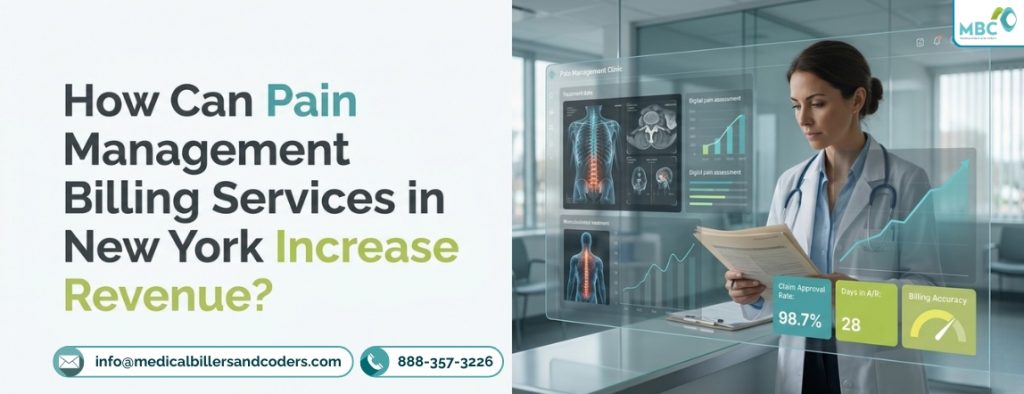
Pain Management Billing Services in New York face a revenue landscape defined by payer complexity, high denial rates on interventional procedures, and constant shifts in CMS reimbursement policy.
For pain management practices operating across New York — from Manhattan to Buffalo — the answer to the title question is direct: specialized RCM services built around the clinical and regulatory demands of interventional pain coding consistently outperform generalist billing in Net Collection Ratio, Days in AR, and denial recovery.
Here is exactly how.
Why Generic Billing Fails Pain Management Practices in New York
Pain management is one of the highest-denial specialties in the country. Procedures like spinal cord stimulator trials (CPT 63650), fluoroscopic-guided epidural steroid injections (CPT 62323), and facet joint nerve blocks (CPT 64493–64495) require modifier precision, diagnosis-to-procedure alignment, and Local Coverage Determination (LCD) documentation that generic medical billing services are not built to handle.
New York payers — including Excellus BlueCross BlueShield, Empire BlueCross, and Healthfirst — maintain strict LCD requirements for interventional pain procedures. A missing ICD-10 code such as M54.4 (lumbago with sciatica) or incomplete prior authorization documentation triggers automatic denial.
For a practice performing 200+ procedures monthly, each avoidable denial represents $800 to $2,400 in delayed or lost revenue.
The Three Revenue Leakage Points in Pain Management Billing Services
Pain management practices in New York typically lose margin through three operational gaps:
- Modifier Errors on Multi-Level Procedures: Bilateral nerve blocks and multi-level spinal injections require modifier 50 and modifier 59 application at the claim level. Incorrect modifier stacking results in bundling denials that recover at less than 40% on appeal without documentation-level intervention.
- LCD Non-Compliance for Interventional Services: Medicare and Medicaid LCD requirements for procedures like sacroiliac joint injections (CPT 27096) and radiofrequency ablation (CPT 64635) demand specific documentation of conservative treatment failure. Missing this documentation results in medical necessity denials — the leading denial category for New York interventional pain practices.
- Anesthesia and Facility Fee Gaps: Pain procedures performed under monitored anesthesia care (MAC) require coordinated facility fee and professional fee billing. Disconnected billing workflows leave anesthesia units — calculated per 15-minute base and time units — systematically under-billed.
How Specialized Pain Management Billing Services in New York Close the Revenue Gap
| Revenue Challenge | Generic Medical Billing | MBC Pain Management RCM |
| LCD Documentation Audit | Reactive (post-denial) | Pre-submission screening |
| Modifier Accuracy | Manual review | Procedure-specific edits |
| Denial Recovery Rate | 55–65% | 88–94% |
| Days in AR | 38–50 days | 19–24 days |
| Net Collection Ratio | 82–87% | 93–97% |
Specialized Pain Management Billing Services in New York reduce Days in AR by building clean-claim scrubbing protocols specific to CPT code families, payer-level contract terms, and New York State Medicaid fee schedules.
The downstream effect is measurable: a mid-size interventional pain practice collecting $2.5M annually can recover $275K–$400K in previously written-off revenue within 90 days of transitioning to specialty-specific RCM services.
For practices looking to benchmark their current billing performance against specialty standards, explore MBC’s pain management billing plans before writing off underperformance as market conditions.
New York-Specific Payer Challenges Pain Management Billers Must Navigate
New York operates under both federal and state-level reimbursement frameworks that add complexity beyond standard Medicare billing rules.
The New York Workers’ Compensation Board maintains its own fee schedule for pain management procedures — entirely separate from Medicare’s Physician Fee Schedule — with distinct documentation requirements for causal relationship, functional impairment, and treatment necessity.
Pain practices with Workers’ Comp and No-Fault volume require RCM services with dedicated lien management infrastructure.
Additionally, New York’s no-fault insurance regulations (11 NYCRR Part 68) impose strict 45-day billing deadlines from the date of service.
Missing this window results in permanent claim forfeiture — a compliance risk that costs New York pain practices an estimated $120K–$180K annually in time-barred revenue.
Measuring ROI from Pain Management Billing Services in New York
The performance standard for specialty-grade Pain Management Billing Services in New York should include a Net Collection Ratio above 93%, a clean claim rate above 96% for interventional CPT codes, denial rate below 8% on first-pass submission, and Days in AR under 25 days for commercial payers.
These benchmarks are achievable — but only through RCM services that combine interventional coding expertise, payer-specific contract knowledge, and New York regulatory compliance into a single operational infrastructure.
Contact MBC at 888-357-3226 or info@medicalbillersandcoders.com to schedule a pain management billing audit for your New York practice.
FAQs
Epidural steroid injections (CPT 62321–62323), facet joint injections (CPT 64493–64495), and spinal cord stimulator trials (CPT 63650) carry the highest denial rates due to LCD non-compliance, missing prior authorization, and modifier errors — all addressable through specialized Pain Management Billing Services in New York.
New York Workers’ Comp uses a separate fee schedule from Medicare and requires documentation of causality, functional limitations, and treatment necessity. Claims must be submitted within 45 days under no-fault rules, or revenue is permanently forfeited.
A well-managed interventional pain practice should target a Net Collection Ratio above 93%. Practices using generic medical billing services typically collect between 82–87%, leaving $150K–$300K in recoverable revenue on the table annually.
New York commercial payers — including Excellus and Empire BlueCross — require prior authorization for most interventional procedures. Gaps in auth management are the second-leading cause of claim denials, making proactive auth tracking a core function of effective RCM services.
Most practices see measurable improvement in Days in AR and denial rates within 30–60 days of transitioning to specialized pain management billing. Full Net Collection Ratio improvement typically stabilizes at 90 days, with annualized recovery averaging $275K–$400K for mid-size practices.
How Can Pain Management Billing Services in New York Increase Revenue?
Phone: 888-357-3226Email: sales@medicalbillersandcoders.com

Catering to more than 40 specialties, Medical Billers and Coders (MBC) is proficient in handling services that range from revenue cycle management to ICD-10 testing solutions. The main goal of our organization is to assist physicians looking for billers and coders, at the same time help billing specialists looking for jobs, reach the right place.