

 Specialities
 Services
 Resource Center
 Pricing
 About
About
 Contact
In practice, most Florida surgery centers are not capturing the full value of it because the billing infrastructure required to convert new procedure eligibility into actual revenue is more complex than it was 12 months ago.
The Gap Between What CMS Allows and What You Actually Collect
The 2026 CPL expansion is a genuine growth opportunity for Florida ASCs adding cardiovascular, spine, or musculoskeletal procedure lines. But CMS approves new procedures immediately — and Florida’s dominant commercial payers take 60 to 180 days to update their internal coverage policies to match. A surgery center billing newly eligible procedures without verifying each payer’s current coverage status generates systematic medical necessity denials during that window. Case volume growth becomes billing loss without a payer variance protocol in place.
That is one of the four structural gaps that specialized ASC billing services in Florida are designed to close. The others are equally consequential:
- ASCQR compliance. CMS finalized the 2.6% payment update exclusively for centers meeting quality reporting requirements. Non-compliance triggers a two-percentage-point reduction — worth $240,000 or more annually at mid-volume billing levels. ASCQR reporting runs through the revenue cycle, not around it.
- Modifier and coding precision. A missing SG modifier or an outdated CPT code produces an instant denial on an ASC facility claim. Unlike physician billing, there is no retroactive correction path once a payer has adjudicated. Clean claims on submission is the only viable operating standard.
- Implant and supply capture. High-value surgical cases generate implant and device costs that must be documented and captured at the claim level before submission. Uncaptured implant charges compound across case volume as a structural per-case revenue deficit.
What Leading Medical Billing Services Actually Protect
The industry average denial rate for ASCs sits between 15 and 25%. Surgery centers working with specialized billing partners consistently achieve 4 to 6%. On a $2 million monthly billing volume, that gap represents $200,000 to $300,000 in additional annual collections — from the same case mix, without adding a single procedure or patient.
Delivering leading medical billing services for Florida ASCs requires more than claim submission. It requires current, plan-specific knowledge of how Florida Blue, Humana, Aetna, and UnitedHealthcare each adjudicate ASC facility claims — because what constitutes a payable claim at one Florida payer requires different modifier combinations and documentation at another. Uniform billing rules applied across Florida’s payer mix are a primary driver of the industry’s high denial rates.
The best medical billing services in Florida also pursue the revenue that has already been earned but not collected — aged A/R claims past 90, 120, or 180 days that most surgery centers write off as uncollectible, when systematic appeal and payer follow-up can recover a significant portion.
Where Your Florida ASC Revenue Cycle Stands Right Now
The question most Florida surgery center administrators cannot answer precisely is: where, specifically, is our revenue cycle losing money? Not the denial rate as a general figure — the specific procedure categories, specific payers, and specific billing workflow failures generating the most recoverable loss in our facility, with our case mix, right now.
That is exactly what an ASC Revenue Protection Assessment answers. MBC’s no-cost assessment audits your denial rate by payer and procedure type, identifies ASCQR compliance gaps, reviews implant charge capture, and quantifies the recoverable revenue in your aged A/R — all specific to your Florida surgery center’s actual billing data.
It takes about 20 minutes of your time. The findings show you whether your current ASC billing services are performing at the level your case volume demands — and exactly what changing that is worth in recovered annual revenue.
Request your free ASC Revenue Protection Assessment here. Florida surgery centers that request an assessment this quarter receive a complete denial pattern analysis with payer-specific recovery estimates at no cost and no commitment.
Frequently Asked Questions: ASC Billing Services in Florida
ASC billing services manage the facility fee revenue cycle specifically for ambulatory surgery centers. Unlike physician billing, an ASC bills only for the facility component — the operating room, equipment, supplies, and implants — using the CMS-1500 form with Place of Service 24 and ASC-specific modifiers including the SG modifier. Medicare’s 9-rate payment system, strict adherence to the ASC Covered Procedures List, and payer-specific bundling rules mean that general medical billing knowledge applied to ASC claims is one of the primary drivers of the industry’s 15–25% denial rates. Effective ASC billing services require coders trained specifically on surgical facility coding and the documentation standards that support ASC claims at the payer level.
Several Florida-specific factors compound the standard challenges of ASC billing services in Florida. Florida has more than 500 active surgery centers, making it one of the most competitive ASC markets in the country. The state’s large elderly population means a higher-than-average share of cases are billed to Medicare and Medicare Advantage plans — which pay ASCs approximately 53 to 56% of what hospital outpatient departments receive for identical procedures, making per-case billing accuracy more consequential. Florida’s dominant commercial payers — Florida Blue, Humana, Aetna, and UnitedHealthcare — each operate distinct fee schedules, modifier requirements, and prior authorization protocols that require plan-specific billing workflows. Applying uniform billing rules across Florida’s payer mix is a systematic source of preventable denials.
The Ambulatory Surgical Center Quality Reporting (ASCQR) program requires Medicare-enrolled ASCs to submit quality measure data to CMS. For 2026, CMS finalized a 2.6% payment rate update exclusively for ASCQR-compliant centers. Surgery centers that fail to meet reporting requirements receive a two-percentage-point reduction to their annual payment rate — representing $240,000 to $1.2 million in lost annual revenue for mid-to-large Florida ASCs depending on billing volume. ASCQR compliance is a revenue cycle function that runs through billing operations. Leading medical billing services in Florida build ASCQR reporting into the revenue cycle workflow as a recurring function, so compliance gaps do not become reimbursement gaps.
CMS added 560 procedures and 35 ancillary services to the ASC Covered Procedures List for 2026, including cardiovascular, spine, and musculoskeletal cases previously restricted to inpatient hospital settings. For Florida surgery centers with the clinical infrastructure to perform these cases, this is direct new revenue. The risk is that CMS approves new procedures immediately, while Florida’s commercial payers take 60 to 180 days to update their internal coverage policies. Billing newly eligible procedures without verifying each Florida payer’s current coverage status produces systematic medical necessity denials during that transition window. Specialized ASC billing services in Florida include payer variance detection protocols that verify CPL procedure coverage at each commercial payer before claims are submitted.
MBC’s no-cost ASC Revenue Protection Assessment is a structured audit of your Florida surgery center’s current billing performance. It covers denial rate analysis broken down by payer and procedure type, ASCQR compliance status, implant and supply charge capture review, payer variance exposure on 2026 CPL additions, and quantification of recoverable revenue in aged A/R claims. The assessment uses your actual billing data — not industry averages — to show where your center is losing money and what recovering it is worth in annual revenue. It takes approximately 20 minutes of your time and carries no cost or commitment. Request your assessment here.
Most Florida surgery centers working with MBC see meaningful denial rate improvement within the first 60 to 90 days of engagement. Structural billing errors — missing modifiers, CPL payer variance denials, implant capture gaps — are corrected in the first billing cycle, producing the fastest improvement. ASCQR compliance workflows are implemented in parallel. Old A/R recovery typically generates the first significant revenue return within the same period, as MBC’s dedicated recovery team pursues aged claims simultaneously with new submission management.
Yes. MBC’s ASC billing services integrate with all major surgery center EMR and practice management platforms used by Florida surgery centers, including AdvanceSurg, Surgical Information Systems (SIS), HST Pathways, Waystar, and others. No software changes or operational disruption are required. MBC’s billing team adapts to your existing system and case management workflow from the first billing cycle.
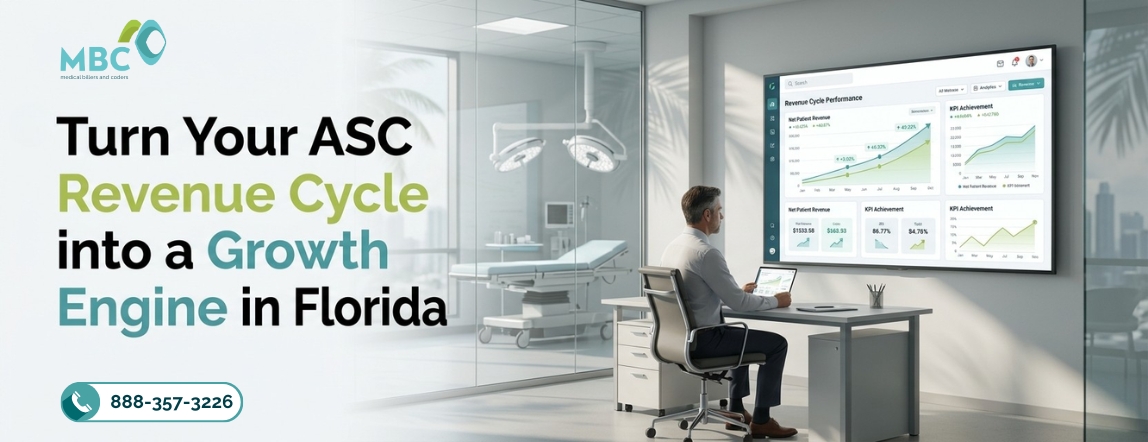
Turn Your ASC Revenue Cycle into a Growth Engine in Florida
Phone: 888-357-3226Fax: 888-316-4566
Email: sales@medicalbillersandcoders.com

Catering to more than 40 specialties, Medical Billers and Coders (MBC) is proficient in handling services that range from revenue cycle management to ICD-10 testing solutions. The main goal of our organization is to assist physicians looking for billers and coders, at the same time help billing specialists looking for jobs, reach the right place.
