Specialities
 Services
 Resource Center
 Pricing
 About
About
 Contact
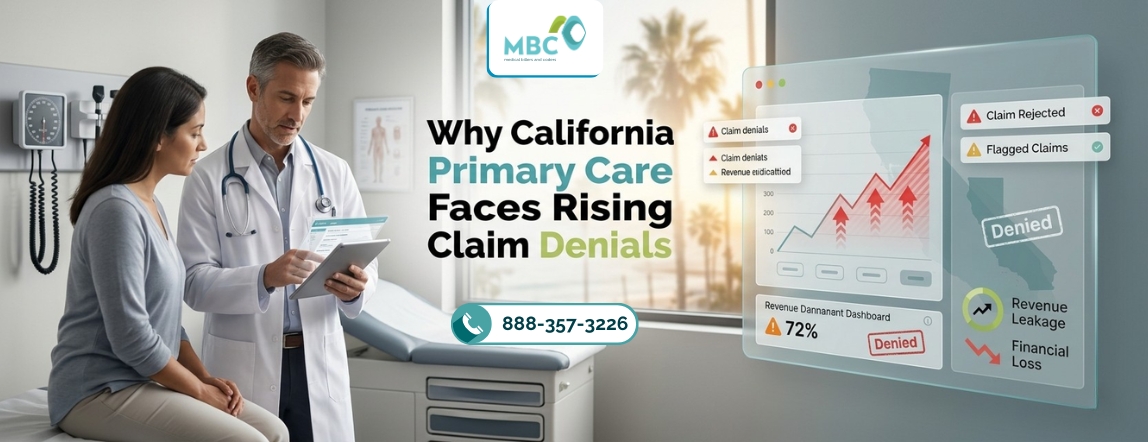
Primary care billing in California is generating more denials per claim cycle than in any previous year — and for most practices, the causes are structural, not random. California’s payer environment layers federal billing rules with state-specific Medi-Cal requirements, Knox-Keene Act compliance obligations, and more than 20 county-organized health plans each applying different coverage criteria. Add commercial payers deploying AI-assisted claim review and the 2026 G2211 conflict rule, creating a new denial trigger on the most common primary care encounter type, and the result is a denial rate that consistently runs above the national average for California primary care practices.
The denials are not concentrated in complex cases. They are appearing on routine encounters — preventive visits with same-day problem management, chronic care management claims, and annual wellness visits billed alongside G2211 on days that also included a procedure. These are the highest-volume encounters in a primary care practice, which means a structural billing error repeats hundreds of times a month before anyone notices the pattern.
The Four Denial Drivers Hitting California Primary Care in 2026
1. Medi-Cal managed care billing applied to fee-for-service patients
Nearly 15.3 million Californians are enrolled in Medi-Cal — approximately 40% of the state’s population. Of those, 88% are in managed care plans rather than fee-for-service. California primary care practices that submit claims directly to Medi-Cal FFS for patients enrolled in a managed care plan generate automatic denials. The correct submission path is to the patient’s specific county health plan — LA Care, Inland Empire Health Plan, Health Net, Molina California, or one of more than 20 others — each with distinct modifier requirements, timely filing windows, and Treatment Authorization Request (TAR) processes. A single billing workflow applied across all Medi-Cal patients is the most consistent source of preventable denials in primary care billing services across California.
2. G2211 and Modifier 25 conflict — new in 2026
California primary care practices that added G2211 (the longitudinal care complexity add-on) to their standard billing workflow in 2024 or 2025 are now generating systematic denials. CMS guidelines prohibit billing G2211 on the same day as an E/M service carrying Modifier 25 for a minor procedure with a 0-day global period. Blue Shield of California and Anthem Blue Cross have both implemented automated claim edits that flag this combination — meaning practices billing G2211 on any visit that also includes a procedure are generating a new denial category on their highest-volume encounter type as of January 1, 2026.
3. Missing or misapplied modifiers on same-day preventive and problem visits
When a California primary care physician performs a preventive wellness exam and also evaluates a separate problem during the same visit, both services are billable — but only if Modifier 25 is correctly appended to the problem-focused E/M. Without it, Blue Shield, Anthem, and Aetna automatically bundle and deny the problem-focused charge. This is the most common avoidable denial in California’s medical billing services for primary care, and it recurs on every affected preventive visit until the workflow is corrected.
4. Eligibility verification gaps from Medi-Cal mid-year plan changes
California Medi-Cal managed care patients can change plans mid-year when they move counties, lose and regain eligibility, or are reassigned by DHCS. A primary care practice that does not verify Medi-Cal eligibility and plan assignment at every visit is systematically submitting claims to the wrong county health plan — generating avoidable denials that accumulate invisibly across a high-volume Medi-Cal patient panel. Real-time eligibility verification through AEVS (Automated Eligibility Verification System) at each encounter is the minimum standard — not a prior-month batch check.
What a Revenue Diagnostic finds: MBC’s medical billing services audit identifies which of these four denial drivers is generating the most recoverable revenue loss in your specific California primary care practice — by payer, encounter type, and denial code — using your actual claims data. It takes 15 minutes and costs nothing.
California’s payer complexity makes primary care billing harder than in most states — but the revenue lost to structural denial patterns is recoverable. MBC’s Primary Care Billing Services are built for California’s payer environment.
Frequently Asked Questions: Primary Care Billing in California
California’s denial rate for primary care runs above the national average because of three compounding factors: Medi-Cal managed care operates through more than 20 county health plans, each applying different coverage criteria and modifier rules; commercial payers Blue Shield of California and Anthem Blue Cross deploy AI-assisted claim review with stricter documentation thresholds than most states; and California’s Knox-Keene Act compliance obligations add a layer of state-specific billing requirements on top of federal rules. A billing approach calibrated for another state generates avoidable denials when applied to California’s payer mix without modification.
The single most common denial source in California primary care billing is submitting Medi-Cal claims to the fee-for-service program for patients enrolled in a managed care plan. Because 88% of Medi-Cal’s 15.3 million enrollees are in managed care, the claim must go directly to the patient’s county health plan — LA Care, Inland Empire Health Plan, Health Net, Molina California, or another county-specific plan. Submitting to Medi-Cal FFS for a managed care member results in an automatic denial of every claim for that patient until the workflow is corrected.
The 2026 G2211 conflict rule prohibits billing the G2211 longitudinal care complexity add-on on the same day as an E/M service carrying Modifier 25 for a minor procedure with a 0-day global period. For California primary care practices, this affects every visit in which a physician performs an in-office procedure — joint injection, wound care, cryotherapy, IUD insertion — and bills G2211 for the ongoing care relationship. Blue Shield of California and Anthem Blue Cross have both implemented automated edits that catch this combination. Practices that added G2211 to their standard workflow in 2024 or 2025 without updating for the 2026 conflict rule are generating systematic denials on previously clean encounter types.
Every visit — not monthly, not weekly, and not based on a prior eligibility check from the same patient’s last appointment. California Medi-Cal managed care patients can change their plan assignment mid-year when they move counties, experience an eligibility interruption, or are reassigned by DHCS. Eligibility verified at the last visit may not reflect the patient’s current plan. Real-time verification through California’s AEVS (Automated Eligibility Verification System) at each encounter is the required standard for clean claims in California’s primary care medical billing services.
MBC’s Primary Care Billing Services maintain payer-specific billing protocols for each of California’s county-organized Medi-Cal health plans, perform real-time AEVS eligibility verification at each encounter, screen for G2211 and Modifier 25 conflicts before submission, and implement a structured denial management workflow with appeal deadlines tracked at the claim level. For California primary care practices, this means the four structural denial drivers — Medi-Cal managed care misrouting, G2211 conflict, Modifier 25 gaps, and eligibility mismatches — are caught before claims go out rather than after denials arrive. MBC’s Revenue Diagnostic identifies exactly which patterns are costing your practice the most recoverable revenue.
Top Wound Care Billing Services in California
Phone: 888-357-3226Fax: 888-316-4566
Email: sales@medicalbillersandcoders.com

Catering to more than 40 specialties, Medical Billers and Coders (MBC) is proficient in handling services that range from revenue cycle management to ICD-10 testing solutions. The main goal of our organization is to assist physicians looking for billers and coders, at the same time help billing specialists looking for jobs, reach the right place.