Specialities
 Services
 Resource Center
 Pricing
 About
About
 Contact
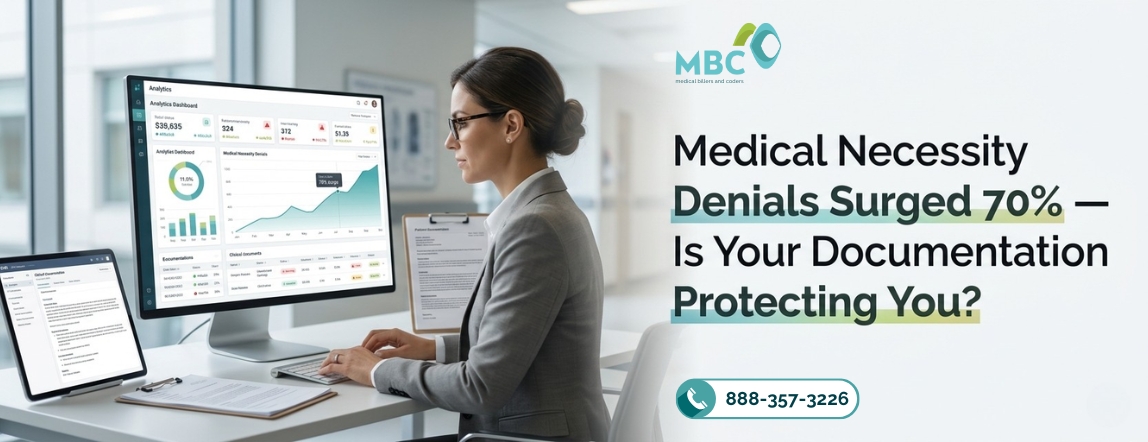
Yes, medical necessity denials are surging at rates that now constitute a structural revenue threat, not an administrative inconvenience, and your clinical documentation is either your strongest shield or your most expensive liability. For CFOs and revenue cycle directors managing multi-specialty or high-acuity practices, the margin impact is no longer theoretical.
The Scale of the Problem
Initial claim denial rates climbed to 11.8% across U.S. healthcare in 2024, up from approximately 10.2% just a few years prior. Medicare Advantage plans drove a 4.8% spike in denials from 2023 to 2024 alone, while commercial plan denials rose an additional 1.5% in the same period. The administrative cost per denied claim has risen from $43.84 in 2022 to $57.23 in 2023 and continues climbing.
The financial consequence is not distributed evenly. Medical necessity denials represent over 40% of inpatient rejection cases, and nearly 65% of those denials are never resubmitted, meaning the revenue is written off permanently. For a multi-specialty group collecting $5M annually, a 10% denial rate on inpatient claims with a 65% write-off rate is not a billing problem. It is an EBITDA event.
The OIG made this explicit. Its landmark report on Medicare Advantage Organizations found that 13% of prior authorization denials that met Medicare coverage rules were still denied and that when appealed, over 80% of those decisions were overturned. The full findings are available at OIG Report OEI-09-18-00260.
Why Documentation Is Failing Revenue Cycle: The Triple Threat
Generic documentation practices are losing ground against payer systems that are no longer staffed by human reviewers. Payers now deploy Natural Language Processing (NLP) algorithms to scan clinical notes in real time, matching language against rigid internal “medical necessity” policies that can span thousands of pages. If your documentation does not hit specific clinical markers, the claim is denied automatically before a clinical reviewer ever sees it.
Three root-cause documentation failures drive the majority of medical necessity denials:
- Vague Clinical Narratives: Notes that describe what happened but fail to establish why a lower level of care was clinically insufficient. Payers require the full patient story — symptoms, failed alternatives, acuity escalation — not just a procedure log.
- Undocumented Comorbidities: Secondary conditions that justify a high-cost procedure or extended stay are frequently omitted. Each missing comorbidity is a denial trigger. For high-acuity cases, this can convert a clean claim into a CO-50 denial (service not medically necessary) requiring a full clinical appeal.
- LCD/NCD Misalignment: Local Coverage Determinations (LCDs) issued by Medicare Administrative Contractors (MACs) set jurisdiction-specific criteria that differ from National Coverage Determinations (NCDs). Documentation written to generic standards rather than MAC-specific LCD requirements fails automatically on Medicare claims. Your documentation has to satisfy both.
The 2026 Regulatory Shift That Changes Everything
The landscape for medical necessity denials 2026 is defined by the full operational implementation of the CMS Interoperability and Prior Authorization Final Rule (CMS-0057-F), released January 17, 2024, with payer compliance deadlines effective January 1, 2026.
The rule mandates standardized electronic prior authorization workflows and requires payers to provide a specific, standardized reason for every medical necessity denial. Full details are at CMS.gov CMS-0057-F.
What this means operationally: payers now have documented, standardized justifications for every denial they issue. That is an advantage for appeals, but only for providers whose documentation is clean enough to challenge those reasons precisely.
Organizations still relying on narrative-heavy, non-structured clinical notes will find that standardized denial reasons expose documentation gaps they were previously unaware of.
Clinical vs. Technical Denials: Where Revenue Actually Bleeds
Not all denials carry the same recovery probability or require the same intervention. Understanding the distinction is foundational to any denial management infrastructure:
| Factor | Technical Denials | Medical Necessity Denials |
| Root Cause | Missing data, wrong ID, timely filing errors | Documentation quality, NLP misalignment, LCD gaps |
| Payer Review Tool | Automated database matching | AI/NLP clinical note scanning |
| Resolution Timeline | Days (correct and resubmit) | Weeks (clinical appeal with expert documentation) |
| Write-Off Risk | Low; most are correctable | High; 65% never resubmitted |
| Prevention Approach | Front-end eligibility and data verification | CDI programs, MAC-specific LCD alignment |
| Cost Per Denial | $43–$57 in rework cost | $57–$117 per claim plus potential permanent loss |
Medical necessity denials are not a billing department problem. They are a clinical documentation and revenue integrity problem, requiring intervention upstream of claim submission, not downstream.
What Protecting Your Revenue Actually Requires
Chasing denials after adjudication costs five times more than preventing them at the point of documentation. High-performing revenue cycle operations are shifting from reactive appeals management to predictive, pre-submission denial interception.
This requires three operational infrastructure components that most practices and generic vendors do not have in place.
- Real-time CDI Integration: Clinical Documentation Improvement programs that review notes at the encounter level, not the billing level, and align documentation with MAC-specific LCD criteria before claim submission.
- CARC/RARC Root-Cause Analytics: Segmenting denials by Claim Adjustment Reason Codes and Remittance Advice Remark Codes to identify payer-specific patterns rather than treating all denials as isolated events.
- Proactive LCD Monitoring: Medicare Administrative Contractor LCDs are updated continuously. A denial prevention infrastructure monitors those updates and feeds changes back into documentation standards and coder training in real time.
Partnering with a qualified revenue integrity partner delivers exactly this infrastructure, treating clinical documentation as a financial instrument rather than a medical record formality. The outcome is measurable — organizations with structured denial prevention programs recover 60–67% of initially denied claims, versus 25% for those managing denials reactively.
Specialty-focused revenue integrity solutions and rcm services go further by embedding payer behavior analytics, identifying which MAO or commercial payer is applying criteria more restrictive than CMS standards and building appeals and documentation protocols specific to those payer patterns.
The Stakes for Multi-Specialty and High-Acuity Practices
For PE-backed groups and multi-site practices, medical necessity denials compound across service lines. A 13% inappropriate denial rate across a $10M Medicare Advantage book, with 65% of those never appealed, represents over $845,000 in preventable annual revenue loss based on documented OIG and industry data.
Specialized medical billing services with CDI expertise and real-time denial analytics close that gap by addressing root causes at the documentation layer, not the rework layer. That is the difference between reactive billing and enterprise revenue performance management.
Ready to Protect Your Revenue Before the Next Denial Hits?
MBC’s Revenue Cycle specialists conduct a comprehensive Documentation and Denial Risk Assessment, identifying LCD alignment gaps, payer-specific denial patterns, and CDI deficiencies before they reach adjudication.
With 26+ years of specialty-specific RCM experience, we deliver the operational infrastructure that turns medical necessity denials into recovered revenue.
Schedule your assessment today: 888-357-3226 | info@medicalbillersandcoders.com
FAQs: Medical Necessity Denials
Vague or incomplete clinical documentation that fails to establish why a lower level of care was insufficient. Payer NLP systems require specific diagnostic narratives, documented comorbidities, and explicit justification aligned with MAC-specific LCD criteria, not just a procedure record.
The OIG confirmed 13% of MA prior authorization denials that met Medicare coverage rules were denied anyway. When appealed with precise documentation, over 80% of these decisions are overturned. Structured, evidence-based appeals produce far better outcomes than passive write-offs.
Effective January 1, 2026, payers must provide a standardized, specific reason for every prior authorization denial. This creates a more structured appeals environment, but only benefits providers whose documentation is clean enough to directly counter those standardized denial reasons.
A National Coverage Determination (NCD) sets nationwide CMS coverage policy, while a Local Coverage Determination (LCD) is issued by a specific Medicare Administrative Contractor for their jurisdiction. Documentation must satisfy both. Failing to align with the applicable MAC’s LCD, even when meeting NCD requirements, is a direct denial trigger on Medicare claims.
Immediately. Most payers impose 30–180 day appeal deadlines from the denial date. Claims should be reviewed within 48 hours of the denial notice, with high-dollar claims prioritized first. Peer-to-peer review requests filed alongside the written appeal produce overturn rates above 80% when documentation is properly structured.

With almost 12 years of experience in healthcare revenue cycle management, this Revenue Cycle Specialist brings deep expertise in medical billing, claims optimization, and practice profitability. Shares industry-backed insights focused on improving collections, reducing denials, and driving operational excellence.