Specialities
 Services
 Resource Center
 Pricing
 About
About
 Contact

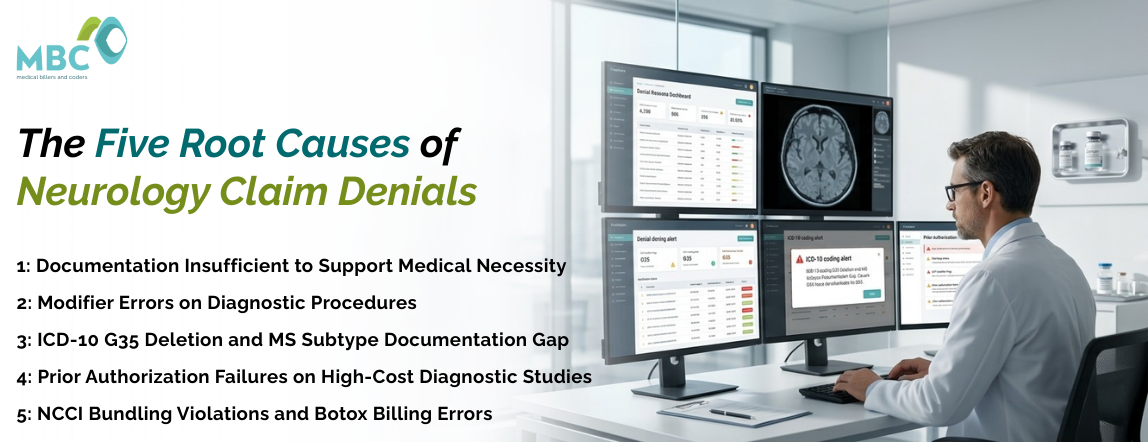
Neurology claim denials are caused by five structural billing failures that compound across every claim cycle: documentation insufficient to support medical necessity, incorrect modifier application on EEG and EMG procedures, ICD-10 specificity gaps following the October 2025 deletion of G35 for multiple sclerosis, prior authorization failures on high-cost diagnostic studies, and NCCI bundling violations on same-day EMG and nerve conduction study billing.
The financial scale of these failures is measurable: neurology practices face a 35% initial denial rate — among the highest of any specialty — with 52% of denials attributed to documentation or medical-necessity errors.
Forty percent of denied neurology claims are never reprocessed, and each reworked claim costs $25–$35 in administrative expense before the lost revenue is counted. For a neurology practice collecting $1M–$5M per month, the combination of write-offs and rework costs from neurology claim denials generates $60,000–$300,000 per month in preventable revenue loss.
Why Neurology Has One of the Highest Denial Rates in Medicine
Neurology billing operates across three simultaneous layers of complexity that most specialty billing workflows are not designed to handle together. First, the diagnostic procedure codes — EEG (CPT 95812–95813, 95816), EMG (CPT 95885–95886), and nerve conduction studies (CPT 95907–95913) — each have distinct documentation requirements, LCD-specific medical-necessity criteria, and payer-specific prior-authorization thresholds that vary independently of one another.
Second, the modifier rules governing these procedures are among the most technically demanding in the CPT system: Modifiers 26, 59, 95, and 50 all apply in neurology contexts, where a single incorrect application can trigger either a bundling denial or an audit flag. Third, the 2026 ICD-10 code changes eliminated G35 as a billable MS diagnosis effective October 1, 2025, resulting in an immediate mass-denial event for any practice still carrying G35 on claims dated after that date.
The 2026 CMS Physician Fee Schedule (CMS-1832-F) applied a 2.5% efficiency adjustment to non-time-based work RVUs across neurology — reducing reimbursement on high-volume diagnostic procedures — while exempting E/M and time-based codes. For practices where EEG, EMG, and NCS procedures account for 40–60% of monthly revenue, the efficiency adjustment compounds the financial impact of each denial: each denied high-acuity diagnostic claim now represents a larger share of the reduced per-procedure reimbursement.
The Five Root Causes of Neurology Claim Denials
Cause 1: Documentation Insufficient to Support Medical Necessity
Medical-necessity documentation is the primary driver of denials in neurology, accounting for 52% of all denials, according to the AMA 2024 Claims Report. For Medicare claims, CMS LCD L34594 (Nerve Conduction Studies and Electromyography) sets explicit documentation requirements: the patient record must contain the reason for referral, a clear diagnostic impression, and actual numeric data — latency, amplitude, conduction velocity — presented in tabular format, not narrative summary.
LCD L34594 additionally requires that EMG/NCS be performed only when clinical suspicion for a myopathic or neuropathic process exists and when history, physical exam, and standard laboratory testing cannot make a definitive diagnosis.
Claims submitted for EMG/NCS without documentation of a failed alternative diagnostic workup are vulnerable to medical-necessity denial, regardless of whether the procedure was clinically appropriate. The same standard applies to EEG studies: the clinical record must document why imaging and clinical examination were insufficient and why electrodiagnostic testing was the necessary next step.
Permanent Fix: Implement a pre-submission documentation checklist for every EEG, EMG, and NCS claim that verifies:
(1) clinical indication clearly stated,
(2) prior workup documented as insufficient for definitive diagnosis,
(3) numeric data present in tabular format,
(4) diagnostic impression linked to the procedure performed.
Claims that do not pass all four checkpoints should not be submitted until documentation is complete.
Cause 2: Modifier Errors on Diagnostic Procedures
Neurology modifier errors simultaneously generate both denial exposure and audit risk. The four modifiers most frequently misapplied in neurology billing are:
Modifier 26 (Professional Component): Required when billing for professional interpretation of an EEG or NCS separately from the technical component. Missing Modifier 26 when billing interpretation-only results in claim rejection or full-procedure payment without technical component rights. Incorrect application of Modifier 26 when the practice owns the equipment generates overpayment and audit exposure.
Modifier 59 (Distinct Procedural Services): Used to unbundle EMG (CPT 95886) and NCS (CPT 95907–95913) when performed on the same day, as these are related but distinct procedures under NCCI edits. Missing Modifier 59 triggers automatic bundling denial. Overuse of Modifier 59 without documentation supporting the distinct nature of each procedure triggers audit review.
Modifier 95 (Synchronous Telemedicine): Required for all tele-neurology claims delivered via real-time audio-video. Missing Modifier 95 results in claim rejection for telehealth services. Modifier 93 applies to audio-only telehealth — using 95 for audio-only or vice versa generates a different denial pathway.
Modifier 25 (Significant, Separately Identifiable E/M): Required when billing an E/M service on the same day as a procedure such as Botox injection (CPT 64615) for chronic migraine. Missing Modifier 25 results in E/M bundling and revenue loss. The E/M documentation must reflect a distinct clinical decision-making process unrelated to the procedure indication.
Permanent Fix: Build modifier-specific claim scrubbing rules that flag every neurology claim for modifier verification before submission. Every EEG and NCS claim should trigger a Modifier 26 check. Every same-day EMG/NCS claim should trigger a Modifier 59 verification. Every telehealth claim should trigger a check for Modifier 95 or 93. Every same-day E/M plus procedure claim should trigger a Modifier 25 check.
Cause 3: ICD-10 G35 Deletion and MS Subtype Documentation Gap
ICD-10 code G35 (Multiple Sclerosis) was deleted effective October 1, 2025, and is not valid for the 2026 code set. Claims with dates of service on or after October 1, 2025, that use G35 are automatically rejected as using an invalid code. The replacement codes require documentation of both the MS subtype and the activity status — information that the prior G35 umbrella code did not require.
For neurology practices with MS patients on standing treatment plans — particularly those receiving Botox, disease-modifying therapies, or ongoing neurological monitoring — any claim cycle carried over from documentation from September 2025 without subtype-specific coding will result in mass denials.
The documentation must come from the clinical record: coders cannot assign a subtype without physician documentation of the specific MS phenotype and activity status.
Permanent Fix: Audit all MS patient records immediately for subtype and activity status documentation. Update EHR templates for MS patient encounters to prompt documentation of phenotype and activity status at every visit. Build a crosswalk from G35 to the applicable G35. x subcodes and verify all active MS patient records are mapped before the next claim submission cycle.
Cause 4: Prior Authorization Failures on High-Cost Diagnostic Studies
Prior authorization is required for MRI brain studies, nerve conduction studies under many commercial payer policies, EMG procedures, and spinal neurostimulators — and the authorization requirements change frequently enough that a policy current six months ago may no longer be valid.
For neurology practices, the risk is compounded by the high cost of procedures: a denied MRI brain study or a denied neurostimulator claim represents $3,000–$15,000 in revenue at risk per claim.
Commercial payers increasingly require prior authorization for even routine NCS procedures, and authorization at the time of scheduling does not guarantee payment when proper billing and coding requirements are not followed. An authorization is confirmation of coverage intent, not a guarantee of reimbursement when documentation or coding does not support the claim as submitted.
Permanent Fix: Maintain a procedure-specific prior authorization matrix updated monthly by payer, covering EEG, EMG, NCS, MRI, neurostimulator programming, and Botox injections. Verify authorization before the procedure, not on the day of service.
Track authorization numbers on every claim and establish a 30-day follow-up protocol for any claim where authorization was obtained but has not been adjudicated.
Cause 5: NCCI Bundling Violations and Botox Billing Errors
NCCI procedure-to-procedure edits and medically unlikely edits (MUEs) generate systematic bundling denials in neurology billing when same-day procedures are not properly distinguished. The most common NCCI violation in neurology is billing CPT 96372 (therapeutic injection) alongside CPT 64615 (Botox injection for chronic migraine) — CPT guidelines and NCCI edits prohibit this combination because 64615 already includes the injection work.
For Botox billing, CPT 64615 must be supported by LCD 34635 diagnosis criteria, and the corresponding drug code J0585 (onabotulinumtoxinA, per unit) must be billed separately at the correct unit count.
Medicare allows a maximum of 600 units per encounter. Billing above this threshold without documentation of medical necessity for extended dosing generates automatic denial. When J0585 is denied, the related injection code 64615 is also subject to denial — creating a cascading loss from a single drug billing error.
Permanent Fix: Run NCCI PTP edit verification on every neurology claim before submission. Build a Botox-specific billing protocol that verifies:
1) LCD 34635 diagnosis code listed and linked to CPT 64615,
(2) J0585 unit count does not exceed 600 units per encounter without additional documentation,
(3) CPT 96372 not billed alongside 64615,
(4) E/M billed same day only with Modifier 25 for a distinct diagnosis and documented separately.
Neurology Claim Denial Quick Reference: Cause, Code, and Permanent Fix
| Denial Root Cause | Affected CPT / ICD-10 | Permanent Fix | Monthly Revenue at Risk |
| Medical necessity documentation gap | 95812–95813, 95816, 95885–95886, 95907–95913 | Pre-submission checklist: tabular data, diagnostic impression, prior workup documented | $20,000–$80,000 |
| Modifier 26 / 59 / 95 / 25 error | EEG, EMG, NCS, telehealth, and E/M same-day claims | Claim-level modifier scrubbing rules before submission | $15,000–$60,000 |
| G35 deleted — MS subtype not documented | All MS patient claims with DOS ≥ Oct 1, 2025 | Crosswalk G35 to G35. x subcodes; update EHR templates for phenotype and activity status | $10,000–$40,000 |
| Prior authorization failure | MRI, NCS, EMG, neurostimulator, Botox | Monthly payer auth matrix; pre-procedure verification; auth number on every claim | $15,000–$75,000 |
| NCCI bundling / Botox billing error | 64615, J0585, 96372 same-day combination | NCCI PTP edit scrubbing; Botox-specific protocol; LCD 34635 diagnosis verification | $10,000–$45,000 |
| TOTAL DENIAL EXPOSURE | Multi-provider neurology group, $1M–$5M monthly collections | Five-gap denial root-cause engineering + pre-submission scrubbing | $70,000–$300,000 per month recoverable |
Table 1: Neurology Claim Denial Root Causes — CPT Codes, Fixes, and Monthly Revenue at Risk
How to Fix Neurology Claim Denials Permanently: The Three-Layer Infrastructure
Addressing neurology claim denials individually — appealing each denial as it ages in AR — recovers some revenue, but never eliminates the pattern. The permanent fix requires three infrastructure layers that operate before the claim is submitted, not after it is denied.

Layer 1 — Pre-Submission Claim Scrubbing. Every neurology claim must pass a specialty-specific scrubbing protocol before submission that checks: modifier logic against NCCI PTP edits, ICD-10 code validity for the date of service, authorization status for the procedure billed, and documentation completeness against the applicable LCD requirements.
Generic claim scrubbing tools built for multi-specialty billing do not apply neurology-specific logic — they check for syntax errors but miss specialty-level bundling rules and LCD-specific documentation requirements.
Layer 2 — Denial Root-Cause Engineering. Denial root-cause engineering classifies every denied claim by denial type, CPT code, payer, and root cause category — then identifies whether the denial is an isolated error or a structural pattern recurring across multiple claims.
A practice receiving 40 Modifier 59 denials per month on same-day EMG/NCS claims does not have 40 individual problems: it has one structural modifier logic error that will recur on every future same-day claim until the root cause is corrected in the claim scrubbing protocol.
Layer 3 — Payer Variance Detection. Commercial payer policies for neurology diagnostic studies — NCS, EMG, EEG, neurostimulator programming — are updated independently of Medicare LCD updates. A NCS prior authorization requirement that UnitedHealthcare implemented in Q3 2025 will not appear in your claim scrubbing tool unless that tool is actively tracking payer policy bulletins.
Payer variance detection protocols verify coverage criteria, authorization requirements, and bundling rules by payer and procedure on a monthly basis — preventing the scenario where a practice bills correctly under Medicare rules and receives systematic commercial payer denials because the commercial policy changed without notice.
How MBC’s Neurology Revenue Integrity Framework Eliminates Denials Permanently
For neurology practices collecting $1M–$5M per month, neurology claim denials are not a billing team performance problem — they are a revenue integrity infrastructure problem. The same five denial root causes recur across every claim cycle until the pre-submission scrubbing, documentation protocols, and payer variance monitoring are built to neurology-specific standards.
Generic RCM tools built for multi-specialty billing apply generic scrubbing logic that overlooks LCD-specific documentation requirements, specialty modifier rules, and payer policy updates affecting NCS and EMG authorizations.
As the leading medical billing company in the USA with 25+ years of neurology billing expertise, MBC delivers medical billing services purpose-built for the complexity of electrodiagnostic coding, MS subtype documentation, and multi-payer authorization management.
The MBC Revenue Integrity Framework applies three operational layers — neurology-specific claim scrubbing, denial root-cause engineering, and monthly payer variance detection — that convert denial patterns into permanently closed billing gaps.
Where most billing vendors deliver monthly AR aging reports, MBC delivers financial performance metrics that CFOs and practice administrators use to manage Yield EBITDA: denial rate by CPT code and payer, net collection ratio by procedure category, Days in AR segmented by denial type, and clean claim rate trending against the specialty benchmark. Practices that partner with MBC consistently achieve a proven 30% reduction in Days in AR within 90 days of engagement.
The starting point is a Complimentary 90-Day Neurology Revenue Diagnostic — a structured audit of your current denial rate by root cause, modifier compliance across EEG, EMG, and NCS claims, ICD-10 G35 crosswalk status for all active MS patients, and prior authorization failure rate by payer and procedure. The diagnostic identifies your specific sources of leakage and the monthly recovery potential from closing each one, before you commit to any billing change.
Stop Appealing Denials. Start Preventing Them.
Medical Billers and Coders (MBC) delivers Neurology Billing Services, Old AR Recovery, RCM Services, and Denial Management Services, backed by 25+ years of neurology-specific billing expertise. Dedicated account manager. No EHR change required.
→ Request Your 90-Day Neurology Revenue Diagnostic
Frequently Asked Questions
Neurology claim denials occur at a 35% initial rate — among the highest of any specialty — because neurology billing requires simultaneous management of LCD-specific medical necessity documentation for EEG, EMG, and NCS procedures, complex modifier rules (Modifier 26, 59, 95, 25), ICD-10 subtype requirements including the October 2025 G35 deletion for multiple sclerosis, prior authorization for high-cost diagnostic studies, and NCCI bundling compliance on same-day procedure combinations.
ICD-10 code G35 (Multiple Sclerosis) was deleted effective October 1, 2025 and is invalid for all claims with dates of service on or after that date; practices must now document and code the specific MS subtype (relapsing-remitting, primary progressive, secondary progressive, clinically isolated syndrome) and activity status, requiring updated EHR documentation templates and a complete crosswalk from G35 to the G35.x subcategory codes.
Forty percent of denied neurology claims are never reprocessed because reworking each denial costs $25–$35 in administrative expense before revenue is recovered, practices lack denial root-cause tracking to identify which denials are worth appealing, and documentation gaps make successful appeals unlikely without additional clinical documentation from the physician — a time-intensive process most billing teams deprioritize against new claim volume.
CPT 64615 for chronic migraine Botox must be supported by LCD 34635 diagnosis criteria, billed with HCPCS J0585 (onabotulinumtoxinA per unit) as a separate drug claim, limited to a maximum of 600 Medicare units per encounter, and never billed alongside CPT 96372 (therapeutic injection) because NCCI edits prohibit this combination; when J0585 is denied, the related CPT 64615 is also subject to denial.
The permanent fix for neurology claim denials requires three infrastructure layers: neurology-specific pre-submission claim scrubbing that applies LCD, NCCI, and modifier logic before submission; denial root-cause engineering that classifies denials by type, CPT, and payer to identify structural patterns rather than treating each denial as an isolated event; and monthly payer variance detection that tracks commercial payer policy updates on NCS, EMG, EEG, and neurostimulator authorization requirements independently of Medicare LCD changes.
References
- Congressional Research Service. (2024). Enhanced premium tax credit and 2026 exchange premiums: Frequently asked questions (R48290).
- Urban Institute. (2025). 4.8 million people will lose coverage in 2026 if enhanced premium tax credits expire.
- Kaiser Family Foundation. (n.d.). ACA enhanced premium tax credit calculator: Estimated premium increases without extension.
- Robert Wood Johnson Foundation. (2025). How the expiration of ACA tax credits will affect healthcare spending.
- Association of State and Territorial Health Officials. (2026). ACA enhanced premium tax credits: Legislative developments in 2025 and 2026.
- Healthcare Financial Management Association. (n.d.). Rising underinsurance ratchets pressure on hospitals: Kaufman Hall National Hospital Flash Report data.
- CNBC. (2026, January 13). As enhanced ACA subsidies lapse, millions poised to drop health insurance.

Catering to more than 40 specialties, Medical Billers and Coders (MBC) is proficient in handling services that range from revenue cycle management to ICD-10 testing solutions. The main goal of our organization is to assist physicians looking for billers and coders, at the same time help billing specialists looking for jobs, reach the right place.