Specialities
 Services
 Resource Center
 Pricing
 About
About
 Contact
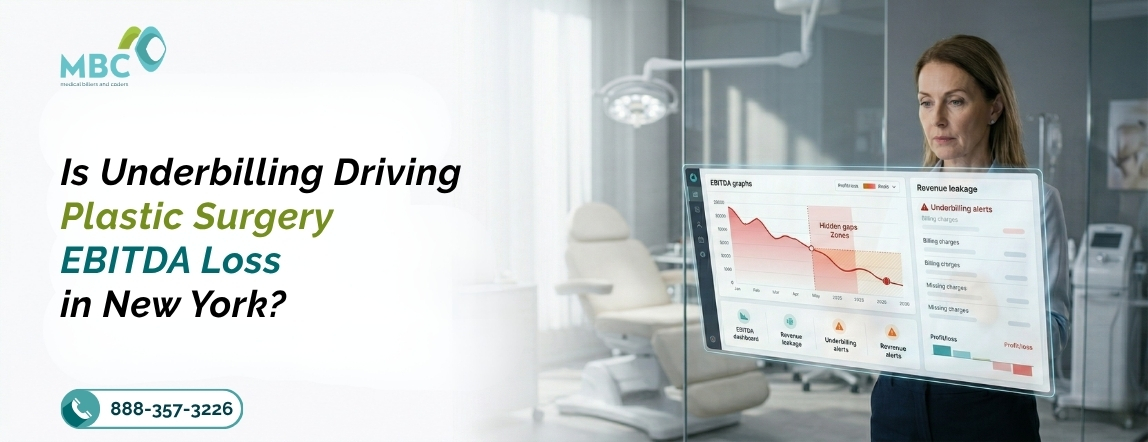
Yes—underbilling is the primary driver of Plastic Surgery EBITDA loss in New York, not claim denials or slow collections. The proof? New York plastic surgery practices with 95%+ clean claim rates and <30 Days in AR still lose 18–28% of potential revenue ($1.2M–$3.8M annually for practices collecting $1M–$5M+ monthly) because performed procedures never generate charges, making traditional revenue cycle metrics completely blind to the largest profit leak in plastic surgery.
The One Test That Proves Underbilling Is Driving Your EBITDA Loss
Is underbilling driving Plastic Surgery EBITDA loss in New York? Run this 2-minute test:
Step 1: Count procedures on last month’s OR schedule: ______
Step 2: Count claims in last month’s billing report: ______
Step 3: Subtract: ______ unbilled procedures
If the gap is 5+ procedures per month, underbilling costs you $132,000–$316,800 annually.
Table 1: Is Underbilling Driving Your Plastic Surgery EBITDA Loss?
| Your Monthly Gap | Average Value Per Procedure | Monthly Loss | Annual EBITDA Impact |
| 5 unbilled procedures | $2,200–$2,640 | $11,000–$13,200 | $132,000–$158,400 |
| 10 unbilled procedures | $2,200–$2,640 | $22,000–$26,400 | $264,000–$316,800 |
| 15 unbilled procedures | $2,200–$2,640 | $33,000–$39,600 | $396,000–$475,200 |
Critical Insight: Your denial reports show a 4% denial rate (excellent). Your AR aging shows 28 days (great). But neither metric measures the 10 procedures you performed last month that never became claims.
Why Standard Metrics Can’t Detect If Underbilling Is Driving EBITDA Loss
Is underbilling driving Plastic Surgery EBITDA loss when your metrics look healthy? Yes—because standard reports only measure performance on submitted claims.
What Your Current Reports Show:
- Clean Claim Rate: 96% → Measures claims submitted, not procedures performed
- Days in AR: 28 days → Measures speed on billed charges, ignores unbilled services
- Denial Rate: 4% → Measures rejections on submitted claims, misses never-submitted procedures
- Collection Rate: 98% → Measures recovery on billed amount, doesn’t count missing revenue
What They Hide:
Last month, you performed 156 procedures. You submitted 142 claims. Where are the other 14?
Those 14 procedures (worth $30,800–$36,960 monthly) don’t appear in ANY standard report:
- Not in denial reports (never denied—never submitted)
- Not in AR aging (not in AR—never billed)
- Not in adjustment reports (not adjusted—never existed as charges)
This is why underbilling driving Plastic Surgery EBITDA loss is the wrong question. The right question is: “How much EBITDA am I losing to procedures I performed but never billed?”
Three Underbilling Patterns Driving Plastic Surgery EBITDA Loss You Can Fix This Week
Pattern 1: Procedures Performed But Never Charged (8–18 Per Month)
How Procedures Vanish:
The Rescheduling Black Hole:
- Monday: Patient scheduled for rhinoplasty, charge entered in system
- Wednesday: Patient reschedules to Friday
- Billing staff: Deletes charge (standard protocol)
- Friday: Patient shows up, procedure performed
- Result: No charge in system—$8,400 procedure done, $0 billed
The “No CPT Code in Dropdown” Skip:
- Surgeon performs a combination procedure (not in template)
- Billing staff: “I don’t see a code for this.”
- Choice: Spend 20 minutes researching, or skip to the next patient
- What happens 72% of the time: They skip it
- Result: 90-minute procedure, $3,600 fee, $0 revenue
The Fix That Takes 10 Minutes Daily:
Before you leave each day:
- Print today’s OR schedule (all patients who had surgery)
- Print today’s charge entry report (all charges created)
- Match them line by line
- Any patient on the OR schedule without charge? → Call the surgeon NOW, enter charge same day
Real Results from 3-OR New York Practice:
- Before daily check: 14 unbilled procedures/month = $369,600 annual loss
- After daily check: 1 unbilled procedure/month = $26,400 annual loss
- EBITDA recovery: $343,200 annually
Copy-Paste Email Template to Send Your Billing Manager:
Subject: New Daily Workflow Starting [Date]
Starting [date], please complete this 10-minute check before leaving each day:
- Print OR schedule for today
- Print charge entry report for today
- Highlight any OR patient without corresponding charge
- Text me immediately with patient name—I’ll confirm what was performed
- Enter charge same day
This prevents procedures from falling through the cracks.
Pattern 2: Complexity Undercoding ($1,200–$2,800 Per Case)
The Pattern:
Your operative note says: “Forehead flap based on supratrochlear vessels.”
Your claim says: 15120 (simple skin graft) = $680
Your note actually supports: 15731 (forehead flap) = $2,480
Underbilling: $1,800 per case
Why It Happens:
Billing staff code from encounter forms (checked by OR nurse), not operative reports (dictated by surgeon). They see the “☐ Skin graft” checkbox and code 15120.
The 5-Second Surgeon Fix:
Add ONE sentence to your operative note template:
“Billing code: CPT [exact code] – [complexity level].”
Examples:
- “Billing code: CPT 15731 – complex axial flap, not simple graft.”
- “Billing code: CPT 19361 – TRAM flap reconstruction”
- “Billing code: CPT 13132 – complex closure >30cm”
Why this works: Billing staff see the exact code IN THE DICTATION—zero interpretation required.
New York Practice Results:
- Reviewed 90 days of flap procedures
- Found 26 of 42 flaps coded as simple grafts (62% undercoded)
- Average underbilling: $1,680 per case
- Annual EBITDA loss: $175,680
- After adding “Billing code” to template: Recovery of $175,680 annually
Pattern 3: Implant Charges Paid But Not Billed (58% Capture Failure Rate)
The Invisible Loss:
- You pay the supplier: $1,200 for breast implants
- You bill patient/insurance: $0 (forgot to add L8600 device code)
- Net result: -$1,200 per case (100% loss on implant cost)
Why The Disconnect:
OR uses implant → Supply chain pays invoice → Billing codes procedure → Nobody connects the three → Implant charge never enters the billing system
The Friday 15-Minute Fix:
Every Friday at 4 PM:
- Pull all implant/device invoices received this week
- Pull all surgical claims submitted this week
- Match invoice serial numbers to claims
- Missing L8600 on the claim, but have the invoice? → File corrected claim Monday (still within 30-day window)
Table 2: Implant Capture Failure EBITDA Impact
| Monthly Implant Cases | Cost You Pay | Should Collect (L8600) | Actual Capture Rate | Annual Loss |
| 12 cases | $14,400 | $21,600–$26,400 | 42% (5 of 12 billed) | $99,360–$132,480 |
| 18 cases | $21,600 | $32,400–$39,600 | 42% (8 of 18 billed) | $149,040–$198,720 |
| 24 cases | $28,800 | $43,200–$52,800 | 42% (10 of 24 billed) | $198,720–$264,960 |
New York Practice Implementation:
- Before weekly check: 42% implant capture = $149,040 annual loss
- After weekly check: 94% implant capture = $17,280 annual loss
- EBITDA recovery: $131,760 annually
How Plastic Surgery Billing Services in New York Prove Underbilling Is Driving Loss
Specialized Plastic Surgery Billing Services in New York: the answer is underbilling, driving Plastic Surgery EBITDA loss through a three-source data comparison that generalist billing companies never perform. Medical Billing Services in New York with plastic surgery expertise compare OR logs (procedures performed), billing reports (claims submitted), and supply invoices (devices used)—revealing the gap between services rendered and revenue captured.
When Plastic Surgery Billing Services in New York implement daily OR reconciliation (preventing unbilled procedures), operative note complexity verification (preventing downcoding), and weekly implant invoice matching (preventing device charge losses), they prove is underbilling driving Plastic Surgery EBITDA loss in New York through documented recovery: $343,200 from procedure capture + $175,680 from complexity coding + $131,760 from implant billing = $650,640 total annual EBITDA recovery from systematic underbilling prevention.
MBC’s Revenue Integrity Partner Approach: Quantifying Underbilling Impact
Medical Billers and Coders function as your Revenue Integrity Partner by answering questions about underbilling, driving Plastic Surgery EBITDA loss with quantified proof rather than assumptions. MBC’s Revenue Diagnostic evaluates your billing through a 90-day comparative analysis: your OR logs show 468 procedures performed, your billing system shows 426 claims submitted—42 procedures × $2,400 average = $100,800 quarterly underbilling ($403,200 annually) that standard revenue cycle reports cannot detect.
MBC helps yield your EBITDA by maximizing reimbursement through the implementation of the three systematic protocols above: daily procedure-to-claim reconciliation (ensuring every OR case generates a charge within 24 hours), operative report coding verification (confirming billed codes match documented complexity), and weekly device invoice-to-claim matching (capturing all implant and supply charges). As your Revenue Integrity Partner, we address underbilling, which drives Plastic Surgery EBITDA loss, by preventing charge capture failures before they become permanent revenue loss—because once the 30-day corrected claim window closes, underbilled procedures become uncollectible write-offs.
Request Your Free Revenue Diagnostic: Prove If Underbilling Is Driving Your Loss
Medical Billers and Coders provides Plastic Surgery EBITDA analysis that definitively answers whether underbilling is driving your EBITDA loss in New York, with documented gap quantification.
What MBC’s Revenue Diagnostic Provides:
- 90-day OR log vs. billing report comparison (exact unbilled procedure count)
- Operative note vs. coded complexity audit (undercoding pattern identification)
- Device invoice vs. claim reconciliation (implant capture rate analysis)
- Exact annual EBITDA recovery opportunity ($343K + $176K + $132K = $651K typical)
- Free assessment proving the underbilling impact
Request Your Free Revenue Diagnostic for procedure-by-procedure underbilling analysis, daily reconciliation workflow template, operative note coding language examples, and weekly implant matching protocol.
MBC’s fee structure: https://www.medicalbillersandcoders.com/pricing
Contact Medical Billers and Coders to implement the three underbilling fixes above—because underbilling is driving Plastic Surgery EBITDA loss in New York, becomes irrelevant when every performed procedure generates appropriate charges within 24 hours.
Frequently Asked Questions
Is underbilling really driving Plastic Surgery EBITDA loss more than denials?
Yes—is underbilling driving Plastic Surgery EBITDA loss represents 18–28% revenue erosion ($1.2M–$3.8M annually) versus 4–8% from claim denials, confirmed when OR logs show 156 procedures performed but billing reports show 142 claims submitted (14 unbilled × $2,400 = $403,200 annual invisible loss) requiring Plastic Surgery Billing Services in New York systematic prevention.
How do I prove that underbilling is driving my EBITDA loss?
Count last month’s OR schedule procedures, count last month’s submitted claims—if gap exists (typically 8–18 procedures monthly), underbilling confirmed worth $22,000–$58,000 monthly; then audit operative notes versus billed codes (complexity gaps) and device invoices versus claims (missing charges) through Medical Billing Services in New York three-source reconciliation proving is underbilling driving Plastic Surgery EBITDA loss.
Why don’t my metrics show underbilling if it’s the primary driver of EBITDA?
Standard metrics (96% clean claim rate, 28 Days in AR, 4% denial rate) only measure submitted claims performance—they cannot detect procedures performed but never billed, making underbilling driving Plastic Surgery EBITDA loss in New York invisible until OR log reconciliation reveals unbilled procedures worth $343,200 annually that never appear in denial reports or AR aging.
What’s the fastest way to stop underbilling from driving EBITDA loss?
Implement daily 10-minute OR reconciliation (match yesterday’s OR schedule to yesterday’s charges, call the surgeon for any unbilled procedures, enter charges the same day), preventing a $343,200 annual loss from procedure-to-claim conversion failures—the fastest Plastic Surgery EBITDA recovery protocol, addressing is underbilling and driving loss through immediate charge capture within 24 hours.
How can Plastic Surgery Billing Services prove that underbilling is driving my loss?
Specialized Plastic Surgery Billing Services in New York compare OR logs (procedures performed) versus billing reports (claims submitted) versus supply invoices (devices used) documenting exact gaps: 42 unbilled procedures = $100,800 quarterly, 26 complexity undercoded cases = $43,680 quarterly, 14 missing implant charges = $32,940 quarterly—proving is underbilling driving Plastic Surgery EBITDA loss through $177,420 quarterly ($709,680 annual) recovery opportunity at https://www.medicalbillersandcoders.com/pricing.
References
- Surgical procedure coding and charge capture best practices.
- Revenue cycle metrics: Hidden underbilling in surgical specialties.

Catering to more than 40 specialties, Medical Billers and Coders (MBC) is proficient in handling services that range from revenue cycle management to ICD-10 testing solutions. The main goal of our organization is to assist physicians looking for billers and coders, at the same time help billing specialists looking for jobs, reach the right place.