Specialities
 Services
 Resource Center
 Pricing
 About
About
 Contact
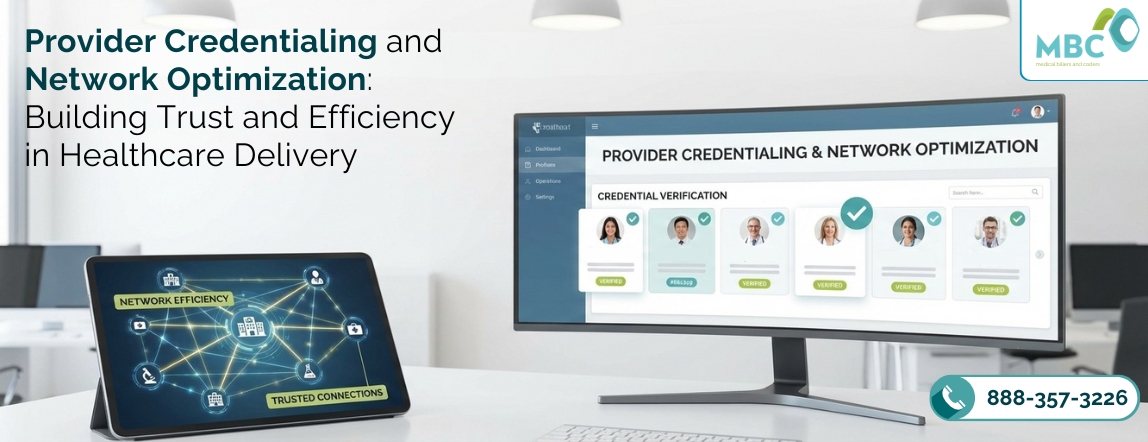
Provider credentialing and network optimization are foundational processes that build trust and improve efficiency in healthcare delivery systems. Healthcare networks function as the backbone of modern patient care delivery. Yet behind every successful healthcare network lies a critical, often invisible process: verifying provider qualifications, ensuring compliance, and maintaining current practitioner information to build networks that patients trust, payers accept, and regulators approve. Organizations that excel at provider credentialing and network optimization create efficient, compliant healthcare delivery networks. Conversely, organizations with credentialing failures face denied claims, loss of payer contracts, compliance penalties, and reputational damage.
Provider credentialing and network optimization work together to create efficient, compliant, and trusted healthcare delivery networks. This comprehensive guide explores how healthcare organizations implement credentialing and network optimization strategies that reduce administrative burden, accelerate network expansion, ensure regulatory compliance, and ultimately improve patient care delivery while building trust with patients, payers, and regulators.
Understanding Provider Credentialing in Modern Healthcare
Provider credentialing is the systematic process of verifying that healthcare providers possess the qualifications, licensure, certifications, and experience they claim to have. It goes beyond simple background checks—credentialing requires a thorough investigation of education, training, malpractice history, sanctions, and current legal standing.
According to the Centers for Medicare & Medicaid Services (CMS), provider credentialing is mandatory for organizations participating in Medicare and Medicaid programs. The CMS Conditions of Participation (CoPs) require that all healthcare practitioners have current, verified credentials before delivering patient care or billing for services.
Why Provider Credentialing Matters
Healthcare credentialing serves multiple critical functions:
- Patient Safety: Credentialing verifies that providers are qualified to deliver the services they offer. This protects patients from receiving care from unqualified practitioners and reduces healthcare organizations’ liability exposure.
- Regulatory Compliance: Federal and state regulations require healthcare organizations to maintain credentialed networks. CMS, state medical boards, and insurance commissioners conduct audits to verify compliance. Credentialing failures result in:
- Loss of Medicare/Medicaid participation
- Payer contract termination
- State licensing board sanctions
- Federal penalties reaching $10,000+ per non-credentialed provider
- Claims Reimbursement: Insurance payers (Medicare, Medicaid, commercial) verify that providers are credentialed before processing claims. Non-credentialed providers cannot bill for services, creating immediate revenue loss.
- Network Trust: Patients and referring physicians trust networks that maintain rigorous credentialing standards. Organizations with credentialing excellence build a reputation for quality and safety.
- Operational Efficiency: Streamlined credentialing processes accelerate network expansion, reduce administrative overhead, and enable faster response to patient demand.
The Credentialing Process: What Healthcare Organizations Must Verify
Comprehensive provider credentialing requires verification of multiple credential elements:
Education and Training Verification
Healthcare organizations must verify:
- Undergraduate degree: Confirmation from the registrar of the granting institution
- Medical/Professional degree: MD, DO, NP, PA, or other clinical credential from accredited schools
- Graduate training: Residency and fellowship completion from accredited programs
- Specialty certifications: Board certification status (American Board of Medical Specialties, specialty boards)
Education verification appears straightforward but involves direct contact with educational institutions, confirmation of graduation dates, and verification that degrees are legitimate and up to date. Organizations cannot accept provider claims of education without independent verification.
Licensure and Regulatory Status
Every healthcare practitioner must hold an active, unrestricted license in the state(s) where they practice. Credentialing requires:
- State medical board verification: Confirmation of active licenses and any disciplinary history
- DEA registration verification: For prescribing providers, confirmation of active Drug Enforcement Administration registration
- State-controlled substance registrations: In states maintaining separate controlled substance licenses
- Malpractice claims history: Verification through the National Practitioner Data Bank (NPDB)
According to the U.S. Department of Health and Human Services, the National Practitioner Data Bank maintains information on medical malpractice payments, adverse licensure actions, and professional society sanctions. Healthcare organizations must query the NPDB for every credentialed provider and maintain current records.
Sanctions and Exclusion Verification
Federal law prohibits healthcare organizations from employing or credentialing providers who are excluded from federal healthcare programs. This includes:
- OIG Exclusions: The Office of Inspector General maintains a list of individuals and entities excluded from federal healthcare programs
- SAM Exclusions: The System for Award Management maintains federal exclusion lists
- State exclusions: State Medicaid programs maintain separate exclusion lists
- Medicare/Medicaid sanctions: State agencies track providers with payment suspensions or program exclusions
Failure to verify exclusion status before credentialing creates significant liability. Healthcare organizations are responsible for identifying excluded providers and must immediately terminate their participation if exclusion is discovered.
Clinical Privileges Delineation
Credentialing involves defining which specific services each provider is authorized to perform. This requires:
- Scope of practice assessment: Verification that requested privileges align with the provider’s training and experience
- Peer review: Evaluation by qualified peers in the same specialty
- Continuing medical education verification: Confirmation that providers meet ongoing learning requirements
- Performance assessment: Review of clinical outcomes and quality metrics
Clinical privileges delineation protects patients by ensuring providers perform only services within their competence and training.
Network Optimization: Leveraging Credentialing for Strategic Growth
Provider credentialing and network optimization are intertwined. Once credentialing infrastructure is established, organizations can leverage it for strategic network development:
Identifying Network Gaps
Network optimization begins with analyzing current provider distribution:
- Geographic coverage: Identifying geographic areas underserved by the network
- Specialty distribution: Determining whether the network has adequate specialists in high-demand areas
- Referral patterns: Understanding how patients flow through the network
- Patient demand: Assessing which services have waitlists or unmet demand
Organizations use this analysis to identify recruitment priorities. Rather than recruiting providers randomly, strategic networks recruit to address specific gaps—whether geographic, specialty, or service-based.
Streamlining the Credentialing Timeline
Traditional credentialing processes take 60-120 days from initial application to credential verification. This delays network expansion and creates challenges when rapid recruitment is needed.
Organizations optimize credentialing timelines through:
- Technology Integration: Credentialing software automates verification requests to educational institutions, licensing boards, and the NPDB. Automation reduces manual tracking and accelerates verification.
- Parallel Processing: Rather than sequential verification (waiting for education verification before requesting licensure verification), parallel processing requests multiple verifications simultaneously, reducing the overall timeline by 30-40%.
- Primary Source Verification: Establishing direct relationships with common verifying sources (medical schools, licensing boards) enables faster response.
- Provider Application Completeness: Requiring complete applications upfront (with all necessary documentation) prevents delays from missing information.
- Dedicated Credentialing Staff: Organizations with dedicated credentialing personnel achieve faster timelines than those with part-time credentialing responsibilities.
Credentialing as a Competitive Advantage
Healthcare organizations that excel at credentialing create competitive advantages:
- Faster Network Expansion: Streamlined credentialing enables rapid network growth in response to market opportunities or competitive threats.
- Provider Recruitment: Providers prefer networks with a reputation for efficient, professional credentialing. Fast credentialing timelines improve recruitment competitiveness.
- Payer Satisfaction: Insurance companies and employers value networks with strong credentialing practices. This leads to:
-
- Faster contract negotiations
- Better contract terms
- Improved payer relationships
- Access to additional payer contracts
- Regulatory Relationships: CMS and state regulators recognize organizations with strong credentialing compliance. This can lead to favorable audit outcomes and reduced regulatory scrutiny.
Regulatory Framework and Compliance Requirements
Healthcare credentialing operates within a complex regulatory framework. Understanding requirements is essential for compliance:
Medicare and Medicaid Requirements
According to the Centers for Medicare & Medicaid Services (CMS), organizations participating in Medicare and Medicaid must maintain compliant credentialing systems. Key requirements include:
- Conditions of Participation (CoPs): Healthcare facilities must maintain credentialed networks with verified credentials, current licenses, and clean exclusion status.
- PECOS Registration: Providers must be registered in the Provider Enrollment, Chains, and Ownership System. Medicare and Medicaid will not pay for services delivered by unregistered providers.
- Recredentialing: CMS requires credentialing updates at least every three years, with interim updates for significant changes in practice, licensure status, or sanctions.
- Documentation: All credentialing documentation must be maintained for at least five years and made available for audit.
State Licensing Board Requirements
State medical boards impose credentialing requirements:
- State License Verification: Providers must maintain active licenses in all states where they practice.
- Continuing Medical Education: Most states require providers to complete ongoing education (CME) hours annually. Healthcare organizations must verify CME compliance.
- Board Certifications: Many state boards require or recommend that providers maintain board certifications in their specialty areas.
- Malpractice Insurance: State boards increasingly require providers to maintain malpractice insurance at specified levels.
Insurance Industry Standards
Private insurance companies establish credentialing standards for network providers:
- NCQA Standards: The National Committee for Quality Assurance (NCQA) sets standards for health plan credentialing processes. NCQA-accredited plans must follow specific credentialing and recredentialing standards.
- Payer-Specific Requirements: Commercial payers often establish their own credentialing requirements beyond regulatory minimums. These might include:
- Specific training or certifications
- Volume requirements
- Quality metric thresholds
- Experience requirements
- Network Adequacy Standards: According to the Centers for Medicare & Medicaid Services, insurance plans must maintain networks adequate to serve their covered populations. This requires strategic credentialing to ensure appropriate provider distribution.
Technology Solutions for Credentialing and Network Optimization
Modern healthcare organizations leverage technology to streamline credentialing and network optimization:
Automated Verification Systems
Credentialing software platforms:
- Automate verification requests to educational institutions, licensing boards, and the NPDB
- Track verification status in real time with automated status updates
- Flag incomplete applications and missing information automatically
- Generate compliance reports for regulatory and audit purposes
- Manage recredentialing cycles automatically
Leading credentialing platforms integrate with multiple data sources, reducing manual verification work by 70-80%.
Provider Data Management
Network optimization requires centralized provider data management:
- Master provider database: Single source of truth for all credentialing information
- Real-time updates: Automatic updates when licensure, sanctions, or exclusion status changes
- Payer integration: Ability to feed credentialing data to multiple payers simultaneously
- Compliance dashboards: Visual display of credentialing status and compliance metrics
Organizations with centralized provider data management achieve:
- 40-50% reduction in credentialing administrative burden
- Faster identification of credentialing lapses
- Improved compliance with regulatory requirements
- Better coordination with payers
Network Analytics and Optimization
Advanced analytics platforms help organizations optimize networks:
- Geographic heat mapping: Visualization of provider distribution and patient demand by location
- Specialty gap analysis: Identification of specialty shortages and overages
- Referral pattern analysis: Understanding how patients move through the network
- Performance analytics: Tracking quality metrics, patient satisfaction, and outcomes by provider
Organizations using network analytics achieve:
- More strategic recruitment decisions
- Better alignment of supply and demand
- Improved network efficiency
- Higher patient and payer satisfaction
Building a World-Class Credentialing and Network Optimization Program
Effective provider credentialing and network optimization require a comprehensive, coordinated approach that addresses all elements of the credentialing process and the network development strategy.
1. Strong Infrastructure: Dedicated credentialing staff, technology platforms, and documented processes that ensure compliance with regulatory requirements.
2. Data Integration: Centralized provider databases integrated with payers, licensing boards, and regulatory systems to maintain current, accurate credentialing information.
3. Continuous Monitoring: Real-time monitoring of licensure status, exclusion lists, and sanctions with automatic alerts when provider status changes.
4. Strategic Planning: Use network analytics to identify recruitment priorities and align provider recruitment with organizational strategy.
5. Quality Assurance: Regular audits of credentialing files, recredentialing processes, and network composition to identify and address gaps.
Organizations that invest in strong credentialing and network optimization programs achieve:
- Regulatory compliance and reduced audit risk
- Faster network expansion and recruitment
- Improved payer relationships and contract terms
- Enhanced patient trust and safety
- Reduced financial exposure to credentialing failures
Conclusion: From Administrative Burden to Strategic Advantage
Provider credentialing and network optimization have evolved from purely compliance functions to strategic business processes that directly impact financial performance and organizational success. Healthcare organizations that excel at provider credentialing and network optimization build networks patients trust, payers prefer, and regulators recognize. More importantly, they create operational advantages that accelerate growth and improve financial performance.
By implementing streamlined credentialing processes, leveraging technology to reduce administrative burden, and using network analytics to drive strategic recruitment, healthcare organizations transform provider credentialing and network optimization from an administrative necessity into a competitive advantage that builds patient trust, enhances operational efficiency, and drives sustainable growth.
How Medical Billers and Coders (MBC) Support Provider Credentialing and Network Optimization
With over 25 years of experience, Medical Billers and Coders specializes in helping healthcare organizations establish compliant, efficient credentialing programs and optimize provider networks for growth and profitability.
Our comprehensive approach includes:
- Credentialing program setup, ensuring compliance with CMS, state, and payer requirements
- Primary source verification through established relationships with educational institutions and licensing boards
- Technology integration to streamline credentialing timelines and reduce administrative burden
- Network analytics and optimization, identifying strategic recruitment priorities and network gaps
- Recredentialing management, maintaining compliance with three-year recredentialing cycles, and interim updates
Ready to strengthen your credentialing program and optimize your network?
Schedule your free credentialing assessment with Medical Billers and Coders today and discover how strategic credentialing and network optimization can accelerate growth, ensure regulatory compliance, and build patient trust.
Frequently Asked Questions About Provider Credentialing and Network Optimization
According to the Centers for Medicare & Medicaid Services (CMS), credentialing timelines vary depending on the verification source’s responsiveness, but most organizations complete initial credentialing within 60-120 days. Organizations with automated systems and parallel processing achieve 45-60 day timelines. Factors affecting timeline include application completeness, verification source responsiveness, and the need for additional peer review or privileging requirements.
If a credentialed provider is identified on the Office of Inspector General (OIG) exclusion list or System for Award Management (SAM) exclusion list, the healthcare organization must immediately terminate the provider’s participation. Continued employment or credentialing of excluded providers violates federal law and results in criminal penalties, loss of federal program participation, and substantial fines. Healthcare organizations must verify exclusion status at hire and regularly monitor ongoing exclusion status.
According to the Centers for Medicare & Medicaid Services (CMS) Conditions of Participation, healthcare organizations must recredential providers at a minimum every three years. However, interim updates are required immediately when significant changes occur, including licensure changes, malpractice claims, disciplinary actions, or exclusion events. Some payers require more frequent recredentialing or continuous credentialing monitoring.
Credentialing failures carry substantial financial and legal consequences. Organizations that credential non-qualified providers or fail to verify exclusion status face: loss of Medicare/Medicaid participation (eliminating 30-40% of healthcare revenue for most organizations), payer contract termination, individual OIG penalties of $10,000+ per violation, and potential fraud liability if non-credentialed providers bill for services. Beyond financial penalties, credentialing failures damage organizational reputation and patient trust.
Organizations optimize networks by analyzing current provider distribution, patient demand, referral patterns, and geographic coverage gaps using data analytics platforms. They identify priority recruitment areas (whether geographic or specialty-based), streamline credentialing to accelerate recruitment, maintain quality standards through peer review and credentialing, and continuously monitor network performance through real-time dashboards. Strategic network optimization aligns provider supply with patient demand, improving overall healthcare delivery efficiency.
References
- Centers for Medicare & Medicaid Services (CMS) – Conditions of Participation
- U.S. Department of Health and Human Services (HHS) – National Practitioner Data Bank (NPDB)
- Office of Inspector General (OIG) – Exclusions
- System for Award Management (SAM) – Exclusions
- National Committee for Quality Assurance (NCQA) – Credentialing Standards
- U.S. Food and Drug Administration (FDA) – Provider Credentials and Qualifications
- State Medical Board Resources

Catering to more than 40 specialties, Medical Billers and Coders (MBC) is proficient in handling services that range from revenue cycle management to ICD-10 testing solutions. The main goal of our organization is to assist physicians looking for billers and coders, at the same time help billing specialists looking for jobs, reach the right place.