Specialities
 Services
 Resource Center
 Pricing
 About
About
 Contact
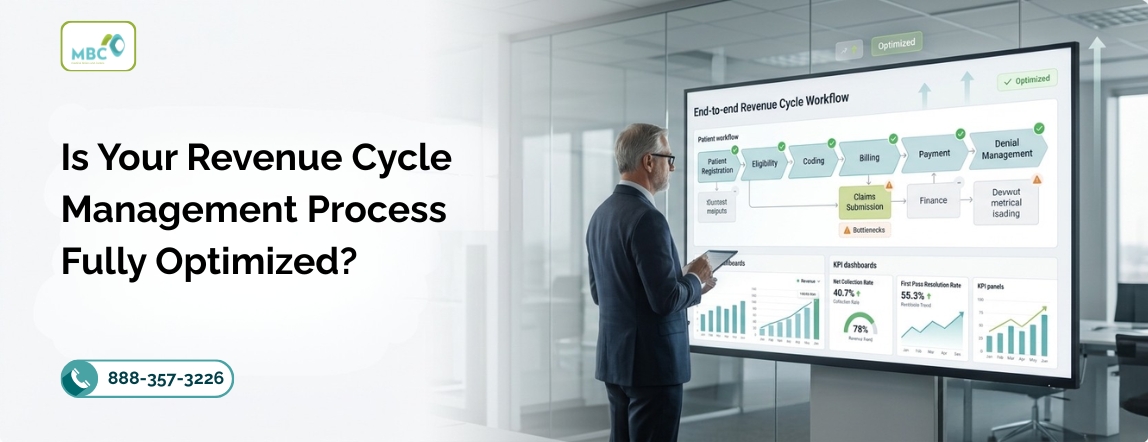
Yes — but only if every step from patient registration to final payment is working without gaps, and for most healthcare organizations in 2026, that’s simply not the case. The Revenue Cycle Management Process is the financial backbone of every healthcare facility.
When it breaks down — even in one stage — you don’t just face delayed payments. You face denied claims, compliance risk, and real revenue loss that compounds month over month. This blog breaks down where most RCM processes fail, what the data says, and what a truly optimized cycle looks like today.
Why Most RCM Processes Are Underperforming Right Now
Let’s start with what the numbers actually show.
According to the Centers for Medicare & Medicaid Services (CMS), improper payments in Medicare Fee-for-Service alone totaled $31.7 billion in FY 2023 — much of it traced back to documentation errors and incorrect coding.
The American Hospital Association (AHA) reported that hospitals spent over $19.7 billion in 2022 just dealing with prior authorizations — a front-end RCM function that, when mishandled, triggers back-end denials at scale. (AHA Prior Authorization Report)
And the Healthcare Financial Management Association (HFMA) benchmarks a healthy initial denial rate at under 5% — yet many facilities are now operating at 10–15%, meaning 1 in 7 claims is being rejected before a dollar is collected.
The gap between where your Revenue Cycle Management Process is and where it needs to be? That’s where revenue leakage lives.
Front-End vs. Back-End: Where Your Process Is Actually Failing
Most billing teams focus on the back end — chasing denials, reworking claims, fighting payers. But the real damage starts at the front door.
| RCM Stage | Front-End Focus | Back-End Focus |
| Primary Activity | Patient intake, eligibility verification, pre-auth | Claim scrubbing, submission, denial management |
| Where Errors Start | Incorrect insurance data, missed authorizations | Incomplete documentation, coding gaps |
| Cost of Failure | $25–$181 per reworked denial (HFMA) | Lost claim value + appeal labor cost |
| Optimization Lever | Real-time eligibility tools, intake workflows | Denial root-cause analysis, AR follow-up |
| Impact on Cash Flow | Prevents denials before submission | Recovers revenue after denials occur |
A fragmented RCM Process treats these as separate functions. An optimized one treats them as one continuous loop — where front-end accuracy directly protects back-end yield.
The Three Revenue Drains You’re Probably Missing
1. Coding Gaps Triggering Downstream Denials
Under the CY 2026 Physician Fee Schedule Final Rule, CMS made significant adjustments to evaluation and management (E/M) documentation requirements and reimbursement thresholds. If your coders aren’t trained on the updated guidelines, you’re likely undercoding complex visits or overbilling low-acuity ones — both of which attract scrutiny.
2. The No Surprises Act Compliance Gap
The No Surprises Act, enforced by CMS since January 2022 and strengthened through updated rulemaking in 2024, requires good-faith cost estimates, advanced explanation of benefits (AEOBs), and real-time eligibility disclosure. Facilities not integrated with payer eligibility APIs are flying blind — and paying for it in denials and patient disputes.
3. Inadequate Denial Root-Cause Infrastructure
Most facilities track denials. Few understand why the same denial codes repeat. Without denial root-cause analytics built into your medical billing services workflow, you’re treating symptoms — not the disease.
What Optimized Actually Looks Like
An optimized Revenue Cycle Management Process isn’t defined by tools — it’s defined by outcomes:
- First-Pass Resolution Rate (FPRR) of 95%+ — meaning nearly every claim is paid on first submission
- Days in AR under 35 — cash flow stability without working capital gaps
- Net Collection Ratio of 97–99% — reflecting true reimbursement effectiveness after all adjustments
- Clean Claim Rate of 98%+ — eliminating rework before it starts
Reaching these benchmarks requires revenue integrity solutions that go beyond claim submission. It means integrating coding audits, payer contract analytics, real-time eligibility, and denial pattern analysis into one operational framework.
This is what separates a vendor from a true revenue integrity partner — one who doesn’t just process claims but architects the system that protects your margins.
Why Outsourcing RCM Outperforms In-House Operations
The OIG 2025–2026 Work Plan has flagged several high-risk billing areas including split/shared visits, telehealth billing, and place-of-service errors. Staying compliant requires specialty-specific expertise that most in-house teams simply don’t have bandwidth to maintain.
Outsourced medical billing and coding services provide:
- Specialty-trained coders updated on the latest LCD, NCD, and payer policy changes
- Denial analytics infrastructure that identifies root causes — not just symptoms
- Compliance monitoring aligned with OIG and CMS audit priorities
- Scalable capacity without the overhead of full-time hiring
Organizations using RCM services from specialized partners consistently outperform internal teams on every key metric — particularly Net Collection Ratio and Days in AR.
Ready to Find Out Where Your Revenue Is Leaking?
If your case volume is growing but your collections aren’t keeping pace, the problem isn’t patient volume — it’s Revenue Cycle Management Process gaps that are quietly eroding your margin.
Medical Billers and Coders (MBC) delivers specialty-specific revenue cycle management built for facilities where generic vendors consistently fall short. From front-end eligibility to denial recovery and CFO-level reporting, we architect the operational infrastructure that protects what you’ve earned.
Call us: 888-357-3226 | Email: info@medicalbillersandcoders.com
Request your Revenue Leakage Diagnostic today — identify exactly where your process is underperforming before committing to anything.
FAQs
It’s the end-to-end financial workflow — from patient registration and insurance verification through coding, claim submission, and final payment collection — that determines how much of your earned revenue you actually collect.
HFMA benchmarks a healthy initial denial rate at under 5%. If yours exceeds that, you have systemic front-end or coding issues that need root-cause analysis — not just rework.
It requires good-faith cost estimates and real-time eligibility verification before services. Facilities without integrated eligibility tools face both compliance exposure and increased patient-initiated disputes.
When your denial rate exceeds 7%, your Days in AR stretches past 45, or your internal team lacks specialty coding expertise, outsourced medical billing services typically recover more than they cost within the first 90 days.
A billing vendor submits claims. A revenue integrity partner analyzes denial patterns, audits coding accuracy, monitors payer contract performance, and provides executive-level visibility — protecting margin, not just processing transactions.

With almost 12 years of experience in healthcare revenue cycle management, this Revenue Cycle Specialist brings deep expertise in medical billing, claims optimization, and practice profitability. Shares industry-backed insights focused on improving collections, reducing denials, and driving operational excellence.