Specialities
 Services
 Resource Center
 Pricing
 About
About
 Contact
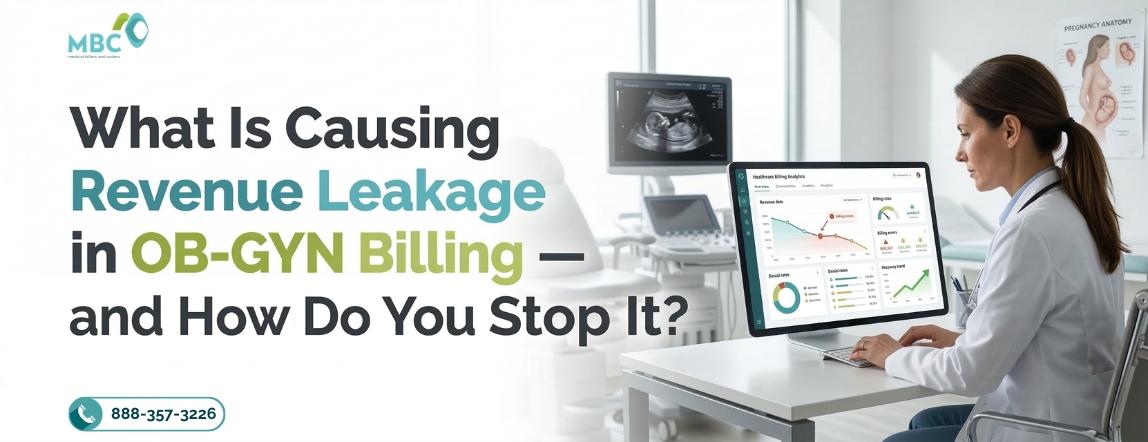
Revenue leakage in OBGYN billing is the leading cause of suppressed Financial Performance in practices collecting $1M to $5M or more per month — driven not by fraud, but by global period miscoding, missed complication billing, and split-care modifier errors that compound silently across every billing cycle.
What Is Revenue Leakage in OBGYN Billing?
Revenue leakage in OBGYN billing refers to billable services that are underpaid, denied, or never submitted due to coding gaps, payer rule misalignment, or workflow failures. Unlike hard denials, leakage surfaces as routine write-offs or bundled encounters — not flagged errors — making it invisible in standard billing reports.
The primary driver is CPT 59400, the global OB package, which bundles routine prenatal, delivery, and post-partum care into a single reimbursement. When patient circumstances deviate from routine — a mid-pregnancy insurance change, a care transfer, or complication management — CPT 59400 becomes a Yield EBITDA liability if the claim is not correctly unbundled.
| Leakage Source | Root Cause | Revenue Impact (per 12 months) | Financial Performance Risk |
| Global period unbundling errors | CPT 59400 miscoded on split or complication cases | $90K–$150K per provider | Yield EBITDA compression |
| Modifier -54 / -55 errors | Shared care deliveries missing correct split modifier | $400–$900 per transfer case | Denial accumulation, AR aging |
| Complication visit bundling | Gestational diabetes, pre-eclampsia absorbed into global | $60K–$90K per provider | Net Collection Ratio suppression |
| Undocumented ultrasound necessity | Missing ICD-10 specificity for payer LCD criteria | 60%+ denial rate on additional scans | Payer Variance Detection gap |
The 3 Triggers Driving Revenue Leakage in OBGYN Billing
Most revenue leakage in OBGYN Billing Services originates from three recurring patterns. Each reflects an absence of Denial Root-Cause Engineering — where billing vendors manage denials reactively, claim by claim, without fixing the upstream coding gaps that generate them.
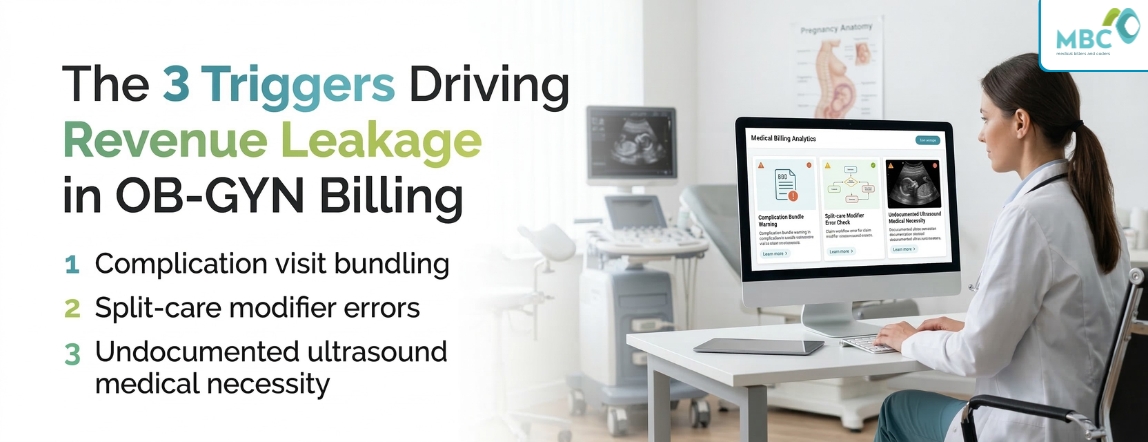
- Complication visit bundling: Gestational diabetes management, pre-eclampsia monitoring, and cerclage procedures are billable outside CPT 59400. When auto-bundled into the global package by EMR defaults, each missed encounter represents $150–$600 in unrecovered revenue per visit.
- Split-care modifier errors: Shared OB care between physicians requires precise application of Modifier -54 (surgical and delivery care) and Modifier -55 (post-partum care only). Errors generate denials or systematic underpayment across every shared-care delivery in the billing cycle.
- Undocumented ultrasound medical necessity: Additional ultrasounds beyond the standard 20-week anatomy scan require ICD-10 specificity aligned to payer LCD criteria. Without this documentation, these claims face a 60% or higher denial rate.
How the MBC Revenue Integrity Framework Addresses Revenue Leakage in OBGYN Billing
The MBC Revenue Integrity Framework treats revenue leakage in OBGYN billing as an Enterprise Revenue Integrity problem — not a claims processing issue. Risk Mitigation is embedded at the encounter level, before submission, rather than applied reactively after denial.
Through Technological Efficiency — automated payer-specific unbundling rules, real-time Payer Variance Detection, and EMR-linked encounter flagging — MBC prevents the leakage patterns that generic billing vendors routinely miss. The measurable outcome is Net Realized Revenue Growth: OB-GYN practices partnering with MBC average a 14% improvement in Net Collection Ratio within 90 days.
| Revenue Leakage Challenge | Generic Billing Vendor | MBC Revenue Integrity Framework |
| Global period unbundling | Manual claim review, no payer-specific rules | Automated unbundling triggers by payer and CPT pairing |
| Complication visit capture | Absorbed into global package by default | Internal encounter flags prevent EMR auto-bundling |
| Payer Variance Detection | Monthly statements only | Real-time denial heatmaps by payer and CPT group |
| Net Realized Revenue Growth | 85–89% Net Collection Ratio | 94–98% Net Collection Ratio within 90 days |
The Scale of Revenue Leakage in OBGYN Billing Across Practice Sizes
Revenue leakage in OBGYN billing scales directly with monthly collections. At a 5% leakage rate — common in practices without encounter-level Payer Variance Detection — a practice collecting $1M per month loses $50K per month. At $3M per month, that figure reaches $150K per month. At $5M or more, unchecked leakage can suppress Yield EBITDA by $250K or more per month.
The more significant variable is duration. Practices operating with a generic billing vendor for 18 months or more typically carry 12 to 24 billing cycles of recoverable leakage in their Financial Performance data — leakage that a Strategic Revenue Diagnostic can quantify and recover.
Request Your Free Revenue Diagnostic
MBC’s Revenue Diagnostic provides a full audit of your OB-GYN revenue leakage posture — denial patterns, unbundling gaps, split-care modifier accuracy, and payer variance — at no cost, before any commitment is made.
MBC’s fee structure is performance-aligned: no recovered revenue, no fee. Practices that complete the Complimentary 90-Day AR Diagnostic receive a quantified recovery roadmap with a clear projection of Net Realized Revenue Growth within the first 90 days.
Request Your Free Revenue Diagnostic
FAQs
Revenue leakage in OB-GYN billing refers to billable services that are underpaid, denied, or never submitted due to global period miscoding, missed complication billing, or split-care modifier errors — resulting in direct Yield EBITDA loss across each billing cycle.
The primary causes of revenue leakage in OB-GYN billing are CPT 59400 unbundling errors, incorrect Modifier -54 and -55 application on shared-care deliveries, and undocumented ultrasound medical necessity — all of which generate denials or write-offs that compound across billing cycles.
Revenue leakage in OB-GYN billing costs practices collecting $1M to $5M or more per month between $50K and $250K or more per month, depending on leakage rate and the number of providers affected by complication bundling and modifier errors.
MBC’s Revenue Integrity Framework stops revenue leakage in OB-GYN billing through automated payer-specific unbundling rules, encounter-level coding flags, and real-time Payer Variance Detection — preventing leakage at the source rather than recovering it after denial.
The Complimentary 90-Day AR Diagnostic is a free audit of your OB-GYN revenue leakage posture — covering denial patterns, global period errors, modifier accuracy, and payer variance — delivered before any contractual commitment and quantifying exactly what your current billing workflow is costing you per billing cycle.

Catering to more than 40 specialties, Medical Billers and Coders (MBC) is proficient in handling services that range from revenue cycle management to ICD-10 testing solutions. The main goal of our organization is to assist physicians looking for billers and coders, at the same time help billing specialists looking for jobs, reach the right place.