Specialities
 Services
 Resource Center
 Pricing
 About
About
 Contact

RPA in revenue cycle management (RCM) is the application of specialized software “bots” to automate repetitive, rules-based tasks within the medical billing and financial workflow.
By deploying robotic process automation, healthcare organizations can achieve a 25% to 50% reduction in operational costs while virtually eliminating human error in data entry.
This guide provides a comprehensive roadmap for healthcare leaders to leverage RPA to stabilize cash flow, enhance provider satisfaction, and transition from manual labor to “exception-based” revenue management.
What Is RPA in Revenue Cycle Management?
Robotic Process Automation (RPA) in the revenue cycle is a technology that uses software scripts—often called “bots”—to emulate human interactions with digital systems to execute high-volume, repetitive administrative tasks. Unlike traditional software integrations that require complex Application Programming Interfaces (APIs), RPA operates at the user-interface level. It “clicks,” “types,” and “navigates” through Electronic Health Records (EHR) and payer portals exactly like a human staff member would, but with 100% consistency and 24/7 availability.
How RPA Differs from Traditional Automation and AI
To understand RPA’s value, it is essential to distinguish it from its technological cousins:
-
Traditional Automation: Relies on hard-coded integrations (APIs) between two specific systems. It is powerful but expensive and rigid to build.
-
Artificial Intelligence (AI): Focuses on “thinking” and “learning.” AI handles unstructured data and makes probabilistic decisions (e.g., predicting which claims might be denied).
-
RPA: Focuses on “doing.” It follows strict “if-then” logic to move data between systems that don’t naturally talk to each other.
Specific RCM Tasks Managed by RPA
-
Patient Data Entry: Moving demographic info from digital intake forms to the EHR.
-
Claim Status Inquiries: Logging into payer portals to check the real-time status of submitted claims.
-
Credentialing Updates: Synchronizing provider data across multiple state and federal databases.
-
Reporting: Pulling data from disparate billing modules into a single Excel or PowerBI dashboard.
How RPA Works: A Knowledge Panel Summary
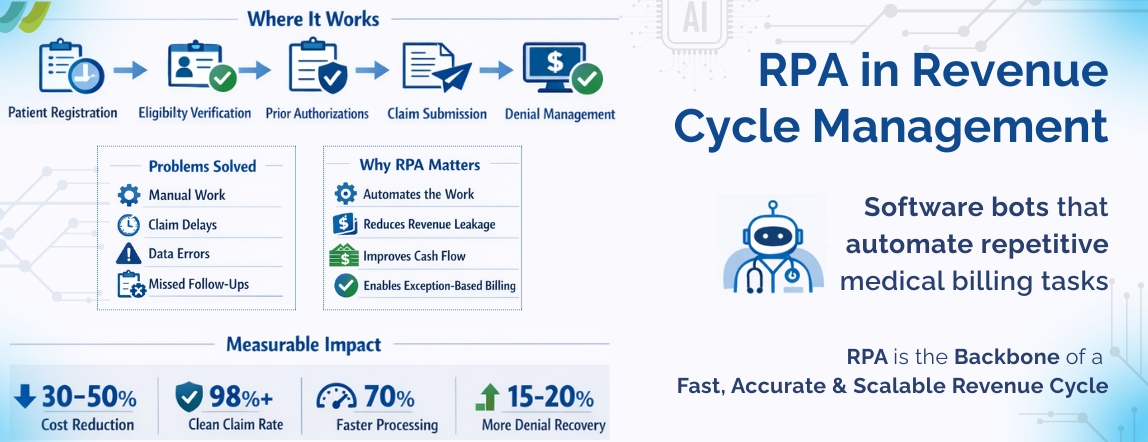
RPA bots follow a pre-defined script to interact with various software applications. The process begins when a “trigger” (like a new file arrival or a scheduled time) activates the bot. The bot then logs into the required systems, extracts or inputs data based on logic-based rules, performs the task (such as a claim submission), and logs out, creating a digital audit trail of every action taken.
The Revenue Cycle Bottlenecks RPA Solves
Manual processes are the primary drivers of “revenue leakage.” By replacing human intervention in the following areas, RPA transforms administrative bottlenecks into streamlined workflows.
Patient Registration and Eligibility Verification
The Problem: Staff often spend 10–15 minutes per patient manually checking insurance websites or calling payers to verify coverage, leading to front-desk backlogs and eligibility-related denials.
The RPA Solution: A bot can automatically monitor the daily appointment schedule and verify eligibility for every patient 48 hours in advance.
Measurable Outcome: A 90% reduction in eligibility denials and significant improvements in front-office throughput.
Prior Authorization Processing
The Problem: Prior auth is cited by physicians as the most burdensome administrative task. It requires manual data retrieval from clinical notes and repetitive entry into payer portals.
The RPA Solution: RPA bots can extract relevant CPT codes and clinical documentation from the EHR and submit the authorization request directly to the payer portal without human oversight.
Measurable Outcome: Processing time drops from days to minutes, accelerating time-to-care and reducing “no-auth” write-offs.
Claim Submission and Scrubbing
The Problem: Human “scrubbers” often miss minor formatting errors or mismatched codes, leading to “clean claim” rates that hover below the industry standard of 95%.
The RPA Solution: Bots perform multi-point claim scrubbing, checking for NPI accuracy, modifier compatibility, and payer-specific rules before submission.
Measurable Outcome: An increase in First-Pass Acceptance Rates (FPAR) to 98% or higher.
Denial Management and Appeals
The Problem: Approximately 65% of denied claims are never re-submitted because the cost of manual labor exceeds the value of the claim.
The RPA Solution: Bots can categorize denials by “reason code,” pull the necessary supporting documentation, and auto-populate appeal letters for low-complexity denials (e.g., “missing info”).
Measurable Outcome: A 15-20% increase in recovered revenue from previously abandoned denials.
Payment Posting and Reconciliation
The Problem: Manually matching Explanation of Benefits (EOB) and Electronic Remittance Advices (ERA) to bank deposits is slow and prone to “fat-finger” errors.
The RPA Solution: RPA bots read digital EOBs, match them to the corresponding patient account, and post the payment to the billing system instantly.
Measurable Outcome: Near-instant reconciliation and a 99% reduction in posting errors.
Quantifiable Benefits of RPA in Healthcare Revenue Cycle
Healthcare organizations moving toward revenue cycle efficiency through RPA report immediate impacts on their bottom line.
-
Cost Reduction (30-50%): According to the CAQH Index, manual transactions cost providers significantly more than electronic ones. RPA allows a single bot to do the work of 3-5 full-time employees (FTEs) at a fraction of the cost.
-
Speed and Throughput (70% faster): Bots do not take breaks, sleep, or get distracted. Tasks that take a human 10 minutes (like checking a claim status) can be completed by a bot in under 60 seconds.
-
Error Elimination: Human data entry has an average error rate of 3-5%. RPA bots operate with 100% accuracy if the underlying data is correct, drastically reducing the “re-work” loop in medical billing.
-
Staff Reallocation: By automating the “drudge work,” practices can move their most talented staff to high-value tasks, such as complex patient financial counseling or negotiating with payers.
RPA vs. Traditional Automation vs. AI: Understanding the Differences
Choosing the right tool is critical for ROI. The table below outlines where RPA sits in the technology stack.
| Feature | Traditional Automation (API) | RPA (The “Bot”) | Artificial Intelligence (AI) |
| Primary Driver | System-to-system integration | User Interface (UI) emulation | Pattern recognition/Learning |
| Complexity | High (Requires IT/Coding) | Moderate (Low-code) | Very High (Data Science) |
| Data Type | Structured only | Structured/Semi-structured | Unstructured (Text/Voice) |
| Best Use Case | Moving data between two new systems | Legacy systems with no API | Predicting future denials |
| Speed to Deploy | 6–12 months | 4–12 weeks | 6–18 months |
Positioning RPA: RPA is the “practical middle ground.” It allows practices with legacy EHRs to achieve modern efficiency without the million-dollar price tag of a total system overhaul or a custom AI build.
How to Evaluate If Your Practice Is Ready for RPA
Not every process should be automated. Use this framework to determine your readiness.
Readiness Indicators
-
High Volume/Low Complexity: You have tasks performed at least 50 times daily that require no “subjective” judgment.
-
Stable Processes: The steps of the task haven’t changed in the last six months.
-
Digital Data: The input for the task is already digital (e.g., PDFs, spreadsheets, EHR fields) rather than handwritten notes.
Red Flags
-
Process Chaos: If your manual process is broken, automating it will only produce “bad results faster.”
-
Frequent UI Changes: If you use a web portal that changes its layout every week, the bot will break frequently.
Questions for Decision-Makers
-
What is the “cost per transaction” for our manual claim status checks?
-
Do we have a dedicated “process owner” who understands the workflow from start to finish?
-
Are our current staff spending more than 25% of their day on data entry?
RPA Implementation: A Phased Approach for Healthcare Organizations
A successful healthcare RPA implementation follows a structured lifecycle to minimize disruption.
Phase 1: Assessment (2–4 Weeks)
Identify 2–3 “low-hanging fruit” processes. Calculate the current manual hours spent and define what “success” looks like (e.g., “Reduce days in AR by 5”).
Phase 2: Pilot/Proof of Concept (4–6 Weeks)
Build a single bot for one specific task, such as eligibility verification. Run the bot in a test environment to ensure it handles “edge cases” (e.g., patients with secondary insurance).
Phase 3: Scale (2–4 Months)
Once the pilot is successful, deploy the bot to the live environment and begin building bots for the next priority areas (Charge Capture or Payment Posting).
Phase 4: Optimize (Ongoing)
Monitor bot performance logs. As payers change their portals, update the bot’s “instructions” to maintain peak efficiency.
Common RPA Implementation Mistakes to Avoid
-
Automating the Wrong Process: Choosing a task that requires “clinical judgment” instead of simple logic. Prevention: Stick to administrative, rules-based tasks first.
-
Ignoring Security/Compliance: Not giving bots their own unique, traceable login credentials. Prevention: Treat every bot as a “digital employee” with a unique ID and limited access.
-
Lack of IT/Operations Alignment: Building bots without consulting the IT team or the billing managers. Prevention: Form a cross-functional “Automation Committee.”
-
The “Set It and Forget It” Mentality: Assuming bots never need maintenance. Prevention: Schedule monthly “bot health checks” to account for software updates.
-
Underestimating Change Management: Failing to explain to staff that bots are there to help them, not replace them. Prevention: Frame RPA as a tool that removes the “boring” parts of their job.
The Future of RPA in Revenue Cycle Management: What’s Next
The next evolution of this technology is Intelligent Automation (IA)—the convergence of RPA and AI.
While current RPA follows a script, the future involves bots that can “see” a document and understand its context using Optical Character Recognition (OCR) and Natural Language Processing (NLP). We are moving toward a “self-healing” revenue cycle where bots don’t just identify a denial; they analyze the reason, decide the best corrective action based on historical success rates, and execute the appeal autonomously.
As healthcare shifts toward value-based care, RPA will become the essential backbone that allows providers to focus on patient outcomes while the “digital workforce” handles the financial complexity.
FAQ’s About RPA in Revenue Cycle Management
Costs vary based on the number of bots, but a typical mid-sized practice can expect an initial investment ranging from $15,000 to $50,000 for development and licensing. However, most practices find that the bot pays for itself within 9 to 12 months through reduced labor costs and increased collections.
Most healthcare organizations begin seeing a positive Return on Investment (ROI) within 6 to 12 months. The fastest ROI usually comes from automating eligibility verification and claim status checks, as these directly impact cash flow speed.
RPA is designed to augment staff, not replace them. While it reduces the need for “data entry” roles, it increases the need for “exception managers”—skilled billers who handle the complex cases that the bot identifies. Most practices use RPA to handle growth without adding new headcount.
Yes, RPA is HIPAA compliant as long as it is implemented with proper security protocols. This includes giving bots unique login credentials, ensuring encrypted data transmission, and maintaining comprehensive audit logs of every action the bot takes within the EHR.
RPA is a “doer” that follows specific rules (e.g., “If the balance is $0, close the account”). AI is a “thinker” that finds patterns (e.g., “This payer is likely to deny this claim based on similar previous submissions”). They are often used together for maximum efficiency.
The “big three” for initial automation are eligibility verification, claim status inquiries, and payment posting. These are high-volume, rules-based, and offer the most immediate impact on reducing Days in AR.

With almost 12 years of experience in healthcare revenue cycle management, this Revenue Cycle Specialist brings deep expertise in medical billing, claims optimization, and practice profitability. Shares industry-backed insights focused on improving collections, reducing denials, and driving operational excellence.